
Meute (Band)
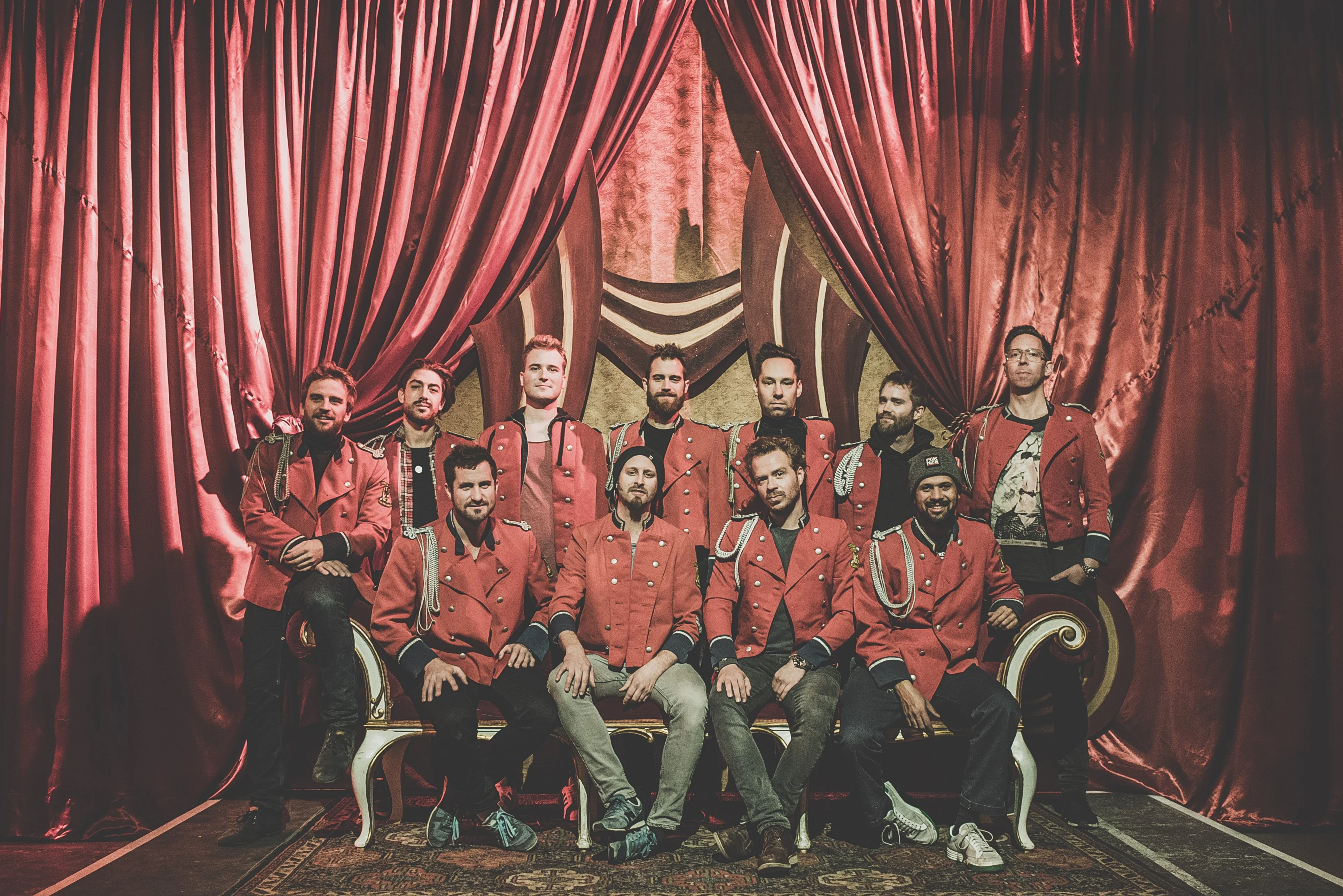
Image from Wikipedia
Image from Wikipedia
MEUTE – The Hamburg Techno Marching Band that Makes Electronic Music Visible
A band between street parades, club culture, and festival moments
MEUTE is not an ordinary ensemble; it is an eleven-member techno marching band from Hamburg that rethinks the flow of electronic dance music with brass instruments, percussion, and precise arrangements. The group combines the power of techno, house, and deep house with the physically immediate presence of a brass band, creating a sound that is urban, archaic, and ultra-modern at the same time. Since its founding, MEUTE has evolved into an internationally sought-after live band that performs equally well on streets, in clubs, in classical concert halls, and on major festival stages.
The particular appeal of MEUTE lies in its reinterpretation of a familiar genre: Instead of DJs and mixing consoles, acoustic instruments take center stage, but the pulse remains electronic, driving, and ecstatic. This artistic idea makes the band one of the most distinctive German live acts in recent music history. When you listen to MEUTE, you don't just experience a cover concept, but a fully developed music career that encompasses reworks, original compositions, performance, and cultural statements.
The founding in Hamburg and the idea behind the project
MEUTE was founded in 2015 at the initiative of trumpeter Thomas Burhorn. Out of the impulse to free techno from the DJ booth and translate it into a hand-played, visually strong form, an ensemble emerged that combines electric energy with acoustic power. The name today represents a distinct musical language, in which marching band tradition, club aesthetics, and pop sensibility do not work against each other, but rather amplify one another.
The lineup of trumpets, saxophones, trombone, sousaphone, marimba, snare drums, and bass drum allows for a sound that is immediately recognizable. MEUTE not only conveys the structure of an electronic track, but also its tension, build-up, and physical effect. Thus, a stage presence is created that sounds less like mere adaptation and more like reinvention.
The breakthrough with “Rej” and the viral moment
The breakthrough came in 2016 with the video for “Rej,” a reinterpretation of the deep house track by the Berlin DJ duo Âme. The recording spread rapidly through social media and became a viral hit. For MEUTE, this was more than just an internet phenomenon: it was confirmation that a techno marching band can be perceived not as a quirky idea, but as a serious musical format.
The video made MEUTE visible internationally and opened doors to festivals, tours, and media resonance far beyond the German music scene. Particularly, the combination of street image, red uniforms, razor-sharp timing, and danceable dynamics shaped the early myth of the band. Even during this phase, it became clear that MEUTE does not simply play tracks but develops a complete live narrative.
Debut, tours, and the creation of an original discography
With the debut album Tumult in the fall of 2017, the concept crystallized into a first clear artistic statement. The band then toured Germany, Austria, Switzerland, France, and Luxembourg, playing more than 150 concerts in the first two years. This established MEUTE not only as an internet sensation but as a band with a hard-earned live routine and impressive endurance.
In 2018, appearances followed at showcase festivals such as ESNS and SXSW, and MEUTE was counted among the most booked festival bands in Europe. The success was based on a rare mix of technical precision and collective enthusiasm for playing. The discography clearly shows how consistently the band expands its repertoire, integrating reworks, live recordings, and originals into a cohesive aesthetic.
Live aesthetics, arrangements, and making electronics visible
MEUTE re-arranges works by well-known DJs, translating the energy of techno, house, and deep house tracks into a language of brass instruments and percussion. This form of arrangement is not merely about translating melodies but recomposing groove, pressure, and dynamics. The pieces retain their club character but gain additional physical presence through breath, metal, skin, and resonant space.
Particularly defining is the way the band builds tension. Flowing transitions, careful dynamics, and a clear focus on collective interplay allow for concerts that are experienced almost entirely through dance. MEUTE “makes” electronic music visible because the mechanics of the beat become immediately tangible through the movements of the musicians.
International recognition and cultural influence
With the performance of “You & Me” in Berlin and further viral appearances, MEUTE became a global reference point for genre-crossing live music. The band has performed not only in Europe but also in North and South America, Southern Africa, Australia, and Oceania. This reach shows that the idea of the techno marching band has grown far beyond a local scene concept.
In the cultural context, MEUTE also holds a special position. The band has played in classical institutions just as naturally as at festivals and on the streets. This mobility explains the influence on the perception of techno, brass music, and live performance: MEUTE liberates electronic music from its rigidity and bestows it with a human, physical, and communal dimension.
Press reviews, recognition, and musical authority
The response from the music press has been remarkably unanimous. MEUTE has been described as one of the most unusual and successful music projects from Hamburg, as an exciting live presence, and as a band that directly moves the audience. Such reactions show that the concept is not only original but also dramaturgically and sonically highly functional.
Furthermore, original artists have positively received the band's reworks. Collaborative stage moments with Laurent Garnier and Stephan Bodzin highlight that MEUTE is not perceived as a fringe figure in the electronic scene. Instead, the band is now regarded as a serious player between club culture, pop interpretation, and musical reinvention.
Current projects: new releases and collaborations
The band's latest phase shows clear activity regarding releases and collaborations. In 2024, the studio album Empor was released, along with other releases in the same year, such as “Vermis,” “Aurora,” “Anti Loudness,” and several reworks. In 2025, Raiva was released in collaboration with Trikk, as well as Jubel on September 19, 2025, marking a new chapter in the band's catalog.
These releases prove that MEUTE does not dwell in the past, but continuously expands its repertoire. The combination of original material, reworks, and collaborations keeps the sound current and enriches the band's aesthetic with new colors. Especially in collaboration with producers and electronic artists, the group remains connected to the present of club music.
Style, lineup, and musical signature
The sound of MEUTE thrives on the contrasts between strict form and emotional explosion. The band works with a precise interplay of trumpets, saxophones, tuba, marimba, and drums, merging technoid repetition with orchestral warmth. The result is a sound that resonates with both parade and warehouse vibe.
The lineup includes Marco Möller, Timon Fenner, OnKL, André Wittmann, Philip Andernach, Philipp Westermann, Adrian Hanack, Johnny Johnson, Sebastian Borkowski, Hans-Christian Stephan, and Thomas Burhorn. This collective structure is central to the artistic development of the band: MEUTE functions as an ensemble, not as a frontman project. This is where the strength of their musical career lies, as the performance arises from interaction, discipline, and mutual trust.
The album and single phases from Tumult to Jubel
MEUTE's discography shows a consistent development from viral rework to a standalone sound world. After Tumult, came Puls, Exanse, Taumel, Empor, and finally Jubel, complemented by numerous singles and reworks such as “Peace,” “Infinite,” “Slow Loris,” “LoCKeDoWN2,” “Loss Of Hope,” “Come Together,” “The Coup,” and “Verden.” With each release, the band refines its relationship between danceability and musical architecture.
It is particularly interesting that MEUTE not only adapts foreign pieces but is increasingly integrating its own compositions. This shift moves the project from being solely a rework band toward becoming an ensemble with its own signature and growing original repertoire. This evolution strengthens the artistic identity and secures the band's lasting position between techno, live jazz, brass band, and pop avant-garde.
Conclusion: Why MEUTE remains so exciting
MEUTE is exciting because the band implements a seemingly simple idea with maximum consequence, shaping it into a new, powerful live experience. Between techno, marching band, club culture, and festival ecstasy, a music emerges that does not need explanation but acts immediately. Those who experience the band live quickly understand how strongly arrangement, rhythm, and collective stage presence can work together.
Especially in a time when many acts rely on digital distance, MEUTE convinces through physical immediacy and musical precision. The Hamburg band demonstrates how modern acoustic instruments can sound when charged with electronic energy. Therefore, a live concert by MEUTE is not just a performance, but an event that one should experience.
Voices of the fans
The great response to the viral videos, international festival appearances, and recent releases shows how strongly MEUTE fascinates people worldwide. The public reactions to the band predominantly highlight the fascination with the unusual sound, the energy on stage, and the transformation of electronic music into a visible, collective live experience.
Official channels of MEUTE:
- Instagram: https://www.instagram.com/meute_official/
- Facebook: https://www.facebook.com/meutesound/
- YouTube: https://www.youtube.com/channel/UCY3cAFsquIk7VGMuk-V8S3g
- Spotify: No official profile found
- TikTok: No official profile found
Sources:
Upcoming Events
MEUTE Open Air Concert
Experience an unforgettable open-air concert with MEUTE in the Piazza in Regensburg on July 24, 2026.
MEUTE - ZMF Freiburg
Experience the unmistakable brass music meets electronic beats of MEUTE at ZMF Freiburg.
MEUTE
July 24, 2026 6:30 PM - 10:00 PM6:30 PM - 10:00 PM