
Markus (Evangelist)
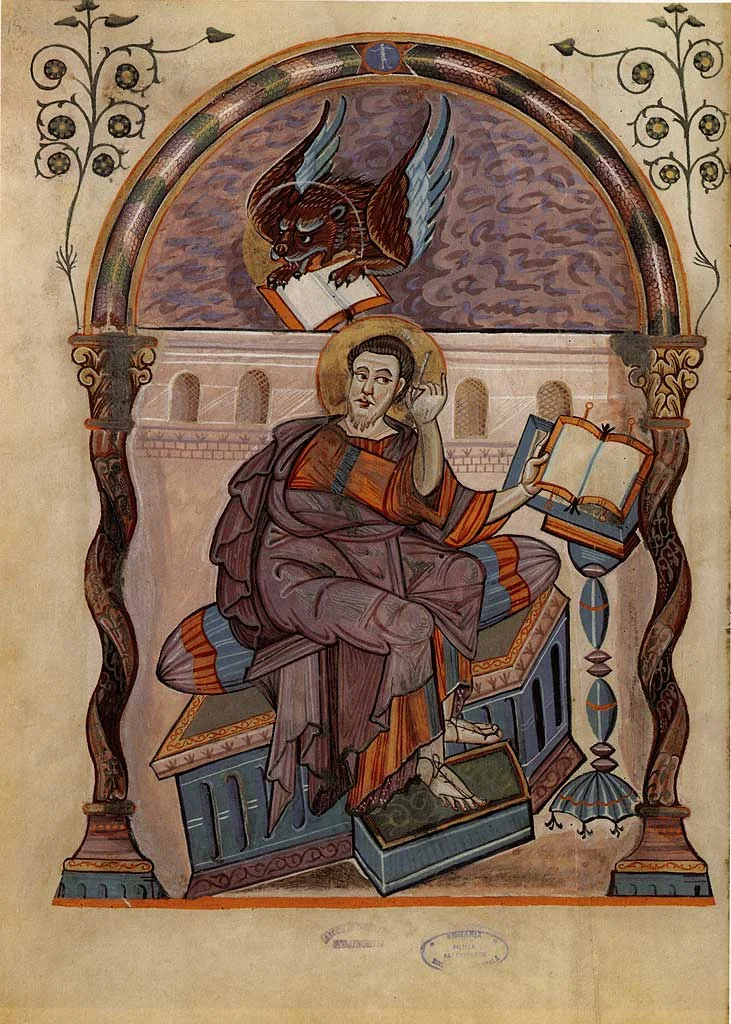
Image from Wikipedia
Image from Wikipedia
Markus (Evangelist) – The Voice of Early Tradition and the Mystery of the Oldest Gospel
A Fascinating Journey Between Tradition, Text, and Symbolism
Markus is not a historical artist figure in the modern sense, but a character of Christian tradition who is regarded in ancient church tradition as the author of the likely oldest Gospel. The name itself does not appear in the Gospel; "Markus" is rather a later attribution and a convention of scholarly literature. This tension between anonymity and tradition makes the figure still intriguing today. ([de.wikipedia.org](https://de.wikipedia.org/wiki/Markus_%28Evangelist%29?utm_source=openai))
In church memory, Markus stands for a concise, narratively dense form of proclamation. His Gospel is described as the earliest of the canonical Gospels and profoundly shaped further tradition, as Matthew and Luke, according to common research, draw on elements from Mark. The Evangelist himself remains behind his text, while his symbol, the Lion of Markus, has significantly influenced the visual culture of Christianity. ([encyclopedia.com](https://www.encyclopedia.com/philosophy-and-religion/bible/new-testament/gospel-according-mark?utm_source=openai))
The Origin of the Name and the Power of Tradition
The name Markus, or Marcus, is a Roman name and not a Jewish one. That scholarship refers to the author of the Gospel as "Markus" follows a later naming tradition and does not automatically mean that a concrete biography of the so-called Markus can be taken as unchanged. This conceptual distinction is one of the most important foundations for a serious classification. ([de.wikipedia.org](https://de.wikipedia.org/wiki/Markus_%28Evangelist%29?utm_source=openai))
In many church and theological representations, Markus is linked to John Markus, the companion of Paul and Barnabas mentioned in the Acts of the Apostles. However, the historical attribution remains uncertain: modern biblical scholarship emphasizes that the Gospel is anonymous and the traditional authorship attribution is unprovable, yet it remains effective in terms of tradition history. ([wissen-digital.de](https://www.wissen-digital.de/Markus_%28Evangelist%29?utm_source=openai))
The Gospel of Mark as a Literary Sensation of Early Christianity
The Gospel of Mark is regarded in many introductions as the earliest of the four canonical Gospels. It is succinct, concentrated, and characterized by an urgency that sharpens the narrative focus on the actions, suffering, and death of Jesus. This very condensation has given the text a special status in the history of the New Testament. ([encyclopedia.com](https://www.encyclopedia.com/philosophy-and-religion/bible/new-testament/gospel-according-mark?utm_source=openai))
Tradition often connects Markus with Peter, of whom he is said to have been a "translator" or companion. Early testimonies like Papias, as relayed by Eusebius, embraced this relationship and added authority to the tradition. However, in scholarly discussion, the prevailing finding remains that the attribution does not emerge from the text itself but from later church memory. ([biblegateway.com](https://www.biblegateway.com/resources/encyclopedia-of-the-bible/Gospel-Mark?utm_source=openai))
Career, Proclamation, and the Interpretation of a Saint's Life
Church traditions recount Markus as a preacher, missionary, and associate within the circle of the apostles. In such portrayals, he travels with Barnabas and Paul, later works in Alexandria, and is even regarded there as the founder of the Christian community. These biographical stations primarily express a saint’s life that integrates the author of the Gospel into the grand narrative of the early church. ([aspern.at](https://aspern.at/glaube/heilige/markus.php?utm_source=openai))
The legend continues: Markus is often remembered as a martyr, with his death located in Alexandria around the year 67. The later translation of his relics to Venice is also a part of the historical impact of his figure and shows how strongly Markus became effective not only as a text author but also as a spiritual symbol. Venice made the Lion of Markus its emblem, granting the Evangelist exceptional cultural visibility. ([aspern.at](https://aspern.at/glaube/heilige/markus.php?utm_source=openai))
Style, Composition, and Theological Handwriting
The Gospel of Mark is characterized by a concise, pointed narrative style. In theological classification, it is often described as particularly immediate and dynamic, with a strong focus on action, conflict, and passion. This very compositional style makes the text so influential in the history of literature and theology. ([smitv.org](https://www.smitv.org/uploads/8/2/6/7/82676528/introduction_to_mark.pdf?utm_source=openai))
Also linguistically, the text exhibits marked peculiarities. Research points to its compressed structure, its closeness to oral tradition, and its significance as a source for Matthew and Luke. Thus, Markus stands at the beginning of a synoptic narrative tradition that profoundly shaped the New Testament's interpretation of Christ. ([newworldencyclopedia.org](https://www.newworldencyclopedia.org/entry/Gospel_of_Mark?utm_source=openai))
The Lion of Markus as a Cultural Symbol
Few other evangelical figures possess such a striking visual emblem as Markus. The Lion of Markus appears in Christian art as a winged lion and was early understood as a sign of the Evangelist. In theological and iconographic interpretations, this symbol refers to the majesty, strength, and spiritual authority of the Gospel. ([logo-buch.de](https://www.logo-buch.de/logo-aktiv/wissensbibliothek/christliches-lexikon/evangelisten-symbole?utm_source=openai))
This symbol was particularly potent in Venice, where the Lion of Markus became a political and cultural emblem. The connection of saint veneration, city symbolism, and religious imagery demonstrates how deeply the Evangelist is woven into European cultural history. Markus is thus not only a biblical authority but also an icon of the Christian visual world. ([de-academic.com](https://de-academic.com/dic.nsf/dewiki/921667?utm_source=openai))
Critical Reception and Historical Treatment of Authorship
Critical exegesis primarily considers Markus as an anonymous text, whose later attribution to a specific person is not historically secure. This does not diminish the significance of the Gospel but sharpens the focus on its context of origin and its historical impact. The tension between tradition and research is at the core of Markus reception. ([newworldencyclopedia.org](https://www.newworldencyclopedia.org/entry/Gospel_of_Mark?utm_source=openai))
Particularly because the work is considered the earliest Gospel, it is at the center of many scholarly debates about sources, editing, and theological objectives. The Markian texts have repeatedly been read in research as a starting point for synoptic development, giving Markus a key position in the history of the New Testament. This authority is based less on a distinctly discernible biography and more on the lasting power of the text itself. ([encyclopedia.com](https://www.encyclopedia.com/philosophy-and-religion/bible/new-testament/gospel-according-mark?utm_source=openai))
Current Projects, Social Media, and Contemporary Presence
For Markus as an Evangelist, there are no current albums, tours, singles, or media projects in the modern sense. There are also no verifiable official social media channels that would be clearly identifiable as accounts of the Evangelist. Therefore, the contemporary presence of Markus remains a literary, liturgical, and iconographic presence. ([de.wikipedia.org](https://de.wikipedia.org/wiki/Markus_%28Evangelist%29?utm_source=openai))
Conclusion: Why Markus Remains Fascinating Today
Markus fascinates through a rare blend of anonymity, authority, and cultural radiance. His name stands for the beginning of a literary tradition that has significantly shaped the understanding of Jesus Christ, and his symbol lives on in the Lion of Markus to this day. Those who read Markus encounter not just a Gospel but a fundamental document of Christian memory culture. ([encyclopedia.com](https://www.encyclopedia.com/philosophy-and-religion/bible/new-testament/gospel-according-mark?utm_source=openai))
This very connection of early text, church tradition, and strong imagery makes Markus one of the most permanently intriguing figures of Christianity. There isn’t a “live experience” in the modern music sense here, but the encounter with the Gospel of Mark, its liturgy, and its symbolism continues to resonate and impress today. ([biblegateway.com](https://www.biblegateway.com/resources/encyclopedia-of-the-bible/Gospel-Mark?utm_source=openai))
Official Channels of Markus (Evangelist):
- Instagram: no official profile found
- Facebook: no official profile found
- YouTube: no official profile found
- Spotify: no official profile found
- TikTok: no official profile found
Sources:
- Wikipedia – Markus (Evangelist)
- Bible Gateway – Gospel of Mark
- Encyclopedia.com – Gospel According To Mark
- St. Markus in der Südstadt Braunschweig – The Lion of Markus
- Bistum Mainz – Coat of Arms and Insignia
- Pfarre Aspern – St. Markus, Evangelist
- CHRISTentum.ch – Markus Evangelist
- Wikipedia: Image and Text Source