
Louis Armstrong
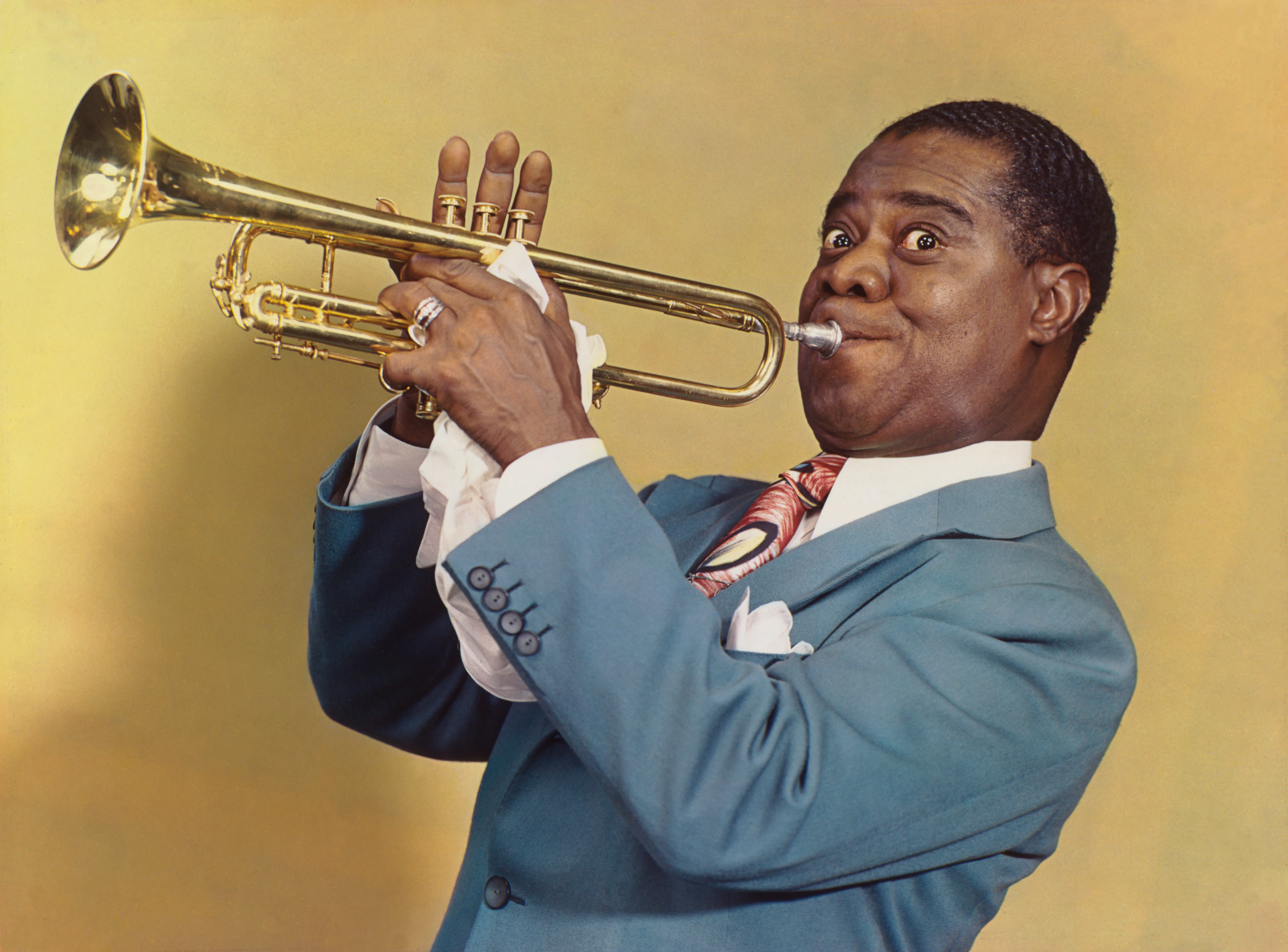
Image from Wikipedia
Image from Wikipedia
Louis Armstrong – The Trumpeter Who Redefined Jazz
Louis Armstrong: From New Orleans Child to Global Jazz Icon
Louis Armstrong, known as "Satchmo", is one of the defining figures in 20th-century music history. Rising from bitter poverty in New Orleans, he became the leading jazz trumpeter, singer, and innovative improviser whose music career shifted jazz from collective ensemble artistry to a form of individual solos. His artistic development blends technical brilliance, rhythmic freedom, and a distinctive voice into a body of work that continues to resonate today. ([britannica.com](https://www.britannica.com/biography/Louis-Armstrong))
The Early Years in New Orleans: Music as Salvation and Calling
Armstrong grew up in great poverty in New Orleans, working as a child in odd jobs while singing in a boys' quartet. In 1913, as a teenager, he entered the Colored Waifs Home, where he learned the cornet in the home’s orchestra, and music became his life-defining passion. From an early age, he was shaped by the musical environment of the city and role models like King Oliver, whose playing he absorbed with great attention. ([britannica.com](https://www.britannica.com/biography/Louis-Armstrong))
This background is crucial for understanding his style. Armstrong brought the emotion, street rhythms, and vocal directness of New Orleans into a form that would later be recognized as the modern jazz language. From his experience of scarcity, he shaped a stage presence that was simultaneously relaxed, virtuosic, and profoundly expressive. ([britannica.com](https://www.britannica.com/biography/Louis-Armstrong))
The Breakthrough in Chicago and New York: From Accompanist to Soloist
The pivotal career step came in 1922 when King Oliver brought him to Chicago to join the Creole Jazz Band. Armstrong stood out with his intelligent ensemble lines, his breaks, and his early solos; it was during this phase that his first recordings emerged, showcasing his compositional and improvisational imagination. Afterward, he spent some time in New York with Fletcher Henderson before returning to Chicago, where he recorded his most significant early works as a bandleader. ([britannica.com](https://www.britannica.com/biography/Louis-Armstrong))
The Hot Five and Hot Seven recordings from 1925 to 1928 are considered a turning point in jazz history. The Library of Congress describes how Armstrong set a new standard with pieces like "Heebie Jeebies," "Big Butter and Egg Man," "Hotter Than That," "Potato Head Blues," and "Struttin' With Some Barbecue": solos became narrative arcs that did not merely accompany but unfolded musical drama. It is here that it becomes audible why Armstrong is regarded as the first great jazz soloist. ([loc.gov](https://www.loc.gov/static/programs/national-recording-preservation-board/documents/Hot-5-and-Hot-7-Recordings_Anderson.pdf))
The Invention of the Modern Jazz Solo
Armstrong's artistry lay not only in his tone but in how he constructed solos. Sources describe his improvisations as melodic, motivic, and structured, with a strong sense of tension and resolution. Particularly "West End Blues" and "Weather Bird" show how he elevated the interplay of ensemble and solo, blues and virtuosic architecture, emotional directness and technical control to a new level. ([loc.gov](https://www.loc.gov/static/programs/national-recording-preservation-board/documents/Hot-5-and-Hot-7-Recordings_Anderson.pdf))
Historically, this marks a watershed: Armstrong shifted the focus of jazz from the collective juxtaposition of voices to the personality of the soloist. The Library of Congress states succinctly: these recordings "altered the course of jazz history by shifting the emphasis from ensemble to solo playing." In this condensation lies Armstrong's legacy as an architect of modern jazz aesthetics. ([loc.gov](https://www.loc.gov/static/programs/national-recording-preservation-board/documents/Hot-5-and-Hot-7-Recordings_Anderson.pdf))
Singer, Entertainer, World Star: The Expansion of His Artistic Profile
Armstrong was not only a trumpeter but also one of the most influential singers of his era. Britannica emphasizes that he was one of the pioneers of scat singing, varying, embellishing, and shaping melodies with his instantly recognizable, rough voice and jazzy flexibility on many recordings. According to Britannica, his vocal aesthetics influenced later greats like Billie Holiday and Bing Crosby. ([britannica.com](https://www.britannica.com/biography/Louis-Armstrong))
In the 1930s and 1940s, Armstrong became an international stage figure, touring with various All-Star lineups and known as "Ambassador Satch." The Library of Congress highlights that in 1937, he became the first African American personality to host a nationally broadcast weekly radio series, demonstrating his cultural reach beyond jazz. Armstrong thus became a musician, entertainer, and media presence in one person. ([blogs.loc.gov](https://blogs.loc.gov/now-see-hear/2024/02/chick-webb-on-nbc/))
Discography: From the Hot Five to Late Career Hits
Louis Armstrong's discography is enormous and has been compiled in a selected chronology by the Louis Armstrong House Museum. Particularly highlighted are the Hot Five and Hot Seven recordings of the 1920s, followed by later albums and projects such as Louis Armstrong Plays W.C. Handy (1954), Satch Plays Fats (1955), Ella and Louis (1955), Satchmo: A Musical Autobiography (1957), Hello, Dolly! (1964), and What a Wonderful World as the late signature of his legacy. The museum also emphasizes that Armstrong's recording career spanned from 1923 to 1971, encompassing thousands of titles. ([louisarmstronghouse.org](https://www.louisarmstronghouse.org/music/?utm_source=openai))
His greatest successes include "Mack the Knife," "Hello, Dolly!" and "What a Wonderful World," according to Britannica and the Armstrong House. The later years brought no departure from art but a new form of sovereignty: less trumpet, more singing, more storytelling, more iconic presence. It is particularly in this phase that Armstrong's ability to merge popularity and stylistic depth is revealed. ([britannica.com](https://www.britannica.com/biography/Louis-Armstrong))
Critical Reception and Cultural Influence
The reception of Armstrong is unanimously extraordinary in the sources. Britannica calls him the leading trumpeter and one of the most influential figures in jazz history, while the Smithsonian describes him as "the first great jazz soloist." The National Park Service website further anchors him as a central figure of New Orleans jazz and as an artist whose influence on the development of the city and vice versa is of historical significance. ([britannica.com](https://www.britannica.com/biography/Louis-Armstrong))
His influence extends far beyond jazz. The Library of Congress and Britannica make it clear that his playing style shaped nearly all subsequent jazz brass players, and his vocal ease transformed singing styles even into pop music. Armstrong thus became a cultural reference figure, not only interpreting standards but setting standards himself—musically, stylistically, and socially. ([loc.gov](https://www.loc.gov/static/programs/national-recording-preservation-board/documents/Hot-5-and-Hot-7-Recordings_Anderson.pdf))
Later Years, Legacy, and Current Legacy Projects
Armstrong passed away in 1971 in New York at the age of 69 due to heart complications; prior to this, he had struggled with health problems. However, his afterlife is active: the Louis Armstrong House Museum continues to organize residencies and research programs with "Armstrong Now," which recontextualize Armstrong's archive in the 21st century and translate it into current artistic practice. Thus, his work remains not merely historical but productively present. ([britannica.com](https://www.britannica.com/biography/Louis-Armstrong))
It is this enduring relevance that makes Armstrong intriguing. His music combines inventiveness, charisma, emotional truthfulness, and a historical explosiveness that has permanently changed jazz. Anyone who wants to understand how a local music form became a global art form will find in Louis Armstrong the great turning point—and on stage, an artist whose energy still electrifies. ([loc.gov](https://www.loc.gov/static/programs/national-recording-preservation-board/documents/Hot-5-and-Hot-7-Recordings_Anderson.pdf))
Conclusion: An Artist Who Has forever Shaped Jazz
Louis Armstrong remains a giant because he not only played exceptionally but also redefined the grammar of jazz. His trumpet, his voice, and his personality shaped a musical career that connects technical mastery, cultural significance, and emotional immediacy. To hear Armstrong is not only to hear a legendary musician but also the moment when jazz found its modern language. ([loc.gov](https://www.loc.gov/static/programs/national-recording-preservation-board/documents/Hot-5-and-Hot-7-Recordings_Anderson.pdf))
Anyone who wants to experience the history of jazz in all its magnitude must encounter Louis Armstrong live in archives, recordings, and concert footage. His music remains an invitation to listen closely, to feel the energy of the moment, and to understand jazz as a living art. Armstrong is not a monument of the past but a lasting invitation to wonder. ([louisarmstronghouse.org](https://www.louisarmstronghouse.org/music/?utm_source=openai))
Official Channels of Louis Armstrong:
- Instagram: No official profile found
- Facebook: No official profile found
- YouTube: No official profile found
- Spotify: https://open.spotify.com/artist/19eLuQmk9aCobbVDHc6eek
- TikTok: No official profile found
Sources:
- Britannica – Louis Armstrong
- U.S. National Park Service – Louis Armstrong
- Library of Congress – Hot Five and Hot Seven Recordings
- Library of Congress Blog – Chick and Satchmo on the Air
- Louis Armstrong House Museum – Music / Selected Discography
- Louis Armstrong House Museum – Armstrong Now
- Smithsonian Magazine – Louis Armstrong: The First Great Jazz Soloist
- Wikipedia: Image and text source