
Johann Wittich
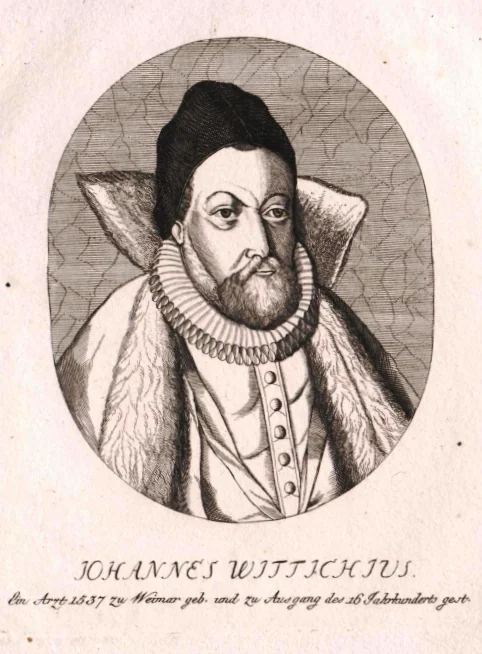
Image from Wikipedia
Image from Wikipedia
Johann Wittich – the learned physician, author, and medical practitioner of the early modern period
A doctor from Weimar who combined medicine, practice, and written culture
Johann Wittich, Latinized as Johannes Wittichius, was born in 1537 in Weimar and died in 1596. He belonged to that generation of early modern physicians who not only applied medical knowledge but also organized, commented on, and prepared it for a broader scholarly audience in their writings. His career led him from the university cities of Jena and Vienna, through stations in Sangerhausen and Eisleben, to the court of the Counts of Schwarzburg in Arnstadt. There, he served as court physician and city physicus or city doctor starting in 1578. ([de.wikipedia.org](https://de.wikipedia.org/wiki/Johann_Wittich))
Biography: Education, Practice, and Rise
Wittich's career demonstrates the typical mobility of an early modern physician with an academic education. He studied medicine in Jena and Vienna before initially working as a practical physician in Sangerhausen, Eisleben, and for the Counts of Mansfeld. His transition to the service of the Counts of Schwarzburg marked a pivotal stage in his career: in Arnstadt, he gained a position that combined medical responsibility, social closeness to the ruling power, and urban duties. ([de.wikipedia.org](https://de.wikipedia.org/wiki/Johann_Wittich))
His role as court and city medic or city doctor made him a key figure between courtly representation and public healthcare. Sources describe him as a physician, district doctor, court physician, writer, and translator. Thus, Wittich appears as a learned practitioner whose significance derives not only from his treatment practices but also from the written documentation of medical knowledge. ([deutsche-biographie.de](https://www.deutsche-biographie.de/pnd118880578.html))
Career in Arnstadt: Medicine as a Public Office
The years in Arnstadt were characterized by dual responsibility. As court physician, Wittich attended to the Counts of Schwarzburg while also being medically responsible for the city. In the world of the 16th century, this meant more than individual healing: the city doctor was a point of contact in times of epidemics, advisor on public health issues, and authority on matters of prevention, dietetics, and pharmacology. ([de.wikipedia.org](https://de.wikipedia.org/wiki/Johann_Wittich))
Biographical records highlight that during this phase, he published a number of books on medical and natural science topics. Some of these texts he dedicated to Counts Johann Günther and Christian Günther of Schwarzburg. The dedications underscore the close connection between knowledge production and princely patronage, which was central to scholarly life in the early modern period. ([de.wikipedia.org](https://de.wikipedia.org/wiki/Johann_Wittich))
Writings: Medical Authority in Printed Form
Wittich left behind a remarkable work profile that combines medical practice, natural observation, and advisory literature. His listed writings include, among others, reports on signs in the sky, on bezoar stones, on the mineral spring in Kissingen, on female infertility, on the effects of natural substances, and an "artificial New Medicine Book" intended as a handy medical compendium. These titles reflect a broad spectrum of interests, ranging from natural phenomena to specific therapeutic questions. ([de.wikipedia.org](https://de.wikipedia.org/wiki/Johann_Wittich))
Especially revealing is the character of these publications: Wittich wrote not abstractly but from the perspective of a physician who observes, organizes, and gives instructions. The "Vade Mecvm" and other texts identify him as an author who aimed to make medical knowledge practically accessible. A devotional book for children is also documented, extending his work beyond strict medical practice into the realm of religious and moral educational prose. ([deutsche-biographie.de](https://www.deutsche-biographie.de/pnd118880578.html))
Scientific Style and Intellectual Profile
Wittich's work stands at the intersection of medicine, natural history, and early modern scholarship. Sources explicitly name him as the author of scientific and medical writings as well as a translator. This paints a picture of an author who did not produce knowledge in isolation but mediated between Latin scholarship, the German vernacular, and practical application. ([deutsche-biographie.de](https://www.deutsche-biographie.de/pnd118880578.html))
His profile fits into an era where authority emerged from experience, study, and printed texts combined. A physician like Wittich had to interpret diseases, evaluate medicines, and simultaneously find the language to make insights understandable. This is precisely where his historical relevance lies: he embodies the type of learned physician who not only heals but also argues, explains, and publishes. ([de.wikipedia.org](https://de.wikipedia.org/wiki/Johann_Wittich))
Cultural and Historical Context
Johann Wittich operated in a world where medicine, piety, governance, and book culture were closely intertwined. His writings were not isolated specialist texts but part of a learned communication space where princely houses, universities, and urban administrations circulated knowledge. That he dedicated some medical works to the lords of Schwarzburg illustrates the political as well as cultural embedding of his work. ([de.wikipedia.org](https://de.wikipedia.org/wiki/Johann_Wittich))
The preservation of his legacy itself speaks to his impact. The German Biography and the Digital Concordance list him under several name variations, which is typical for early modern source material and confirms his historical presence in various catalogs and research contexts. Thus, Wittich remains not merely a marginal figure but a documented part of the medical history of the 16th century. ([deutsche-biographie.de](https://www.deutsche-biographie.de/pnd118880578.html))
Reception and Academic Classification
Relevant reference works paint a clear picture: Johann Wittich was a physician, author, and translator with a focus on medical and natural scientific texts. In modern research, he primarily represents the medical scholarship that shaped the early modern knowledge system. His works document not spectacular individual inventions but the continuous effort in diagnosis, explanation, and instruction. ([deutsche-biographie.de](https://www.deutsche-biographie.de/pnd118880578.html))
For today’s readers, this connection between practice and writing is particularly fascinating. Wittich's biography tells of rising through study, of responsibility in the service of a court and a city, and of the ambition to secure medical knowledge for the long term. In an era without modern journals, the book assumed the role of a knowledge repository – and Wittich was one of those physicians who actively filled this repository. ([de.wikipedia.org](https://de.wikipedia.org/wiki/Johann_Wittich))
Conclusion: Why Johann Wittich Remains Interesting to This Day
Johann Wittich fascinates as an example of an educated physician who bridged the university, court, and city, bringing medical experience into printed form. His career shows how closely scientific authority, practical healing, and literary activity were intertwined in the early modern period. Those interested in the history of medicine and culture will find in him a precisely documented and simultaneously multifaceted personality. ([de.wikipedia.org](https://de.wikipedia.org/wiki/Johann_Wittich))
It is this blend of expertise, social responsibility, and literary productivity that makes Johann Wittich engaging. His biography invites readers to view the history of medicine not merely as a succession of theories but as a vibrant culture of writing, teaching, and acting. Anyone seeking to understand the world of early modern physicians should delve into Wittich's contributions. ([de.wikipedia.org](https://de.wikipedia.org/wiki/Johann_Wittich))
Official Channels of Johann Wittich:
- Instagram: No official profile found
- Facebook: No official profile found
- YouTube: No official profile found
- Spotify: No official profile found
- TikTok: No official profile found