
Delay in B-34 Project in Wyhlen
Badger, Dispute, Delay: Wyhlen's Bypass Won't Come Until 2029
According to current plans, the Wyhlen bypass (B 34) in the Lörrach district is not expected to open to traffic until the second half of 2029. This means a significant delay for a road project that has been contested for years. The main reasons cited by those responsible are problems with the building ground, adjustments to drainage, nature conservation requirements—and most recently, a conflict over badger setts in an adjacent railway embankment along with missing documentation.
At the groundbreaking ceremony in 2017, the target year was still 2024. The new route is intended to relieve the town centers of Grenzach and Wyhlen from through traffic: The Freiburg Regional Council expects a traffic reduction of more than 60 percent in parts of the town passage. Less noise and emissions are also expected—as well as more safety for pedestrians and cyclists.
Why the Project is Delayed by Years
It has been apparent for several years that the bypass would not be completed within the originally announced timeframe. According to the Regional Council, plans for drainage, for example, had to be revised; there were also difficulties with the building ground and questions of nature conservation. According to the authority, many of these issues have now been resolved.
The project gained new momentum with the section along the Hochrheinbahn: There, the future B 34 will run in places directly next to the existing railway embankment. To build the road, a separate embankment is to be constructed—in an environment where the stability of the railway embankment plays a safety-relevant role.
Badger Setts at the Railway Embankment: Safety Issue and Jurisdictional Conflict
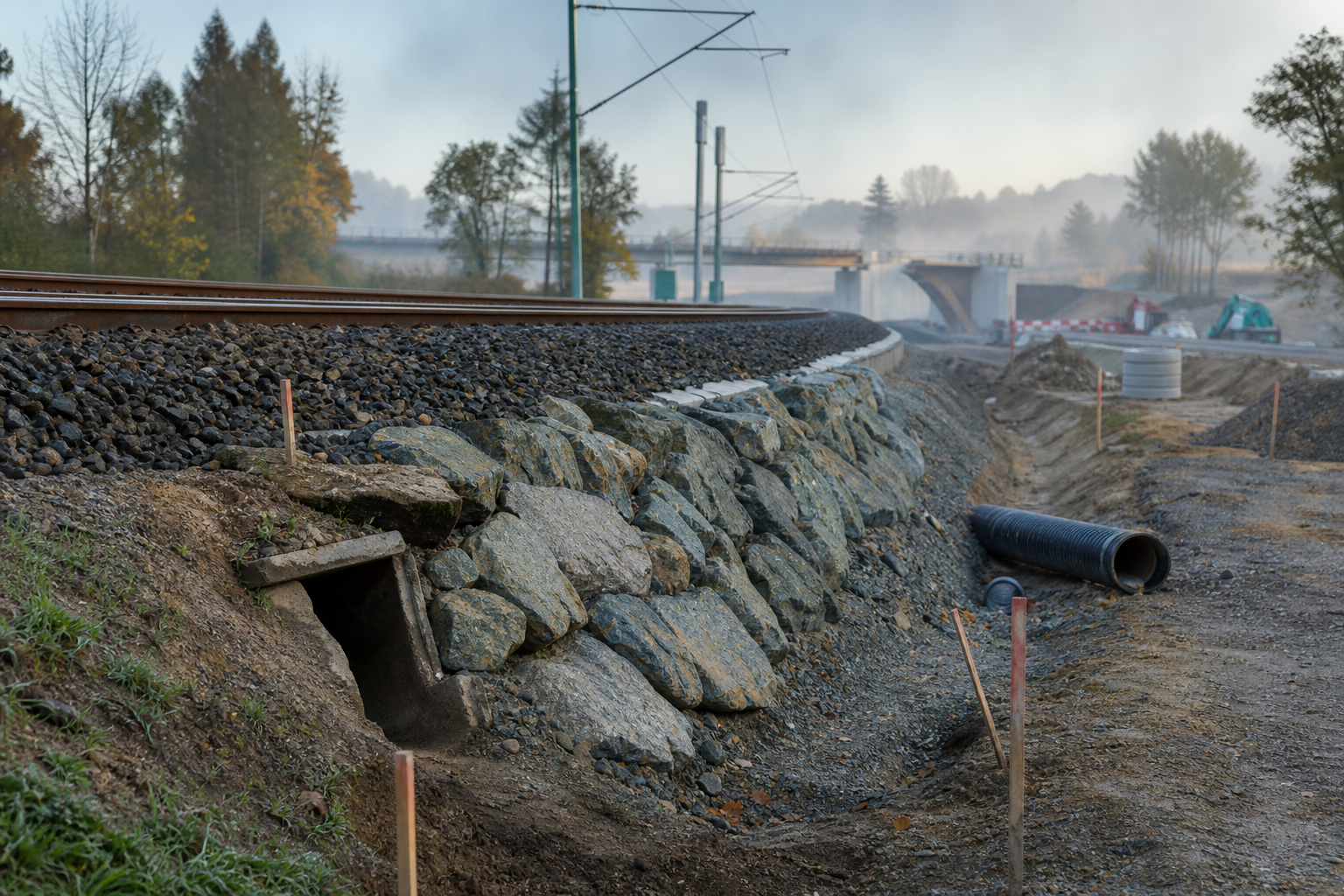
According to the Regional Council, cavities were discovered in the railway embankment as early as 2021. Department head Dieter Bollinger classifies them as badger setts. From the perspective of the road construction administration, this was not only a nature conservation issue, but above all a matter of statics and safety: The cavities could have impaired stability. Therefore, Deutsche Bahn was asked to drive the animals away and close the openings.
Deutsche Bahn states that the necessary deterrence measures were not completed until September 2025. It refers to statutory closed seasons. At the same time, the railway describes the cooperation with the Regional Council as constructive and good.
The Regional Council paints a much more tense picture. Bollinger says the deterrence should have taken place much earlier; overall, he speaks of tough coordination. He also describes organizational friction losses, such as missing contact persons and a lack of answers to questions important for the construction process. The question of which evidence is required is also assessed differently: The railway states that, from its point of view, static proof of the embankment's stability is not necessary.
Missing Evidence—and a More Expensive Construction Method as a Solution
According to the Regional Council, the badgers have now been successfully deterred and the cavities filled. However, this is not sufficient for construction approval as long as the documentation remains incomplete. Bollinger says that evidence and precise information on how the badger setts were filled are missing; without these documents, there will be no approval for the next steps.
To avoid further delays, the road embankment is now to be constructed using a modified method. The plan is to stabilize the embankment with injected concrete so that the adjacent railway embankment is subjected to as little stress as possible. Bollinger expects additional costs of around 100,000 to 150,000 euros as a result. In addition, coarse-grained material is to be used so that badgers cannot dig into the structure again—a detail that shows how closely nature conservation requirements and construction execution are intertwined here.
What the Bypass is Supposed to Bring for Grenzach-Wyhlen—and What is Now Crucial
The bypass remains politically controversial in Grenzach-Wyhlen and at the same time central for many as a relief project. It is intended to free the current town passage from through traffic, reduce noise and pollutant exposure, and improve traffic safety.
Individual bridges and tunnel structures have already been completed on the route; however, a continuous roadway is still missing. The Regional Council points out that other difficulties—especially with the building ground and in nature conservation—have now been resolved. What is now crucial is less a single structure than the interaction of those involved: Without clear responsibilities, reliable evidence, and complete documentation, even a technically feasible section can become a bottleneck.
Whether the opening in the second half of 2029 will succeed therefore depends not only on construction progress and weather windows, but also on whether the new method actually minimizes the risks at the railway embankment—and whether coordination between road construction and the railway runs more smoothly in the future than in recent years.