
Freiburg im Breisgau
Rathausgasse 3, 79098 Freiburg im Breisgau, Deutschland
St. Martin | Services & History in Freiburg
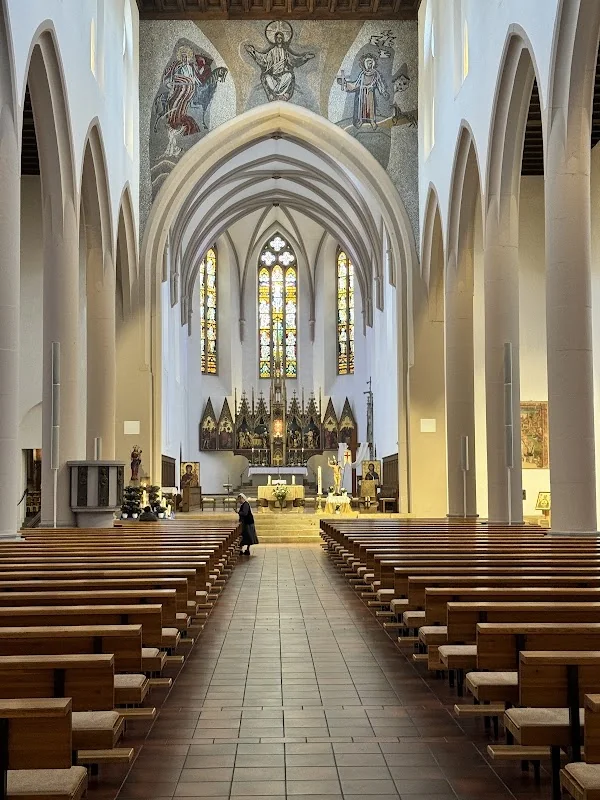
St. Martin in Freiburg is more than just a church at the Town Hall Square. The parish church is located at Rathausgasse 3 in the heart of the old town and closely connects urban space, faith, music, and history. Its roots go back to the first chapel from the year 1206; in 1226, Count Konrad handed the site over to the Franciscans, from whose monastery complex the present-day St. Martin's Church emerged. Today, St. Martin is a spiritual center right in the city and also a place where people come together for prayer, silence, sacraments, and music. Since January 1, 2026, the St. Martin page belongs to the new parish of Freiburg i.Br., but will temporarily remain an important source of information. Those looking for a central Freiburg church that is not only historically significant but also actively used will find a place here with a strong presence and clear identity. ([visit.freiburg.de](https://visit.freiburg.de/martinskirche-freiburg))
Services, Confession, and Spiritual Offers at St. Martin
The interest surrounding St. Martin mainly focuses on when services take place and what spiritual offers are available. The official page regularly publishes morning prayers, Eucharistic celebrations, rosaries, Eucharistic adoration, confession, and vespers. This makes St. Martin not just a church building but a place with a reliable liturgical rhythm. Particularly defining is the self-description as a spiritual center in the neighborhood of the cathedral, the most important church in the city. St. Martin is explicitly designed as a point of tranquility in the midst of the city center, where the Eucharist, with the midday mass and Eucharistic adoration, forms the spiritual center. This makes the church interesting for the regular congregation, city visitors, and tourists alike, as it invites not just for a quick photo stop but for a moment of reflection. ([kath-freiburg-mitte.de](https://www.kath-freiburg-mitte.de/st-martin/?utm_source=openai))
This open spiritual use fits very well with the additional offers of the parish. The St. Martin page points to the Liturgy of the Hours of the Dominican Order, to which participants are warmly invited. Additionally, there is spiritual guidance for those seeking a personal form of conversation and prayer, as well as a prayer group for young adults up to 35 years old that meets bi-weekly on Tuesdays at 8 PM in the church. This mix of public liturgy, individual guidance, and communal forms of prayer shapes the character of the place. St. Martin is thus not an anonymous sight but an active parish church with clear times, a noticeable spiritual offer, and a concrete everyday life. Those wishing to contact the parish can find the relevant contacts and the parish office on the community's pages. For SEO and real visitors, these points are important: regular services, confession times, prayer forms, and a clearly reachable parish office. ([kath-freiburg-mitte.de](https://www.kath-freiburg-mitte.de/st-martin/?utm_source=openai))
Baptism, Marriage, and Other Sacraments at St. Martin
St. Martin is also a very concrete and flexible parish church when it comes to the sacraments. Baptism celebrations are usually possible as individual baptisms; there are currently no fixed baptism dates in the year. The parish mentions possible time slots on Saturday mornings, Saturday afternoons, and Sunday afternoons. Particularly interesting is the process itself: Baptism is celebrated in St. Martin as a journey of stations, beginning under the gallery, focusing on the Word of God at the ambo, performing the actual baptism at the baptismal font, and finally referring to the Eucharist at the altar. This involves the entire church space in the celebration, resulting in a very vivid and deeply rooted liturgy for families. Additionally, music is explicitly included, either with an organist or an electric piano. Adult baptisms are also possible, but with a longer preparation of at least six months and an individual faith course. ([kath-freiburg-mitte.de](https://www.kath-freiburg-mitte.de/st-martin/sakramente/taufe/))
The same clear but practical framework applies to weddings. Marriages are generally possible at St. Martin, usually on Saturday mornings or Saturday afternoons. The parish requests that contact be made at least six months in advance; binding commitments are given a maximum of one year in advance. Those wishing to marry with an external clergyman at St. Martin should expect a church usage fee. Equally important for practice: The facilities at St. Martin are generally not available for private celebrations or receptions after the wedding, and the space in front of the church belongs to the city. For visitors interested in farewells, funerals, or pastoral care in special life situations, the parish also offers separate information and refers to the parish office. This shows how comprehensively St. Martin is organized as a parish: baptism, marriage, guidance, and farewell are all part of a liturgical and pastoral context. ([kath-freiburg-mitte.de](https://www.kath-freiburg-mitte.de/st-martin/sakramente/trauung/))
History of St. Martin's Church at the Town Hall Square
The historical depth of St. Martin is one of the most important reasons why the church is so present in the Freiburg cityscape. As early as 1206, there was a first chapel at this site. In 1226, Count Konrad handed it over to the Franciscans, who gradually developed a monastery complex there. The site is also associated with a popular legend: In the former Franciscan church, Berthold Schwarz is said to have invented gunpowder in the mid-14th century. However, the official account emphasizes that this is an anecdote and that the invention of black powder historically dates back to the 13th century. Nevertheless, this story illustrates how strongly St. Martin has been connected to city history and memory for centuries. In 1851, Berthold Schwarz was honored with a monument in front of the former Franciscan church at the present Town Hall Square. ([visit.freiburg.de](https://visit.freiburg.de/martinskirche-freiburg))
Over the centuries, the church has undergone several transformations. After the Thirty Years' War, the interior was baroque, and later, from 1875, neo-Gothic elements replaced baroque and rococo altars. This change was also related to the fact that the Franciscans left their convent around 1783, and the church continued to be used as St. Martin's parish church. The most severe rupture the building experienced was in November 1944, when the monastery and church caught fire from phosphorus bombs, leaving only the outer walls and west gable standing. Reconstruction began as early as 1949, and on Martin's Day in 1951, the church was consecrated again. Today, it is experienced by the public not only as a house of worship but also as a point of tranquility in the Freiburg city center. This mix of destruction, reconstruction, and continued use makes St. Martin a particularly credible place of historical continuity. ([visit.freiburg.de](https://visit.freiburg.de/martinskirche-freiburg))
Music, St. Martin's Choir, and Klais-Thomas Organ
Another central search impulse at St. Martin is music. The Freiburg St. Martin's Choir is intergenerational: students and professionals sing there, as well as retirees. The choir organizes concerts and services, covering works from all stylistic periods. In recent years, works such as Mendelssohn's Elijah, Bach's St. John Passion, Handel's Messiah, and a program on the Camino de Santiago have been part of the repertoire. Additionally, there are orchestral masses, smaller choral pieces, and offerings for children and youth. The St. Martin's Choir is also regularly involved in the Freiburg Choir Night. This breadth is particularly valuable for a city center parish because it does not separate faith and culture but connects them. For families and music lovers, it is also interesting that the choir consciously includes younger listeners and thinks of its programs not only liturgically but also concertedly. ([chorstadt-freiburg.de](https://chorstadt-freiburg.de/chor/martinschor))
The organizational side is also clearly regulated. The rehearsals of the St. Martin's Choir take place on Mondays from 7:45 PM to 9:45 PM in the St. Martin music hall, with entry via the cloister at the Town Hall Square. The choir has been led for many years by Susanne Falk, who has developed a concert-capable ensemble from a small church choir. The official page also describes the Klais-Thomas organ of the parish church, whose manuals are mechanically operated and the pedal is electrically controlled. This is complemented by modern technical functions such as recorders and free couplings. The page also includes media examples, such as organ recordings by Reger, Franck, Vierne, and Karg-Elert. This is important for the perception of St. Martin because the church possesses a strong identity not only architecturally and liturgically but also acoustically. Those searching for organ, choir, and church music in Freiburg will likely end up right here. ([kath-freiburg-mitte.de](https://www.kath-freiburg-mitte.de/st-martin/musik-und-kunst/martinschor/))
Access, Parking, and Location in the Old Town
The location of St. Martin is one of the greatest practical advantages of the site. The church is located at Rathausgasse 3, 79098 Freiburg im Breisgau, directly in the historic center and in close proximity to the Town Hall Square. The city's tourism information describes St. Martin's Church as located opposite the Town Hall; city tours also name the meeting point as Town Hall Square or St. Martin's Church. Therefore, those coming to St. Martin for the first time will find the place in the midst of the old town's network, surrounded by the most famous points of the city center. At the same time, the location is also clearly positioned in terms of traffic: For the Freiburg city center, there is a parking guidance system with 16 parking garages in three zones. In the old town, the parking garages Unterlinden, Schwarzwald-City, Rotteck, Zähringer-Tor, Karlsbau, Landratsamt, Schlossberg, and Schwabentor are included; there are also free P+R spaces on the outskirts. Those wishing to avoid parking fees or traffic jams can also opt for free P+R spaces at the city limits and continue by tram. ([visit.freiburg.de](https://visit.freiburg.de/martinskirche-freiburg))
For specific access, it is also helpful to know that Rathausgasse is located west of the Town Hall Square in the delivery traffic area and that special rules apply there. This means: Spontaneously parking just before the church is often difficult in the city center, while the official city administration explicitly refers to the parking guidance system, parking garages, and P+R solutions. Therefore, those wishing to visit the church should rather arrive with a parking garage in the old town or by public transport and cover the last stretch on foot. This also fits well with the overall atmosphere of St. Martin, as the place is not designed for fast car traffic but for a conscious arrival in the city center. Especially for visitors who want to combine Town Hall Square, Old Town Hall, Tourist Information, and St. Martin's Church, the location is ideal. One moves in the tightest space between city history, church space, and urban everyday life. Practically, this means: St. Martin is very central, but when planning parking, one should consider the city's old town logic. ([freiburg.de](https://www.freiburg.de/pb/site/Freiburg/get/params_E1528565765/890375/Lieferverkehr_Innenstadt_D_2019.pdf))
St. Martin is therefore particularly suitable for those seeking a genuine connection of faith, history, music, and city center location in Freiburg. The church is not just a backdrop for photos but an active place with services, sacraments, choir rehearsals, organ music, and pastoral presence. Those interested in the Freiburg old town will find one of the most prominent points between the Town Hall, cathedral, and historic alleys. For the visit, it is worth checking the current dates of the parish, as this is where it becomes evident how lively this place is still used today. ([kath-freiburg-mitte.de](https://www.kath-freiburg-mitte.de/st-martin/?utm_source=openai))
Sources:
Mehr anzeigenWeniger anzeigen
St. Martin | Services & History in Freiburg
St. Martin in Freiburg is more than just a church at the Town Hall Square. The parish church is located at Rathausgasse 3 in the heart of the old town and closely connects urban space, faith, music, and history. Its roots go back to the first chapel from the year 1206; in 1226, Count Konrad handed the site over to the Franciscans, from whose monastery complex the present-day St. Martin's Church emerged. Today, St. Martin is a spiritual center right in the city and also a place where people come together for prayer, silence, sacraments, and music. Since January 1, 2026, the St. Martin page belongs to the new parish of Freiburg i.Br., but will temporarily remain an important source of information. Those looking for a central Freiburg church that is not only historically significant but also actively used will find a place here with a strong presence and clear identity. ([visit.freiburg.de](https://visit.freiburg.de/martinskirche-freiburg))
Services, Confession, and Spiritual Offers at St. Martin
The interest surrounding St. Martin mainly focuses on when services take place and what spiritual offers are available. The official page regularly publishes morning prayers, Eucharistic celebrations, rosaries, Eucharistic adoration, confession, and vespers. This makes St. Martin not just a church building but a place with a reliable liturgical rhythm. Particularly defining is the self-description as a spiritual center in the neighborhood of the cathedral, the most important church in the city. St. Martin is explicitly designed as a point of tranquility in the midst of the city center, where the Eucharist, with the midday mass and Eucharistic adoration, forms the spiritual center. This makes the church interesting for the regular congregation, city visitors, and tourists alike, as it invites not just for a quick photo stop but for a moment of reflection. ([kath-freiburg-mitte.de](https://www.kath-freiburg-mitte.de/st-martin/?utm_source=openai))
This open spiritual use fits very well with the additional offers of the parish. The St. Martin page points to the Liturgy of the Hours of the Dominican Order, to which participants are warmly invited. Additionally, there is spiritual guidance for those seeking a personal form of conversation and prayer, as well as a prayer group for young adults up to 35 years old that meets bi-weekly on Tuesdays at 8 PM in the church. This mix of public liturgy, individual guidance, and communal forms of prayer shapes the character of the place. St. Martin is thus not an anonymous sight but an active parish church with clear times, a noticeable spiritual offer, and a concrete everyday life. Those wishing to contact the parish can find the relevant contacts and the parish office on the community's pages. For SEO and real visitors, these points are important: regular services, confession times, prayer forms, and a clearly reachable parish office. ([kath-freiburg-mitte.de](https://www.kath-freiburg-mitte.de/st-martin/?utm_source=openai))
Baptism, Marriage, and Other Sacraments at St. Martin
St. Martin is also a very concrete and flexible parish church when it comes to the sacraments. Baptism celebrations are usually possible as individual baptisms; there are currently no fixed baptism dates in the year. The parish mentions possible time slots on Saturday mornings, Saturday afternoons, and Sunday afternoons. Particularly interesting is the process itself: Baptism is celebrated in St. Martin as a journey of stations, beginning under the gallery, focusing on the Word of God at the ambo, performing the actual baptism at the baptismal font, and finally referring to the Eucharist at the altar. This involves the entire church space in the celebration, resulting in a very vivid and deeply rooted liturgy for families. Additionally, music is explicitly included, either with an organist or an electric piano. Adult baptisms are also possible, but with a longer preparation of at least six months and an individual faith course. ([kath-freiburg-mitte.de](https://www.kath-freiburg-mitte.de/st-martin/sakramente/taufe/))
The same clear but practical framework applies to weddings. Marriages are generally possible at St. Martin, usually on Saturday mornings or Saturday afternoons. The parish requests that contact be made at least six months in advance; binding commitments are given a maximum of one year in advance. Those wishing to marry with an external clergyman at St. Martin should expect a church usage fee. Equally important for practice: The facilities at St. Martin are generally not available for private celebrations or receptions after the wedding, and the space in front of the church belongs to the city. For visitors interested in farewells, funerals, or pastoral care in special life situations, the parish also offers separate information and refers to the parish office. This shows how comprehensively St. Martin is organized as a parish: baptism, marriage, guidance, and farewell are all part of a liturgical and pastoral context. ([kath-freiburg-mitte.de](https://www.kath-freiburg-mitte.de/st-martin/sakramente/trauung/))
History of St. Martin's Church at the Town Hall Square
The historical depth of St. Martin is one of the most important reasons why the church is so present in the Freiburg cityscape. As early as 1206, there was a first chapel at this site. In 1226, Count Konrad handed it over to the Franciscans, who gradually developed a monastery complex there. The site is also associated with a popular legend: In the former Franciscan church, Berthold Schwarz is said to have invented gunpowder in the mid-14th century. However, the official account emphasizes that this is an anecdote and that the invention of black powder historically dates back to the 13th century. Nevertheless, this story illustrates how strongly St. Martin has been connected to city history and memory for centuries. In 1851, Berthold Schwarz was honored with a monument in front of the former Franciscan church at the present Town Hall Square. ([visit.freiburg.de](https://visit.freiburg.de/martinskirche-freiburg))
Over the centuries, the church has undergone several transformations. After the Thirty Years' War, the interior was baroque, and later, from 1875, neo-Gothic elements replaced baroque and rococo altars. This change was also related to the fact that the Franciscans left their convent around 1783, and the church continued to be used as St. Martin's parish church. The most severe rupture the building experienced was in November 1944, when the monastery and church caught fire from phosphorus bombs, leaving only the outer walls and west gable standing. Reconstruction began as early as 1949, and on Martin's Day in 1951, the church was consecrated again. Today, it is experienced by the public not only as a house of worship but also as a point of tranquility in the Freiburg city center. This mix of destruction, reconstruction, and continued use makes St. Martin a particularly credible place of historical continuity. ([visit.freiburg.de](https://visit.freiburg.de/martinskirche-freiburg))
Music, St. Martin's Choir, and Klais-Thomas Organ
Another central search impulse at St. Martin is music. The Freiburg St. Martin's Choir is intergenerational: students and professionals sing there, as well as retirees. The choir organizes concerts and services, covering works from all stylistic periods. In recent years, works such as Mendelssohn's Elijah, Bach's St. John Passion, Handel's Messiah, and a program on the Camino de Santiago have been part of the repertoire. Additionally, there are orchestral masses, smaller choral pieces, and offerings for children and youth. The St. Martin's Choir is also regularly involved in the Freiburg Choir Night. This breadth is particularly valuable for a city center parish because it does not separate faith and culture but connects them. For families and music lovers, it is also interesting that the choir consciously includes younger listeners and thinks of its programs not only liturgically but also concertedly. ([chorstadt-freiburg.de](https://chorstadt-freiburg.de/chor/martinschor))
The organizational side is also clearly regulated. The rehearsals of the St. Martin's Choir take place on Mondays from 7:45 PM to 9:45 PM in the St. Martin music hall, with entry via the cloister at the Town Hall Square. The choir has been led for many years by Susanne Falk, who has developed a concert-capable ensemble from a small church choir. The official page also describes the Klais-Thomas organ of the parish church, whose manuals are mechanically operated and the pedal is electrically controlled. This is complemented by modern technical functions such as recorders and free couplings. The page also includes media examples, such as organ recordings by Reger, Franck, Vierne, and Karg-Elert. This is important for the perception of St. Martin because the church possesses a strong identity not only architecturally and liturgically but also acoustically. Those searching for organ, choir, and church music in Freiburg will likely end up right here. ([kath-freiburg-mitte.de](https://www.kath-freiburg-mitte.de/st-martin/musik-und-kunst/martinschor/))
Access, Parking, and Location in the Old Town
The location of St. Martin is one of the greatest practical advantages of the site. The church is located at Rathausgasse 3, 79098 Freiburg im Breisgau, directly in the historic center and in close proximity to the Town Hall Square. The city's tourism information describes St. Martin's Church as located opposite the Town Hall; city tours also name the meeting point as Town Hall Square or St. Martin's Church. Therefore, those coming to St. Martin for the first time will find the place in the midst of the old town's network, surrounded by the most famous points of the city center. At the same time, the location is also clearly positioned in terms of traffic: For the Freiburg city center, there is a parking guidance system with 16 parking garages in three zones. In the old town, the parking garages Unterlinden, Schwarzwald-City, Rotteck, Zähringer-Tor, Karlsbau, Landratsamt, Schlossberg, and Schwabentor are included; there are also free P+R spaces on the outskirts. Those wishing to avoid parking fees or traffic jams can also opt for free P+R spaces at the city limits and continue by tram. ([visit.freiburg.de](https://visit.freiburg.de/martinskirche-freiburg))
For specific access, it is also helpful to know that Rathausgasse is located west of the Town Hall Square in the delivery traffic area and that special rules apply there. This means: Spontaneously parking just before the church is often difficult in the city center, while the official city administration explicitly refers to the parking guidance system, parking garages, and P+R solutions. Therefore, those wishing to visit the church should rather arrive with a parking garage in the old town or by public transport and cover the last stretch on foot. This also fits well with the overall atmosphere of St. Martin, as the place is not designed for fast car traffic but for a conscious arrival in the city center. Especially for visitors who want to combine Town Hall Square, Old Town Hall, Tourist Information, and St. Martin's Church, the location is ideal. One moves in the tightest space between city history, church space, and urban everyday life. Practically, this means: St. Martin is very central, but when planning parking, one should consider the city's old town logic. ([freiburg.de](https://www.freiburg.de/pb/site/Freiburg/get/params_E1528565765/890375/Lieferverkehr_Innenstadt_D_2019.pdf))
St. Martin is therefore particularly suitable for those seeking a genuine connection of faith, history, music, and city center location in Freiburg. The church is not just a backdrop for photos but an active place with services, sacraments, choir rehearsals, organ music, and pastoral presence. Those interested in the Freiburg old town will find one of the most prominent points between the Town Hall, cathedral, and historic alleys. For the visit, it is worth checking the current dates of the parish, as this is where it becomes evident how lively this place is still used today. ([kath-freiburg-mitte.de](https://www.kath-freiburg-mitte.de/st-martin/?utm_source=openai))
Sources:
St. Martin | Services & History in Freiburg
St. Martin in Freiburg is more than just a church at the Town Hall Square. The parish church is located at Rathausgasse 3 in the heart of the old town and closely connects urban space, faith, music, and history. Its roots go back to the first chapel from the year 1206; in 1226, Count Konrad handed the site over to the Franciscans, from whose monastery complex the present-day St. Martin's Church emerged. Today, St. Martin is a spiritual center right in the city and also a place where people come together for prayer, silence, sacraments, and music. Since January 1, 2026, the St. Martin page belongs to the new parish of Freiburg i.Br., but will temporarily remain an important source of information. Those looking for a central Freiburg church that is not only historically significant but also actively used will find a place here with a strong presence and clear identity. ([visit.freiburg.de](https://visit.freiburg.de/martinskirche-freiburg))
Services, Confession, and Spiritual Offers at St. Martin
The interest surrounding St. Martin mainly focuses on when services take place and what spiritual offers are available. The official page regularly publishes morning prayers, Eucharistic celebrations, rosaries, Eucharistic adoration, confession, and vespers. This makes St. Martin not just a church building but a place with a reliable liturgical rhythm. Particularly defining is the self-description as a spiritual center in the neighborhood of the cathedral, the most important church in the city. St. Martin is explicitly designed as a point of tranquility in the midst of the city center, where the Eucharist, with the midday mass and Eucharistic adoration, forms the spiritual center. This makes the church interesting for the regular congregation, city visitors, and tourists alike, as it invites not just for a quick photo stop but for a moment of reflection. ([kath-freiburg-mitte.de](https://www.kath-freiburg-mitte.de/st-martin/?utm_source=openai))
This open spiritual use fits very well with the additional offers of the parish. The St. Martin page points to the Liturgy of the Hours of the Dominican Order, to which participants are warmly invited. Additionally, there is spiritual guidance for those seeking a personal form of conversation and prayer, as well as a prayer group for young adults up to 35 years old that meets bi-weekly on Tuesdays at 8 PM in the church. This mix of public liturgy, individual guidance, and communal forms of prayer shapes the character of the place. St. Martin is thus not an anonymous sight but an active parish church with clear times, a noticeable spiritual offer, and a concrete everyday life. Those wishing to contact the parish can find the relevant contacts and the parish office on the community's pages. For SEO and real visitors, these points are important: regular services, confession times, prayer forms, and a clearly reachable parish office. ([kath-freiburg-mitte.de](https://www.kath-freiburg-mitte.de/st-martin/?utm_source=openai))
Baptism, Marriage, and Other Sacraments at St. Martin
St. Martin is also a very concrete and flexible parish church when it comes to the sacraments. Baptism celebrations are usually possible as individual baptisms; there are currently no fixed baptism dates in the year. The parish mentions possible time slots on Saturday mornings, Saturday afternoons, and Sunday afternoons. Particularly interesting is the process itself: Baptism is celebrated in St. Martin as a journey of stations, beginning under the gallery, focusing on the Word of God at the ambo, performing the actual baptism at the baptismal font, and finally referring to the Eucharist at the altar. This involves the entire church space in the celebration, resulting in a very vivid and deeply rooted liturgy for families. Additionally, music is explicitly included, either with an organist or an electric piano. Adult baptisms are also possible, but with a longer preparation of at least six months and an individual faith course. ([kath-freiburg-mitte.de](https://www.kath-freiburg-mitte.de/st-martin/sakramente/taufe/))
The same clear but practical framework applies to weddings. Marriages are generally possible at St. Martin, usually on Saturday mornings or Saturday afternoons. The parish requests that contact be made at least six months in advance; binding commitments are given a maximum of one year in advance. Those wishing to marry with an external clergyman at St. Martin should expect a church usage fee. Equally important for practice: The facilities at St. Martin are generally not available for private celebrations or receptions after the wedding, and the space in front of the church belongs to the city. For visitors interested in farewells, funerals, or pastoral care in special life situations, the parish also offers separate information and refers to the parish office. This shows how comprehensively St. Martin is organized as a parish: baptism, marriage, guidance, and farewell are all part of a liturgical and pastoral context. ([kath-freiburg-mitte.de](https://www.kath-freiburg-mitte.de/st-martin/sakramente/trauung/))
History of St. Martin's Church at the Town Hall Square
The historical depth of St. Martin is one of the most important reasons why the church is so present in the Freiburg cityscape. As early as 1206, there was a first chapel at this site. In 1226, Count Konrad handed it over to the Franciscans, who gradually developed a monastery complex there. The site is also associated with a popular legend: In the former Franciscan church, Berthold Schwarz is said to have invented gunpowder in the mid-14th century. However, the official account emphasizes that this is an anecdote and that the invention of black powder historically dates back to the 13th century. Nevertheless, this story illustrates how strongly St. Martin has been connected to city history and memory for centuries. In 1851, Berthold Schwarz was honored with a monument in front of the former Franciscan church at the present Town Hall Square. ([visit.freiburg.de](https://visit.freiburg.de/martinskirche-freiburg))
Over the centuries, the church has undergone several transformations. After the Thirty Years' War, the interior was baroque, and later, from 1875, neo-Gothic elements replaced baroque and rococo altars. This change was also related to the fact that the Franciscans left their convent around 1783, and the church continued to be used as St. Martin's parish church. The most severe rupture the building experienced was in November 1944, when the monastery and church caught fire from phosphorus bombs, leaving only the outer walls and west gable standing. Reconstruction began as early as 1949, and on Martin's Day in 1951, the church was consecrated again. Today, it is experienced by the public not only as a house of worship but also as a point of tranquility in the Freiburg city center. This mix of destruction, reconstruction, and continued use makes St. Martin a particularly credible place of historical continuity. ([visit.freiburg.de](https://visit.freiburg.de/martinskirche-freiburg))
Music, St. Martin's Choir, and Klais-Thomas Organ
Another central search impulse at St. Martin is music. The Freiburg St. Martin's Choir is intergenerational: students and professionals sing there, as well as retirees. The choir organizes concerts and services, covering works from all stylistic periods. In recent years, works such as Mendelssohn's Elijah, Bach's St. John Passion, Handel's Messiah, and a program on the Camino de Santiago have been part of the repertoire. Additionally, there are orchestral masses, smaller choral pieces, and offerings for children and youth. The St. Martin's Choir is also regularly involved in the Freiburg Choir Night. This breadth is particularly valuable for a city center parish because it does not separate faith and culture but connects them. For families and music lovers, it is also interesting that the choir consciously includes younger listeners and thinks of its programs not only liturgically but also concertedly. ([chorstadt-freiburg.de](https://chorstadt-freiburg.de/chor/martinschor))
The organizational side is also clearly regulated. The rehearsals of the St. Martin's Choir take place on Mondays from 7:45 PM to 9:45 PM in the St. Martin music hall, with entry via the cloister at the Town Hall Square. The choir has been led for many years by Susanne Falk, who has developed a concert-capable ensemble from a small church choir. The official page also describes the Klais-Thomas organ of the parish church, whose manuals are mechanically operated and the pedal is electrically controlled. This is complemented by modern technical functions such as recorders and free couplings. The page also includes media examples, such as organ recordings by Reger, Franck, Vierne, and Karg-Elert. This is important for the perception of St. Martin because the church possesses a strong identity not only architecturally and liturgically but also acoustically. Those searching for organ, choir, and church music in Freiburg will likely end up right here. ([kath-freiburg-mitte.de](https://www.kath-freiburg-mitte.de/st-martin/musik-und-kunst/martinschor/))
Access, Parking, and Location in the Old Town
The location of St. Martin is one of the greatest practical advantages of the site. The church is located at Rathausgasse 3, 79098 Freiburg im Breisgau, directly in the historic center and in close proximity to the Town Hall Square. The city's tourism information describes St. Martin's Church as located opposite the Town Hall; city tours also name the meeting point as Town Hall Square or St. Martin's Church. Therefore, those coming to St. Martin for the first time will find the place in the midst of the old town's network, surrounded by the most famous points of the city center. At the same time, the location is also clearly positioned in terms of traffic: For the Freiburg city center, there is a parking guidance system with 16 parking garages in three zones. In the old town, the parking garages Unterlinden, Schwarzwald-City, Rotteck, Zähringer-Tor, Karlsbau, Landratsamt, Schlossberg, and Schwabentor are included; there are also free P+R spaces on the outskirts. Those wishing to avoid parking fees or traffic jams can also opt for free P+R spaces at the city limits and continue by tram. ([visit.freiburg.de](https://visit.freiburg.de/martinskirche-freiburg))
For specific access, it is also helpful to know that Rathausgasse is located west of the Town Hall Square in the delivery traffic area and that special rules apply there. This means: Spontaneously parking just before the church is often difficult in the city center, while the official city administration explicitly refers to the parking guidance system, parking garages, and P+R solutions. Therefore, those wishing to visit the church should rather arrive with a parking garage in the old town or by public transport and cover the last stretch on foot. This also fits well with the overall atmosphere of St. Martin, as the place is not designed for fast car traffic but for a conscious arrival in the city center. Especially for visitors who want to combine Town Hall Square, Old Town Hall, Tourist Information, and St. Martin's Church, the location is ideal. One moves in the tightest space between city history, church space, and urban everyday life. Practically, this means: St. Martin is very central, but when planning parking, one should consider the city's old town logic. ([freiburg.de](https://www.freiburg.de/pb/site/Freiburg/get/params_E1528565765/890375/Lieferverkehr_Innenstadt_D_2019.pdf))
St. Martin is therefore particularly suitable for those seeking a genuine connection of faith, history, music, and city center location in Freiburg. The church is not just a backdrop for photos but an active place with services, sacraments, choir rehearsals, organ music, and pastoral presence. Those interested in the Freiburg old town will find one of the most prominent points between the Town Hall, cathedral, and historic alleys. For the visit, it is worth checking the current dates of the parish, as this is where it becomes evident how lively this place is still used today. ([kath-freiburg-mitte.de](https://www.kath-freiburg-mitte.de/st-martin/?utm_source=openai))
Sources:
Frequently Asked Questions
Reviews
No reviews found