
Freiburg im Breisgau
Sundgauallee 9, 79114 Freiburg im Breisgau, Deutschland
St. Albert | Freiburg & Photos
St. Albert in Freiburg is a Catholic church with a clear local anchoring in the Betzenhausen-Bischofslinde district and a strong impact on community, worship, and neighborhood. The official church overview assigns St. Albert to the parish of Freiburg Northwest, mentions 300 seats, and locates the church at Sundgauallee 9 in 79114 Freiburg im Breisgau. Thus, St. Albert is not only a sacred building but also a place where religious life, community structure, and everyday paths meet in a neighborhood. Those searching for St. Albert Freiburg usually refer to a church that stands out due to its post-war architecture, its regular services, and its active parish life. This mix makes the location equally relevant for visitors, community members, seekers of photos, and people with practical interests. The combination of official address, clear affiliation, and good findability is particularly important for a location like this, as it provides both spiritual and organizational orientation. ([katholische-kirche-freiburg.de](https://katholische-kirche-freiburg.de/kirche-vor-ort/kirchen-im-stadtdekanat-freiburg/?utm_source=openai))
Where is St. Albert located in Freiburg and how many seats are there?
Those who wish to visit St. Albert will find the church in the northwest of Freiburg in Betzenhausen-Bischofslinde. The official representation in the Freiburg city deanery lists the location with 300 seats, the address Sundgauallee 9, and the parish office of the Freiburg Northwest parish. These figures are not only practical for planning a visit to a service but also for anyone interested in the size and use of the building. 300 seats mean a manageable, but by no means small church: large enough for a vibrant community life, yet close enough to avoid feeling like an anonymous large space. This balance is important for many Catholic churches in the urban structure, as it connects shared liturgy, personal encounters, and a functioning neighborhood culture. St. Albert is thus a very typical yet distinctive place for Freiburg's church life, as it combines local presence with clear administrative and contact structures. For inquiries about St. Albert Freiburg or St. Albert Freiburg im Breisgau, this classification is therefore crucial: The name stands for a specific church in a specific neighborhood and not for any other St. Albert location in Germany. ([katholische-kirche-freiburg.de](https://katholische-kirche-freiburg.de/kirche-vor-ort/kirchen-im-stadtdekanat-freiburg/?utm_source=openai))
The practice for visitors is also clearly regulated. The St. Albert parish office is located at Sundgauallee 9 according to the official website and is reachable on several weekdays, including Wednesday and Friday mornings as well as Tuesday and Thursday afternoons. For people who have spontaneous questions, are looking for a mass, or want to learn about community life, this is an important advantage. The website of the parish also shows that St. Albert is firmly integrated into the digital structure of the Northwest area: worship calendar, events, pastoral care, kindergartens, and community life are centrally brought together there. This is particularly helpful for orientation on-site, as it ensures that not only the address is correct, but also the paths to the relevant information remain short. Therefore, those searching for St. Albert photos, St. Albert directions, or St. Albert church ideally land on a page that transparently depicts this mix of address, contact, and use. The church is thus a well-structured, clearly described place where the search for information aligns with real community practice. ([st.albert.kath-freiburg-nordwest.de](https://st.albert.kath-freiburg-nordwest.de/))
Worship calendar, parish office, and current dates
A central reason for searching at St. Albert is the worship calendar. The Catholic Church Freiburg lists St. Albert in its calendar with regular Eucharistic celebrations on Sunday at 09:30 AM throughout the year 2026. Additionally, the page for St. Albert indicates irregular services in native languages. This is a strong signal for a community in an urban environment, as it shows that St. Albert is not only a local church but also a place where different liturgical forms have their place. For visitors, this means: If someone is looking for a specific date, they should always check the current calendar, as the structure is dynamic and can be adjusted seasonally. This is particularly important for church events, as holidays, special services, devotions, and international celebrations can change the course of the year. For the search intent behind terms like St. Albert service, St. Albert Freiburg, or St. Albert Freiburg Northwest, this calendar is the decisive point of contact. It not only answers the question of when something takes place but also which forms of faith life are practiced in St. Albert. ([katholische-kirche-freiburg.de](https://www.katholische-kirche-freiburg.de/gottesdienste/03-gottesdienste-in-freiburg-nordwest/detail/serientermin/id/4169131-eucharistiefeier/?cb-id=12456736&utm_source=openai))
The website of the parish also shows that St. Albert is organizationally much more than just the place of Sunday mass. The navigation includes dedicated areas for community life, scouts, altar servers, choir community, educational work, kindergarten, and an offering called Café and more. This is a good indication of how deeply the church is anchored in the everyday life of the community. Visitors searching for St. Albert photos or an impression of life on-site will thus encounter an active, diverse structure, not just a quiet building. The parish area is also part of the Roman Catholic parish of Freiburg i.Br. and is therefore integrated into a larger ecclesiastical framework. This integration makes it sensible to view St. Albert not just as a building but as a functioning community space. Those looking for a place for mass, conversation, youth work, music, or education will find here a classic urban parish with modern communication methods. This also explains why the website of St. Albert is relevant for many search queries: it bundles practical information and simultaneously shows that the church is a lively meeting point in the neighborhood. ([st.albert.kath-freiburg-nordwest.de](https://st.albert.kath-freiburg-nordwest.de/))
History and architecture of St. Albert in Betzenhausen
The architectural history of St. Albert is closely linked to the post-war period. The Monument Preservation Office of Baden-Württemberg states that the Catholic church St. Albert in Freiburg-Betzenhausen had its foundation stone laid in 1967, was consecrated in 1969, and had a kindergarten and community rooms added in 1970/71. The architect was Erwin Heine from Freiburg, and the construction management was taken over by Rudolf Feßler. A Freiburg engineering office was responsible for the structural engineering, and several artists were involved in the furnishings, including Kurt Frank, H. G. Schmidt, Bruno Knittel, and Kemter. This information is important because it shows that St. Albert was conceived as an ensemble from the beginning: church, community life, and supplementary facilities were not planned separately but in relation to each other. This makes the place very plausible today for a church in the district, as it is built not only for the liturgical moment but also for the social and educational functions of community life. For all those searching for the history of St. Albert Freiburg, this connection between construction phase and community structure is the decisive core. ([denkmalpflege-bw.de](https://www.denkmalpflege-bw.de/denkmale/projekte/bau-und-kunstdenkmalpflege/inventarisation/zwoelf-kirchen/index.php?id=2641))
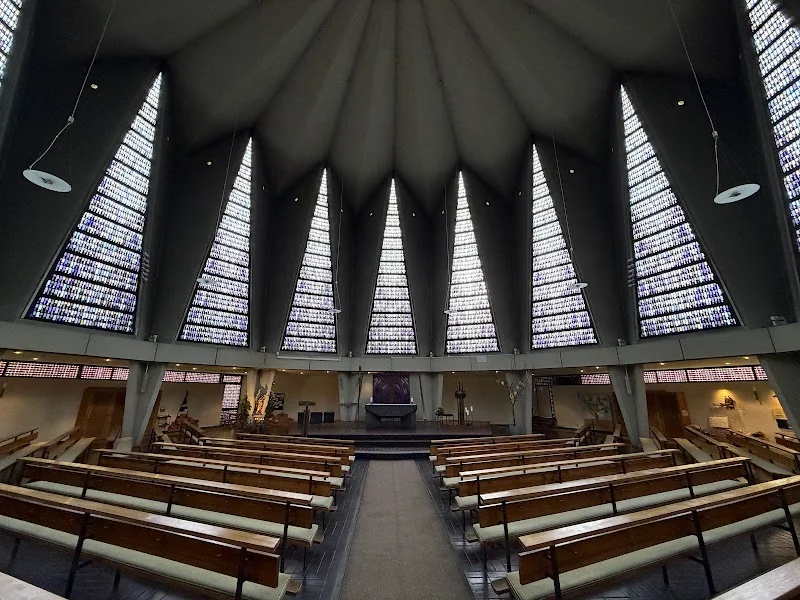
Architecturally, St. Albert is described by the Monument Preservation Office as a reinterpretation of Gothic structures, which is constructively and materially up to date. Particularly striking is the description of a star-shaped, crown-like folded structure over a circular space on a square base. This makes it clear why the church appears so distinctive in photo and architectural contexts: it is neither classically historicist nor strictly functionalist, but combines liturgical symbolism with modern construction. The use of prefabricated concrete elements shows how consistently the church was anchored in its time, while the Gothic charm keeps the connection to tradition open. For the perception on-site, this means a strong external presence that clearly distinguishes itself from many other Freiburg churches. Those searching for St. Albert photos often seek exactly this tension between clear form, religious symbolism, and material aesthetics. This also explains why the church appears in monument and regional publications: it is an example of how church construction in the 1960s found new forms without abandoning the connection to the Christian spatial idea. In Freiburg-Betzenhausen, St. Albert is therefore not only a community church but also a significant architectural monument. ([denkmalpflege-bw.de](https://www.denkmalpflege-bw.de/denkmale/projekte/bau-und-kunstdenkmalpflege/inventarisation/zwoelf-kirchen/index.php?id=2641))
Community life, children, music, and encounters
St. Albert is also interesting because the parish website makes a wide range of groups and offerings visible. Among other things, there are educational work, choir community, kindergarten, altar servers, mission-development-peace, scouts, and Café and more. Such areas are not just accessories for a parish in Freiburg but a crucial part of its identity. They show that the church is not only used on Sundays but brings together various age groups and interests throughout the week. Families, volunteers, music enthusiasts, and people looking for connections in the neighborhood particularly benefit from this diversity. Those searching for St. Albert Freiburg are often interested not only in the building itself but also in what happens there: What groups are there, who can be contacted, how is community lived? The website answers these questions not with a brief list but with a structure that encourages participation. This is valuable for SEO as well as for real use, as seekers often decide at this point whether a place is relevant for them. St. Albert is thus an example of a church that brings together faith, education, music, and neighborhood. ([st.albert.kath-freiburg-nordwest.de](https://st.albert.kath-freiburg-nordwest.de/))
Additionally, the Catholic Church Freiburg also shows St. Albert in connection with different forms of liturgy and community life. Native language services are celebrated there irregularly, and the worship calendar lists the church as a fixed part of the Northwest area. This emphasizes that St. Albert is not just a local address but a place where the diversity of a large city community becomes visible. For people with an international background or interest in specific liturgical forms, this is a real added value. The parish office also contributes to the church's connectivity: it forms the organizational interface between individual inquiries, groups, events, and community life. Therefore, those seeking contact find a reliable address and reliable times here. In summary, this creates the image of a community that is classically rooted in Catholicism but is organized modernly and communicates openly. This fits well with a church whose building also architecturally mediates between tradition and modernity. For this reason, St. Albert in Freiburg is more than a landmark: it is a functioning social space with clear tasks, established contacts, and diverse opportunities for encounters. ([katholische-kirche-freiburg.de](https://www.katholische-kirche-freiburg.de/gottesdienste/muttersprachliche-gottesdienste/?utm_source=openai))
Directions, parking, and practical tips
For visitors arriving by car, practical orientation is as important as history. The official address is Sundgauallee 9, 79114 Freiburg im Breisgau. On a date page of the Catholic Church Freiburg, the Gaußstraße is explicitly mentioned as a meeting point and parking option for a St. Albert event. This is a valuable hint as it shows that the church is not isolated in the densely built urban area but is embedded in a residential and neighborhood environment where parking space must be organized strategically. Therefore, those attending a service, devotion, or event should always read the respective event information and not just know the address. Particularly for churches in urban areas, the exact parking and access situation can vary depending on the occasion. For the search intent behind St. Albert directions or St. Albert parking, this official hint is therefore particularly helpful. It is more concrete than a general assumption and provides a real point of reference for orientation. ([katholische-kirche-freiburg.de](https://www.katholische-kirche-freiburg.de/detail/termin/id/4404758-karfreitagsliturgie/?cb-id=12339281&vt=1&utm_source=openai))
Even without a detailed parking map, the location for visitors can be clearly described: St. Albert belongs to the northwest of Freiburg and is situated in the district context of Betzenhausen-Bischofslinde. The church overview of the Freiburg city deanery assigns the location to this community. In practice, this means that access typically occurs via Sundgauallee and that the community's instructions are decisive for events. Those not arriving by car benefit from the clear address structure, as navigation systems can easily find the church. This point is important for content searches because many people initially ask very pragmatically: Where exactly is it, how do I get there, and where can I park? St. Albert answers these questions with a combination of official address, parish office, event notice, and clear local assignment. This makes the location very user-friendly in the digital everyday life. Therefore, anyone looking for a reliable church in Freiburg will find in St. Albert a place that is not only spiritually but also organizationally well accessible. ([katholische-kirche-freiburg.de](https://katholische-kirche-freiburg.de/kirche-vor-ort/kirchen-im-stadtdekanat-freiburg/?utm_source=openai))
Photos, impressions, and why St. Albert is so often searched
That many people search for St. Albert photos is easily understandable. The church has a distinctive form language that can be particularly well recognized in photos and detail views. The Monument Preservation Office of Baden-Württemberg and LEO-BW document St. Albert with visual material, interior and exterior views, as well as an architectural historical classification. The description as a reinterpretation of Gothic structures with prefabricated concrete parts makes it clear that the building has much to tell visually: lines, proportions, and materiality create a profile that distinguishes it from older basilicas or strictly modern multipurpose spaces. This is precisely why St. Albert is interesting for those seeking images, architecture, and special church facades. When someone sees a photo, they quickly understand why the church stands out in a locally oriented search: it is recognizable, distinctive, and shapes its environment. For a location page, this is important because images are often the first trigger for further questions. People then want to know where the church is located, how it is used, and what makes it historically special. In St. Albert, these layers come together, which is why photos are not just decorative material but make the identity of the place visible. ([denkmalpflege-bw.de](https://www.denkmalpflege-bw.de/denkmale/projekte/bau-und-kunstdenkmalpflege/inventarisation/zwoelf-kirchen/index.php?id=2641))
The regional perception also plays a role in the classification in Freiburg-Betzenhausen. LEO-BW names St. Albert as a church in Freiburg-Betzenhausen and points to the connection of sacred use, post-war modernity, and local anchoring. This explains why the church is relevant for residents of the neighborhood as well as for visitors specifically searching for a special church building. In photos, St. Albert does not appear arbitrary but stands out due to its structural clarity and historical context. Those interested in church architecture will find here a good example of how in the 1960s space, liturgy, and material were thought together. Those searching for practical reasons quickly recognize the address, the use, and the community affiliation. And those looking for a strong image on social media or in the discover environment receive from St. Albert exactly the mix of place of faith, cultural monument, and neighborhood shaping that generates attention. Therefore, St. Albert is interesting not only as a place of worship but also as a visual and content search destination. Especially the connection of photos, history, and community makes the church a sustainable entry for local search and SEO. ([leo-bw.de](https://www.leo-bw.de/en-GB/detail-gis/-/Detail/details/DOKUMENT/LandApp/177145/St%20Albert))
Sources:
Show moreShow less
St. Albert | Freiburg & Photos
St. Albert in Freiburg is a Catholic church with a clear local anchoring in the Betzenhausen-Bischofslinde district and a strong impact on community, worship, and neighborhood. The official church overview assigns St. Albert to the parish of Freiburg Northwest, mentions 300 seats, and locates the church at Sundgauallee 9 in 79114 Freiburg im Breisgau. Thus, St. Albert is not only a sacred building but also a place where religious life, community structure, and everyday paths meet in a neighborhood. Those searching for St. Albert Freiburg usually refer to a church that stands out due to its post-war architecture, its regular services, and its active parish life. This mix makes the location equally relevant for visitors, community members, seekers of photos, and people with practical interests. The combination of official address, clear affiliation, and good findability is particularly important for a location like this, as it provides both spiritual and organizational orientation. ([katholische-kirche-freiburg.de](https://katholische-kirche-freiburg.de/kirche-vor-ort/kirchen-im-stadtdekanat-freiburg/?utm_source=openai))
Where is St. Albert located in Freiburg and how many seats are there?
Those who wish to visit St. Albert will find the church in the northwest of Freiburg in Betzenhausen-Bischofslinde. The official representation in the Freiburg city deanery lists the location with 300 seats, the address Sundgauallee 9, and the parish office of the Freiburg Northwest parish. These figures are not only practical for planning a visit to a service but also for anyone interested in the size and use of the building. 300 seats mean a manageable, but by no means small church: large enough for a vibrant community life, yet close enough to avoid feeling like an anonymous large space. This balance is important for many Catholic churches in the urban structure, as it connects shared liturgy, personal encounters, and a functioning neighborhood culture. St. Albert is thus a very typical yet distinctive place for Freiburg's church life, as it combines local presence with clear administrative and contact structures. For inquiries about St. Albert Freiburg or St. Albert Freiburg im Breisgau, this classification is therefore crucial: The name stands for a specific church in a specific neighborhood and not for any other St. Albert location in Germany. ([katholische-kirche-freiburg.de](https://katholische-kirche-freiburg.de/kirche-vor-ort/kirchen-im-stadtdekanat-freiburg/?utm_source=openai))
The practice for visitors is also clearly regulated. The St. Albert parish office is located at Sundgauallee 9 according to the official website and is reachable on several weekdays, including Wednesday and Friday mornings as well as Tuesday and Thursday afternoons. For people who have spontaneous questions, are looking for a mass, or want to learn about community life, this is an important advantage. The website of the parish also shows that St. Albert is firmly integrated into the digital structure of the Northwest area: worship calendar, events, pastoral care, kindergartens, and community life are centrally brought together there. This is particularly helpful for orientation on-site, as it ensures that not only the address is correct, but also the paths to the relevant information remain short. Therefore, those searching for St. Albert photos, St. Albert directions, or St. Albert church ideally land on a page that transparently depicts this mix of address, contact, and use. The church is thus a well-structured, clearly described place where the search for information aligns with real community practice. ([st.albert.kath-freiburg-nordwest.de](https://st.albert.kath-freiburg-nordwest.de/))
Worship calendar, parish office, and current dates
A central reason for searching at St. Albert is the worship calendar. The Catholic Church Freiburg lists St. Albert in its calendar with regular Eucharistic celebrations on Sunday at 09:30 AM throughout the year 2026. Additionally, the page for St. Albert indicates irregular services in native languages. This is a strong signal for a community in an urban environment, as it shows that St. Albert is not only a local church but also a place where different liturgical forms have their place. For visitors, this means: If someone is looking for a specific date, they should always check the current calendar, as the structure is dynamic and can be adjusted seasonally. This is particularly important for church events, as holidays, special services, devotions, and international celebrations can change the course of the year. For the search intent behind terms like St. Albert service, St. Albert Freiburg, or St. Albert Freiburg Northwest, this calendar is the decisive point of contact. It not only answers the question of when something takes place but also which forms of faith life are practiced in St. Albert. ([katholische-kirche-freiburg.de](https://www.katholische-kirche-freiburg.de/gottesdienste/03-gottesdienste-in-freiburg-nordwest/detail/serientermin/id/4169131-eucharistiefeier/?cb-id=12456736&utm_source=openai))
The website of the parish also shows that St. Albert is organizationally much more than just the place of Sunday mass. The navigation includes dedicated areas for community life, scouts, altar servers, choir community, educational work, kindergarten, and an offering called Café and more. This is a good indication of how deeply the church is anchored in the everyday life of the community. Visitors searching for St. Albert photos or an impression of life on-site will thus encounter an active, diverse structure, not just a quiet building. The parish area is also part of the Roman Catholic parish of Freiburg i.Br. and is therefore integrated into a larger ecclesiastical framework. This integration makes it sensible to view St. Albert not just as a building but as a functioning community space. Those looking for a place for mass, conversation, youth work, music, or education will find here a classic urban parish with modern communication methods. This also explains why the website of St. Albert is relevant for many search queries: it bundles practical information and simultaneously shows that the church is a lively meeting point in the neighborhood. ([st.albert.kath-freiburg-nordwest.de](https://st.albert.kath-freiburg-nordwest.de/))
History and architecture of St. Albert in Betzenhausen
The architectural history of St. Albert is closely linked to the post-war period. The Monument Preservation Office of Baden-Württemberg states that the Catholic church St. Albert in Freiburg-Betzenhausen had its foundation stone laid in 1967, was consecrated in 1969, and had a kindergarten and community rooms added in 1970/71. The architect was Erwin Heine from Freiburg, and the construction management was taken over by Rudolf Feßler. A Freiburg engineering office was responsible for the structural engineering, and several artists were involved in the furnishings, including Kurt Frank, H. G. Schmidt, Bruno Knittel, and Kemter. This information is important because it shows that St. Albert was conceived as an ensemble from the beginning: church, community life, and supplementary facilities were not planned separately but in relation to each other. This makes the place very plausible today for a church in the district, as it is built not only for the liturgical moment but also for the social and educational functions of community life. For all those searching for the history of St. Albert Freiburg, this connection between construction phase and community structure is the decisive core. ([denkmalpflege-bw.de](https://www.denkmalpflege-bw.de/denkmale/projekte/bau-und-kunstdenkmalpflege/inventarisation/zwoelf-kirchen/index.php?id=2641))
Architecturally, St. Albert is described by the Monument Preservation Office as a reinterpretation of Gothic structures, which is constructively and materially up to date. Particularly striking is the description of a star-shaped, crown-like folded structure over a circular space on a square base. This makes it clear why the church appears so distinctive in photo and architectural contexts: it is neither classically historicist nor strictly functionalist, but combines liturgical symbolism with modern construction. The use of prefabricated concrete elements shows how consistently the church was anchored in its time, while the Gothic charm keeps the connection to tradition open. For the perception on-site, this means a strong external presence that clearly distinguishes itself from many other Freiburg churches. Those searching for St. Albert photos often seek exactly this tension between clear form, religious symbolism, and material aesthetics. This also explains why the church appears in monument and regional publications: it is an example of how church construction in the 1960s found new forms without abandoning the connection to the Christian spatial idea. In Freiburg-Betzenhausen, St. Albert is therefore not only a community church but also a significant architectural monument. ([denkmalpflege-bw.de](https://www.denkmalpflege-bw.de/denkmale/projekte/bau-und-kunstdenkmalpflege/inventarisation/zwoelf-kirchen/index.php?id=2641))
Community life, children, music, and encounters
St. Albert is also interesting because the parish website makes a wide range of groups and offerings visible. Among other things, there are educational work, choir community, kindergarten, altar servers, mission-development-peace, scouts, and Café and more. Such areas are not just accessories for a parish in Freiburg but a crucial part of its identity. They show that the church is not only used on Sundays but brings together various age groups and interests throughout the week. Families, volunteers, music enthusiasts, and people looking for connections in the neighborhood particularly benefit from this diversity. Those searching for St. Albert Freiburg are often interested not only in the building itself but also in what happens there: What groups are there, who can be contacted, how is community lived? The website answers these questions not with a brief list but with a structure that encourages participation. This is valuable for SEO as well as for real use, as seekers often decide at this point whether a place is relevant for them. St. Albert is thus an example of a church that brings together faith, education, music, and neighborhood. ([st.albert.kath-freiburg-nordwest.de](https://st.albert.kath-freiburg-nordwest.de/))
Additionally, the Catholic Church Freiburg also shows St. Albert in connection with different forms of liturgy and community life. Native language services are celebrated there irregularly, and the worship calendar lists the church as a fixed part of the Northwest area. This emphasizes that St. Albert is not just a local address but a place where the diversity of a large city community becomes visible. For people with an international background or interest in specific liturgical forms, this is a real added value. The parish office also contributes to the church's connectivity: it forms the organizational interface between individual inquiries, groups, events, and community life. Therefore, those seeking contact find a reliable address and reliable times here. In summary, this creates the image of a community that is classically rooted in Catholicism but is organized modernly and communicates openly. This fits well with a church whose building also architecturally mediates between tradition and modernity. For this reason, St. Albert in Freiburg is more than a landmark: it is a functioning social space with clear tasks, established contacts, and diverse opportunities for encounters. ([katholische-kirche-freiburg.de](https://www.katholische-kirche-freiburg.de/gottesdienste/muttersprachliche-gottesdienste/?utm_source=openai))
Directions, parking, and practical tips
For visitors arriving by car, practical orientation is as important as history. The official address is Sundgauallee 9, 79114 Freiburg im Breisgau. On a date page of the Catholic Church Freiburg, the Gaußstraße is explicitly mentioned as a meeting point and parking option for a St. Albert event. This is a valuable hint as it shows that the church is not isolated in the densely built urban area but is embedded in a residential and neighborhood environment where parking space must be organized strategically. Therefore, those attending a service, devotion, or event should always read the respective event information and not just know the address. Particularly for churches in urban areas, the exact parking and access situation can vary depending on the occasion. For the search intent behind St. Albert directions or St. Albert parking, this official hint is therefore particularly helpful. It is more concrete than a general assumption and provides a real point of reference for orientation. ([katholische-kirche-freiburg.de](https://www.katholische-kirche-freiburg.de/detail/termin/id/4404758-karfreitagsliturgie/?cb-id=12339281&vt=1&utm_source=openai))
Even without a detailed parking map, the location for visitors can be clearly described: St. Albert belongs to the northwest of Freiburg and is situated in the district context of Betzenhausen-Bischofslinde. The church overview of the Freiburg city deanery assigns the location to this community. In practice, this means that access typically occurs via Sundgauallee and that the community's instructions are decisive for events. Those not arriving by car benefit from the clear address structure, as navigation systems can easily find the church. This point is important for content searches because many people initially ask very pragmatically: Where exactly is it, how do I get there, and where can I park? St. Albert answers these questions with a combination of official address, parish office, event notice, and clear local assignment. This makes the location very user-friendly in the digital everyday life. Therefore, anyone looking for a reliable church in Freiburg will find in St. Albert a place that is not only spiritually but also organizationally well accessible. ([katholische-kirche-freiburg.de](https://katholische-kirche-freiburg.de/kirche-vor-ort/kirchen-im-stadtdekanat-freiburg/?utm_source=openai))
Photos, impressions, and why St. Albert is so often searched
That many people search for St. Albert photos is easily understandable. The church has a distinctive form language that can be particularly well recognized in photos and detail views. The Monument Preservation Office of Baden-Württemberg and LEO-BW document St. Albert with visual material, interior and exterior views, as well as an architectural historical classification. The description as a reinterpretation of Gothic structures with prefabricated concrete parts makes it clear that the building has much to tell visually: lines, proportions, and materiality create a profile that distinguishes it from older basilicas or strictly modern multipurpose spaces. This is precisely why St. Albert is interesting for those seeking images, architecture, and special church facades. When someone sees a photo, they quickly understand why the church stands out in a locally oriented search: it is recognizable, distinctive, and shapes its environment. For a location page, this is important because images are often the first trigger for further questions. People then want to know where the church is located, how it is used, and what makes it historically special. In St. Albert, these layers come together, which is why photos are not just decorative material but make the identity of the place visible. ([denkmalpflege-bw.de](https://www.denkmalpflege-bw.de/denkmale/projekte/bau-und-kunstdenkmalpflege/inventarisation/zwoelf-kirchen/index.php?id=2641))
The regional perception also plays a role in the classification in Freiburg-Betzenhausen. LEO-BW names St. Albert as a church in Freiburg-Betzenhausen and points to the connection of sacred use, post-war modernity, and local anchoring. This explains why the church is relevant for residents of the neighborhood as well as for visitors specifically searching for a special church building. In photos, St. Albert does not appear arbitrary but stands out due to its structural clarity and historical context. Those interested in church architecture will find here a good example of how in the 1960s space, liturgy, and material were thought together. Those searching for practical reasons quickly recognize the address, the use, and the community affiliation. And those looking for a strong image on social media or in the discover environment receive from St. Albert exactly the mix of place of faith, cultural monument, and neighborhood shaping that generates attention. Therefore, St. Albert is interesting not only as a place of worship but also as a visual and content search destination. Especially the connection of photos, history, and community makes the church a sustainable entry for local search and SEO. ([leo-bw.de](https://www.leo-bw.de/en-GB/detail-gis/-/Detail/details/DOKUMENT/LandApp/177145/St%20Albert))
Sources:
St. Albert | Freiburg & Photos
St. Albert in Freiburg is a Catholic church with a clear local anchoring in the Betzenhausen-Bischofslinde district and a strong impact on community, worship, and neighborhood. The official church overview assigns St. Albert to the parish of Freiburg Northwest, mentions 300 seats, and locates the church at Sundgauallee 9 in 79114 Freiburg im Breisgau. Thus, St. Albert is not only a sacred building but also a place where religious life, community structure, and everyday paths meet in a neighborhood. Those searching for St. Albert Freiburg usually refer to a church that stands out due to its post-war architecture, its regular services, and its active parish life. This mix makes the location equally relevant for visitors, community members, seekers of photos, and people with practical interests. The combination of official address, clear affiliation, and good findability is particularly important for a location like this, as it provides both spiritual and organizational orientation. ([katholische-kirche-freiburg.de](https://katholische-kirche-freiburg.de/kirche-vor-ort/kirchen-im-stadtdekanat-freiburg/?utm_source=openai))
Where is St. Albert located in Freiburg and how many seats are there?
Those who wish to visit St. Albert will find the church in the northwest of Freiburg in Betzenhausen-Bischofslinde. The official representation in the Freiburg city deanery lists the location with 300 seats, the address Sundgauallee 9, and the parish office of the Freiburg Northwest parish. These figures are not only practical for planning a visit to a service but also for anyone interested in the size and use of the building. 300 seats mean a manageable, but by no means small church: large enough for a vibrant community life, yet close enough to avoid feeling like an anonymous large space. This balance is important for many Catholic churches in the urban structure, as it connects shared liturgy, personal encounters, and a functioning neighborhood culture. St. Albert is thus a very typical yet distinctive place for Freiburg's church life, as it combines local presence with clear administrative and contact structures. For inquiries about St. Albert Freiburg or St. Albert Freiburg im Breisgau, this classification is therefore crucial: The name stands for a specific church in a specific neighborhood and not for any other St. Albert location in Germany. ([katholische-kirche-freiburg.de](https://katholische-kirche-freiburg.de/kirche-vor-ort/kirchen-im-stadtdekanat-freiburg/?utm_source=openai))
The practice for visitors is also clearly regulated. The St. Albert parish office is located at Sundgauallee 9 according to the official website and is reachable on several weekdays, including Wednesday and Friday mornings as well as Tuesday and Thursday afternoons. For people who have spontaneous questions, are looking for a mass, or want to learn about community life, this is an important advantage. The website of the parish also shows that St. Albert is firmly integrated into the digital structure of the Northwest area: worship calendar, events, pastoral care, kindergartens, and community life are centrally brought together there. This is particularly helpful for orientation on-site, as it ensures that not only the address is correct, but also the paths to the relevant information remain short. Therefore, those searching for St. Albert photos, St. Albert directions, or St. Albert church ideally land on a page that transparently depicts this mix of address, contact, and use. The church is thus a well-structured, clearly described place where the search for information aligns with real community practice. ([st.albert.kath-freiburg-nordwest.de](https://st.albert.kath-freiburg-nordwest.de/))
Worship calendar, parish office, and current dates
A central reason for searching at St. Albert is the worship calendar. The Catholic Church Freiburg lists St. Albert in its calendar with regular Eucharistic celebrations on Sunday at 09:30 AM throughout the year 2026. Additionally, the page for St. Albert indicates irregular services in native languages. This is a strong signal for a community in an urban environment, as it shows that St. Albert is not only a local church but also a place where different liturgical forms have their place. For visitors, this means: If someone is looking for a specific date, they should always check the current calendar, as the structure is dynamic and can be adjusted seasonally. This is particularly important for church events, as holidays, special services, devotions, and international celebrations can change the course of the year. For the search intent behind terms like St. Albert service, St. Albert Freiburg, or St. Albert Freiburg Northwest, this calendar is the decisive point of contact. It not only answers the question of when something takes place but also which forms of faith life are practiced in St. Albert. ([katholische-kirche-freiburg.de](https://www.katholische-kirche-freiburg.de/gottesdienste/03-gottesdienste-in-freiburg-nordwest/detail/serientermin/id/4169131-eucharistiefeier/?cb-id=12456736&utm_source=openai))
The website of the parish also shows that St. Albert is organizationally much more than just the place of Sunday mass. The navigation includes dedicated areas for community life, scouts, altar servers, choir community, educational work, kindergarten, and an offering called Café and more. This is a good indication of how deeply the church is anchored in the everyday life of the community. Visitors searching for St. Albert photos or an impression of life on-site will thus encounter an active, diverse structure, not just a quiet building. The parish area is also part of the Roman Catholic parish of Freiburg i.Br. and is therefore integrated into a larger ecclesiastical framework. This integration makes it sensible to view St. Albert not just as a building but as a functioning community space. Those looking for a place for mass, conversation, youth work, music, or education will find here a classic urban parish with modern communication methods. This also explains why the website of St. Albert is relevant for many search queries: it bundles practical information and simultaneously shows that the church is a lively meeting point in the neighborhood. ([st.albert.kath-freiburg-nordwest.de](https://st.albert.kath-freiburg-nordwest.de/))
History and architecture of St. Albert in Betzenhausen
The architectural history of St. Albert is closely linked to the post-war period. The Monument Preservation Office of Baden-Württemberg states that the Catholic church St. Albert in Freiburg-Betzenhausen had its foundation stone laid in 1967, was consecrated in 1969, and had a kindergarten and community rooms added in 1970/71. The architect was Erwin Heine from Freiburg, and the construction management was taken over by Rudolf Feßler. A Freiburg engineering office was responsible for the structural engineering, and several artists were involved in the furnishings, including Kurt Frank, H. G. Schmidt, Bruno Knittel, and Kemter. This information is important because it shows that St. Albert was conceived as an ensemble from the beginning: church, community life, and supplementary facilities were not planned separately but in relation to each other. This makes the place very plausible today for a church in the district, as it is built not only for the liturgical moment but also for the social and educational functions of community life. For all those searching for the history of St. Albert Freiburg, this connection between construction phase and community structure is the decisive core. ([denkmalpflege-bw.de](https://www.denkmalpflege-bw.de/denkmale/projekte/bau-und-kunstdenkmalpflege/inventarisation/zwoelf-kirchen/index.php?id=2641))
Architecturally, St. Albert is described by the Monument Preservation Office as a reinterpretation of Gothic structures, which is constructively and materially up to date. Particularly striking is the description of a star-shaped, crown-like folded structure over a circular space on a square base. This makes it clear why the church appears so distinctive in photo and architectural contexts: it is neither classically historicist nor strictly functionalist, but combines liturgical symbolism with modern construction. The use of prefabricated concrete elements shows how consistently the church was anchored in its time, while the Gothic charm keeps the connection to tradition open. For the perception on-site, this means a strong external presence that clearly distinguishes itself from many other Freiburg churches. Those searching for St. Albert photos often seek exactly this tension between clear form, religious symbolism, and material aesthetics. This also explains why the church appears in monument and regional publications: it is an example of how church construction in the 1960s found new forms without abandoning the connection to the Christian spatial idea. In Freiburg-Betzenhausen, St. Albert is therefore not only a community church but also a significant architectural monument. ([denkmalpflege-bw.de](https://www.denkmalpflege-bw.de/denkmale/projekte/bau-und-kunstdenkmalpflege/inventarisation/zwoelf-kirchen/index.php?id=2641))
Community life, children, music, and encounters
St. Albert is also interesting because the parish website makes a wide range of groups and offerings visible. Among other things, there are educational work, choir community, kindergarten, altar servers, mission-development-peace, scouts, and Café and more. Such areas are not just accessories for a parish in Freiburg but a crucial part of its identity. They show that the church is not only used on Sundays but brings together various age groups and interests throughout the week. Families, volunteers, music enthusiasts, and people looking for connections in the neighborhood particularly benefit from this diversity. Those searching for St. Albert Freiburg are often interested not only in the building itself but also in what happens there: What groups are there, who can be contacted, how is community lived? The website answers these questions not with a brief list but with a structure that encourages participation. This is valuable for SEO as well as for real use, as seekers often decide at this point whether a place is relevant for them. St. Albert is thus an example of a church that brings together faith, education, music, and neighborhood. ([st.albert.kath-freiburg-nordwest.de](https://st.albert.kath-freiburg-nordwest.de/))
Additionally, the Catholic Church Freiburg also shows St. Albert in connection with different forms of liturgy and community life. Native language services are celebrated there irregularly, and the worship calendar lists the church as a fixed part of the Northwest area. This emphasizes that St. Albert is not just a local address but a place where the diversity of a large city community becomes visible. For people with an international background or interest in specific liturgical forms, this is a real added value. The parish office also contributes to the church's connectivity: it forms the organizational interface between individual inquiries, groups, events, and community life. Therefore, those seeking contact find a reliable address and reliable times here. In summary, this creates the image of a community that is classically rooted in Catholicism but is organized modernly and communicates openly. This fits well with a church whose building also architecturally mediates between tradition and modernity. For this reason, St. Albert in Freiburg is more than a landmark: it is a functioning social space with clear tasks, established contacts, and diverse opportunities for encounters. ([katholische-kirche-freiburg.de](https://www.katholische-kirche-freiburg.de/gottesdienste/muttersprachliche-gottesdienste/?utm_source=openai))
Directions, parking, and practical tips
For visitors arriving by car, practical orientation is as important as history. The official address is Sundgauallee 9, 79114 Freiburg im Breisgau. On a date page of the Catholic Church Freiburg, the Gaußstraße is explicitly mentioned as a meeting point and parking option for a St. Albert event. This is a valuable hint as it shows that the church is not isolated in the densely built urban area but is embedded in a residential and neighborhood environment where parking space must be organized strategically. Therefore, those attending a service, devotion, or event should always read the respective event information and not just know the address. Particularly for churches in urban areas, the exact parking and access situation can vary depending on the occasion. For the search intent behind St. Albert directions or St. Albert parking, this official hint is therefore particularly helpful. It is more concrete than a general assumption and provides a real point of reference for orientation. ([katholische-kirche-freiburg.de](https://www.katholische-kirche-freiburg.de/detail/termin/id/4404758-karfreitagsliturgie/?cb-id=12339281&vt=1&utm_source=openai))
Even without a detailed parking map, the location for visitors can be clearly described: St. Albert belongs to the northwest of Freiburg and is situated in the district context of Betzenhausen-Bischofslinde. The church overview of the Freiburg city deanery assigns the location to this community. In practice, this means that access typically occurs via Sundgauallee and that the community's instructions are decisive for events. Those not arriving by car benefit from the clear address structure, as navigation systems can easily find the church. This point is important for content searches because many people initially ask very pragmatically: Where exactly is it, how do I get there, and where can I park? St. Albert answers these questions with a combination of official address, parish office, event notice, and clear local assignment. This makes the location very user-friendly in the digital everyday life. Therefore, anyone looking for a reliable church in Freiburg will find in St. Albert a place that is not only spiritually but also organizationally well accessible. ([katholische-kirche-freiburg.de](https://katholische-kirche-freiburg.de/kirche-vor-ort/kirchen-im-stadtdekanat-freiburg/?utm_source=openai))
Photos, impressions, and why St. Albert is so often searched
That many people search for St. Albert photos is easily understandable. The church has a distinctive form language that can be particularly well recognized in photos and detail views. The Monument Preservation Office of Baden-Württemberg and LEO-BW document St. Albert with visual material, interior and exterior views, as well as an architectural historical classification. The description as a reinterpretation of Gothic structures with prefabricated concrete parts makes it clear that the building has much to tell visually: lines, proportions, and materiality create a profile that distinguishes it from older basilicas or strictly modern multipurpose spaces. This is precisely why St. Albert is interesting for those seeking images, architecture, and special church facades. When someone sees a photo, they quickly understand why the church stands out in a locally oriented search: it is recognizable, distinctive, and shapes its environment. For a location page, this is important because images are often the first trigger for further questions. People then want to know where the church is located, how it is used, and what makes it historically special. In St. Albert, these layers come together, which is why photos are not just decorative material but make the identity of the place visible. ([denkmalpflege-bw.de](https://www.denkmalpflege-bw.de/denkmale/projekte/bau-und-kunstdenkmalpflege/inventarisation/zwoelf-kirchen/index.php?id=2641))
The regional perception also plays a role in the classification in Freiburg-Betzenhausen. LEO-BW names St. Albert as a church in Freiburg-Betzenhausen and points to the connection of sacred use, post-war modernity, and local anchoring. This explains why the church is relevant for residents of the neighborhood as well as for visitors specifically searching for a special church building. In photos, St. Albert does not appear arbitrary but stands out due to its structural clarity and historical context. Those interested in church architecture will find here a good example of how in the 1960s space, liturgy, and material were thought together. Those searching for practical reasons quickly recognize the address, the use, and the community affiliation. And those looking for a strong image on social media or in the discover environment receive from St. Albert exactly the mix of place of faith, cultural monument, and neighborhood shaping that generates attention. Therefore, St. Albert is interesting not only as a place of worship but also as a visual and content search destination. Especially the connection of photos, history, and community makes the church a sustainable entry for local search and SEO. ([leo-bw.de](https://www.leo-bw.de/en-GB/detail-gis/-/Detail/details/DOKUMENT/LandApp/177145/St%20Albert))
Sources:
Frequently Asked Questions
Reviews
No reviews found