
Freiburg im Breisgau
Lehener Str. 77, 79106 Freiburg im Breisgau, Deutschland
Pavilion for All eV | Events & Directions
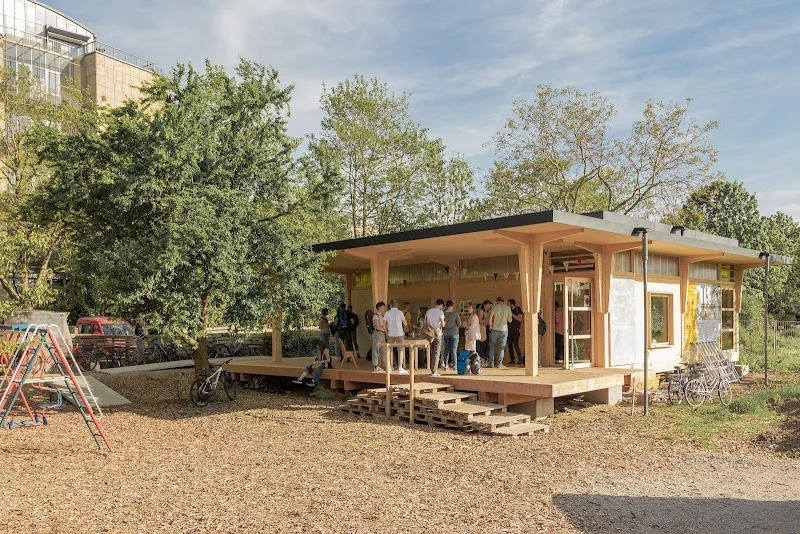
The Pavilion for All eV is more than just a venue in Freiburg: it is a temporary wooden pavilion in the new construction area Kleineschholz, right next to the Employment Agency, and at the same time a space for exchange, housing project ideas, and community-oriented urban development. The association was founded in July 2022 and is aimed at individuals, groups, and initiatives who want to build and live together in Kleineschholz, Dietenbach, or beyond. At the municipal level, the pavilion is described as the first concrete point of contact in the construction area; on the association's website, it is understood as a place where events are organized, contacts are made, and future-oriented solutions are practically thought out. This very mix is what makes the location appealing: it is experimental, close to the current questions of the city, and at the same time open to people who want to inform themselves, network, or become active themselves. Therefore, anyone searching for Pavilion for All Freiburg, Pavilion for All, or Pavilion for events will end up at a place that cannot be reduced to pure event logic but fulfills a genuine social mandate. ([pavillonfueralle.org](https://pavillonfueralle.org/ueber-uns/))
Events, Networking Café, and Housing Project Program
If the search query focuses on events, programs, or Pavilion for events, the Pavilion for All primarily emphasizes exchange. The association organizes formats for those interested in housing projects and those experienced in housing projects, for groups needing participation, and for people who want to orient themselves first. Particularly defining is the networking café: new participants receive a brief introduction to Kleineschholz, Dietenbach, the housing project landscape, and the current state of affairs before the circle opens for conversations, questions, and mutual support. According to the website, this format usually takes place once a month, always on the second Saturday, although dates may shift due to holidays or vacations. That is why the current calendar is so important. In addition, the experience treasure, expert lectures, and the GeBauT workshop series are mentioned as fixed or recurring formats. This range shows that the pavilion is not just a space for lectures but a place for advice, networking, and concrete planning. Anyone looking to establish a housing project, seeking inspiration, or wanting to find suitable collaborators will find here a structured yet open framework. ([pavillonfueralle.org](https://pavillonfueralle.org/unser-angebot/))
What is particularly interesting is how the pavilion understands its events. It is not about classic event entertainment but about formats that make knowledge accessible and support the development of communal living forms. The association describes the place as a testing ground for innovative, ecological, and future-oriented approaches. In expert lectures, hard facts about construction, financing, energy concepts, and community processes are conveyed; in workshops and open meetings, this knowledge is to be directly applied to the needs of the respective groups. This makes the Pavilion for All exciting for people who do not just want to consume but want to co-create. At the same time, the website emphasizes that there are often free time slots between events when the space can be used by housing project groups for workshops and planning meetings. Thus, a venue becomes a vibrant hub for initiatives working together on affordable, social, and sustainable housing. This dual character of being a program location and project workshop is a central reason why the pavilion fits so well with the search terms related to programs, events, and housing projects in Freiburg. ([pavillonfueralle.org](https://pavillonfueralle.org/unser-angebot/))
Room Inquiry, Equipment, and Capacity
Anyone looking for a space for a meeting, workshop, or planning discussion will find a relatively open yet clearly regulated usage situation at the Pavilion for All. Provided the space is not occupied by the association itself, groups can submit a room inquiry. In case of multiple inquiries for the same period, funding members have priority; a secure confirmation or rejection will be made no later than two weeks before the desired date. Additionally, first-time users are provided with a brief introduction to ensure the smooth use of the pavilion. The handover of keys is arranged by agreement, and there are instructions regarding toilet use, technology, and everything to consider when leaving the pavilion. These processes are important because the place is consciously thought of as communal: not as an anonymously rented event space but as a jointly responsible area. That is why the inquiry is not just a formality but part of a usage model based on consideration, clarity, and collaboration. ([pavillonfueralle.org](https://pavillonfueralle.org/unser-raum/))
The equipment is also kept deliberately pragmatic and grows according to the financial possibilities, according to the association. Currently, four tables and 70 chairs are available on-site; thus, the pavilion is well-suited for smaller to medium-sized events with seating character. Additionally, there is a filter coffee machine with 20 cups, a screen for presentations, and the possibility to provide power for projectors, coffee machines, or lights via a generator and batteries. A permanently installed projector is planned, as well as a small outdoor kitchen that is intended to make the space even more versatile. In practice, this means: the pavilion is not a high-end event space with complete infrastructure but a flexible place with a real DIY character. This can be an advantage for many formats because the atmosphere remains personal and spaces can be adapted more easily. Anyone looking for a location with capacity, atmosphere, and social added value will find here an environment that is consciously not over-staged but focuses on usability, community, and development. ([pavillonfueralle.org](https://pavillonfueralle.org/unser-raum/))
Directions, Public Transport, and Parking
For questions about directions and parking, the official information is pleasantly clear. The Pavilion for All is located on Lehener Straße, right next to the Employment Agency, in the new construction area Kleineschholz. The property is only temporarily used until this part of the construction area is built up. Therefore, there are currently no official parking spaces directly at the pavilion. Access must be kept clear for construction vehicles, which means for visitors: arriving by car is possible, but not intended as a classic park-and-event situation. Instead, parking is available on Lehener Straße. Bicycles can be parked on the property, which fits well with the more neighborly and community-oriented character of the place. For search queries like Pavilion for All parking or directions Pavilion for All, this information is central because it shows that one should briefly consider the visit logistics in advance. Anyone wanting to come by car should respect the construction context and allow enough time for parking searches. ([pavillonfueralle.org](https://pavillonfueralle.org/))
However, the pavilion is easily accessible by public transport. The nearest stops are Rathaus im Stühlinger with lines 1, 2, 3, and 4; alternatively, Westarkaden can be used with line 4. According to the association's website, it takes about ten minutes on foot from both stops to the pavilion. These paths are short enough to make the location practical for event formats with multiple participants. Especially for housing project meetings, information evenings, or networking formats, this is a plus because many visitors can orient themselves without searching for parking and without complicated routes. The location in western Stühlinger also connects the proximity to the Kleineschholz neighborhood with an urban, well-connected environment. So anyone searching for public transport, directions, or walking routes will find here a location that is consciously anchored in a growing district and remains easily accessible for the city center and adjacent neighborhoods. ([pavillonfueralle.org](https://pavillonfueralle.org/))
Accessibility, Access, and On-Site Use
Regarding accessibility, the Pavilion for All is honest and at the same time future-oriented. On the room page, it states that the pavilion is currently accessible via a temporary ramp, allowing wheelchairs and strollers to enter. At the same time, a barrier-free, wheelchair-accessible eco-toilet is being pursued. This openness is important because it does not claim to be already at the goal but clearly states the current state of development. For search terms like barrier-free, wheelchair-accessible, or access, this is relevant information: the pavilion is usable but not yet in a fully developed state. Visitors should therefore expect that the place still has a provisional character. This fits with a construction area in development, where much is growing and improving in parallel. The association's attitude is pragmatic and inclusive at the same time: access should be open to as many people as possible, even if technical and financial prerequisites still need to be expanded. ([pavillonfueralle.org](https://pavillonfueralle.org/unser-raum/))
Children are also welcome according to the website, with a clear note that the area around the pavilion still has a construction site feel and the small gardens are being demolished. Parents are asked to ensure that children do not play on the construction site, as there may be dangers from construction debris and the surrounding area. This information is important not only for families but also for choosing the appropriate event format. Anyone planning a quiet planning meeting, workshop, or information event can better assess the environment when they know that it is not a closed, perfectly shielded courtyard. At the same time, the association states that new groups usually receive a brief introduction and that a user manual for the toilet and technology is available in the pavilion. This shows: the use is organized communally, and the threshold for initial events remains low. Especially in combination with the temporary ramp and clear usage rules, a space is created that remains accessible and comprehensible despite the construction site character. ([pavillonfueralle.org](https://pavillonfueralle.org/unser-raum/))
Kleineschholz, Background, and Community-Oriented Idea
The Pavilion for All is closely connected to the Kleineschholz neighborhood. According to the association's website, the association was founded in July 2022 and rents the temporary wooden pavilion in the future construction area as a non-profit organization. Its task is to be a point of contact for individuals and groups interested in housing projects who want to build and live in Kleineschholz, Dietenbach, or beyond. The association's goals also emphasize that residential and housing communities in Freiburg and the surrounding area should be supported in realizing their projects more efficiently and sustainably. The pavilion provides the place where information, networking, and professional exchange come together. The topics are broadly defined: information events, workshops, and open meetings are intended to make the necessary know-how accessible. The website also highlights the importance of climate-friendly construction and the social dimension of housing projects. Thus, the pavilion is not only a place for meetings but also a small laboratory for the question of how living in a growing city can be thought of in a community-oriented way. ([pavillonfueralle.org](https://pavillonfueralle.org/ueber-uns/))
The city of Freiburg describes the pavilion in its Kleineschholz reporting as the first building of the future neighborhood, even if it is only temporary. It is located near the Employment Agency and offers builders and other interested parties the opportunity to meet, network, inform themselves, and jointly plan projects for the new neighborhood. It is also emphasized that, with the support of the Department for Affordable Housing of the city of Freiburg and the Kleineschholz project group, a place has been created here that serves as a first concrete point of contact for community-oriented actors in the construction area. This classification is important because it places the pavilion in the urban planning context beyond mere association work. So anyone searching for Kleineschholz, Pavilion for All Freiburg, or background information about the location will not find a random event space here but a piece of urban development in the making. This makes the place so special: it is simultaneously a symbol, workspace, and meeting point. ([freiburg.de](https://www.freiburg.de/pb/2021733.html))
The city's participation page also underscores this role. It states that the public has been broadly involved in the development of the new neighborhood from the beginning, and the Pavilion for All offers a place for networking and exchange. The first building of the new neighborhood is explicitly described there as a space with a networking café for housing projects and interested parties. Together with the feedback from the public, which revolved around affordable housing, traffic, and parking spaces, it shows that the pavilion is in the midst of a process that goes far beyond a single association. It is a visible place where discussions about sustainable construction methods, social mixing, and housing policy issues become concrete. Exactly therein lies its significance for Freiburg: not as a finished landmark but as an open, politically relevant, and community-oriented space where the future is negotiated. ([freiburg.de](https://www.freiburg.de/pb/2050957.html))
Get Involved, Membership, and Engagement
Another reason why the Pavilion for All feels so vibrant is the broad engagement behind it. On the participation page, the association explains that it is funded exclusively through grants from foundations, donations, and membership fees. A supporting membership currently costs 120 euros per year for individuals or 240 euros per year for housing project groups. The association also emphasizes that good events are usually offered free of charge for everyone and that additional funds help maintain, optimize infrastructure, and strengthen the team. This transparency is interesting for seekers who want to understand not only a place but also the underlying structure. It becomes clear: the pavilion is not a classic commercial event operation but a solidarity-funded space supported by many shoulders. This also explains why the theme of participation is so central. ([pavillonfueralle.org](https://pavillonfueralle.org/mach-mit/))
The page also shows how concretely people can get involved. Among other things, the AG Garden, AG Events, AG Building, and AG Public Relations are mentioned. It is about maintaining the outdoor area, planning the program, further developing the building, and visibility on social media and the website. Additionally, there are open invitations to people who bring their own ideas for an offer or just want to try out where they can contribute. For many housing projects, this kind of self-organization is familiar: one does not just use a space but also helps to improve it. The Pavilion for All thus combines the logic of an open meeting point with the culture of a participatory place. This is particularly valuable for Freiburg because it links the local discussion about affordable housing with concrete participation. The city of Freiburg even describes the association in the budget context as a local housing policy actor with a key role in creating community-oriented and affordable housing. This gives the engagement political weight. ([pavillonfueralle.org](https://pavillonfueralle.org/mach-mit/))
Anyone who engages with the Pavilion for All quickly realizes that here not only a space is managed but a network is growing. Events, room allocation, housing project consulting, public relations, and neighborhood development interlink. This is exactly what makes the location interesting for different target groups: for initiatives looking for a workshop space, for people with questions about housing projects, for neighborhood groups wishing for exchange, and for all those who are following the development of Kleineschholz. Because the place lies between construction site, provisional, and future laboratory, it is particularly credible. It does not promise the perfect event but a real, changeable space with a clear stance. So anyone looking for a venue with substance is in the right place. ([pavillonfueralle.org](https://pavillonfueralle.org/ueber-uns/))
Sources:
- Pavilion for All e.V. – Official Website ([pavillonfueralle.org](https://pavillonfueralle.org/))
- Pavilion for All e.V. – Our Space ([pavillonfueralle.org](https://pavillonfueralle.org/unser-raum/))
- City of Freiburg – Participation in Kleineschholz ([freiburg.de](https://www.freiburg.de/pb/2050957.html))
- City of Freiburg – Background: The Pavilion for All ([freiburg.de](https://www.freiburg.de/pb/2021733.html))
Mehr anzeigenWeniger anzeigen
Pavilion for All eV | Events & Directions
The Pavilion for All eV is more than just a venue in Freiburg: it is a temporary wooden pavilion in the new construction area Kleineschholz, right next to the Employment Agency, and at the same time a space for exchange, housing project ideas, and community-oriented urban development. The association was founded in July 2022 and is aimed at individuals, groups, and initiatives who want to build and live together in Kleineschholz, Dietenbach, or beyond. At the municipal level, the pavilion is described as the first concrete point of contact in the construction area; on the association's website, it is understood as a place where events are organized, contacts are made, and future-oriented solutions are practically thought out. This very mix is what makes the location appealing: it is experimental, close to the current questions of the city, and at the same time open to people who want to inform themselves, network, or become active themselves. Therefore, anyone searching for Pavilion for All Freiburg, Pavilion for All, or Pavilion for events will end up at a place that cannot be reduced to pure event logic but fulfills a genuine social mandate. ([pavillonfueralle.org](https://pavillonfueralle.org/ueber-uns/))
Events, Networking Café, and Housing Project Program
If the search query focuses on events, programs, or Pavilion for events, the Pavilion for All primarily emphasizes exchange. The association organizes formats for those interested in housing projects and those experienced in housing projects, for groups needing participation, and for people who want to orient themselves first. Particularly defining is the networking café: new participants receive a brief introduction to Kleineschholz, Dietenbach, the housing project landscape, and the current state of affairs before the circle opens for conversations, questions, and mutual support. According to the website, this format usually takes place once a month, always on the second Saturday, although dates may shift due to holidays or vacations. That is why the current calendar is so important. In addition, the experience treasure, expert lectures, and the GeBauT workshop series are mentioned as fixed or recurring formats. This range shows that the pavilion is not just a space for lectures but a place for advice, networking, and concrete planning. Anyone looking to establish a housing project, seeking inspiration, or wanting to find suitable collaborators will find here a structured yet open framework. ([pavillonfueralle.org](https://pavillonfueralle.org/unser-angebot/))
What is particularly interesting is how the pavilion understands its events. It is not about classic event entertainment but about formats that make knowledge accessible and support the development of communal living forms. The association describes the place as a testing ground for innovative, ecological, and future-oriented approaches. In expert lectures, hard facts about construction, financing, energy concepts, and community processes are conveyed; in workshops and open meetings, this knowledge is to be directly applied to the needs of the respective groups. This makes the Pavilion for All exciting for people who do not just want to consume but want to co-create. At the same time, the website emphasizes that there are often free time slots between events when the space can be used by housing project groups for workshops and planning meetings. Thus, a venue becomes a vibrant hub for initiatives working together on affordable, social, and sustainable housing. This dual character of being a program location and project workshop is a central reason why the pavilion fits so well with the search terms related to programs, events, and housing projects in Freiburg. ([pavillonfueralle.org](https://pavillonfueralle.org/unser-angebot/))
Room Inquiry, Equipment, and Capacity
Anyone looking for a space for a meeting, workshop, or planning discussion will find a relatively open yet clearly regulated usage situation at the Pavilion for All. Provided the space is not occupied by the association itself, groups can submit a room inquiry. In case of multiple inquiries for the same period, funding members have priority; a secure confirmation or rejection will be made no later than two weeks before the desired date. Additionally, first-time users are provided with a brief introduction to ensure the smooth use of the pavilion. The handover of keys is arranged by agreement, and there are instructions regarding toilet use, technology, and everything to consider when leaving the pavilion. These processes are important because the place is consciously thought of as communal: not as an anonymously rented event space but as a jointly responsible area. That is why the inquiry is not just a formality but part of a usage model based on consideration, clarity, and collaboration. ([pavillonfueralle.org](https://pavillonfueralle.org/unser-raum/))
The equipment is also kept deliberately pragmatic and grows according to the financial possibilities, according to the association. Currently, four tables and 70 chairs are available on-site; thus, the pavilion is well-suited for smaller to medium-sized events with seating character. Additionally, there is a filter coffee machine with 20 cups, a screen for presentations, and the possibility to provide power for projectors, coffee machines, or lights via a generator and batteries. A permanently installed projector is planned, as well as a small outdoor kitchen that is intended to make the space even more versatile. In practice, this means: the pavilion is not a high-end event space with complete infrastructure but a flexible place with a real DIY character. This can be an advantage for many formats because the atmosphere remains personal and spaces can be adapted more easily. Anyone looking for a location with capacity, atmosphere, and social added value will find here an environment that is consciously not over-staged but focuses on usability, community, and development. ([pavillonfueralle.org](https://pavillonfueralle.org/unser-raum/))
Directions, Public Transport, and Parking
For questions about directions and parking, the official information is pleasantly clear. The Pavilion for All is located on Lehener Straße, right next to the Employment Agency, in the new construction area Kleineschholz. The property is only temporarily used until this part of the construction area is built up. Therefore, there are currently no official parking spaces directly at the pavilion. Access must be kept clear for construction vehicles, which means for visitors: arriving by car is possible, but not intended as a classic park-and-event situation. Instead, parking is available on Lehener Straße. Bicycles can be parked on the property, which fits well with the more neighborly and community-oriented character of the place. For search queries like Pavilion for All parking or directions Pavilion for All, this information is central because it shows that one should briefly consider the visit logistics in advance. Anyone wanting to come by car should respect the construction context and allow enough time for parking searches. ([pavillonfueralle.org](https://pavillonfueralle.org/))
However, the pavilion is easily accessible by public transport. The nearest stops are Rathaus im Stühlinger with lines 1, 2, 3, and 4; alternatively, Westarkaden can be used with line 4. According to the association's website, it takes about ten minutes on foot from both stops to the pavilion. These paths are short enough to make the location practical for event formats with multiple participants. Especially for housing project meetings, information evenings, or networking formats, this is a plus because many visitors can orient themselves without searching for parking and without complicated routes. The location in western Stühlinger also connects the proximity to the Kleineschholz neighborhood with an urban, well-connected environment. So anyone searching for public transport, directions, or walking routes will find here a location that is consciously anchored in a growing district and remains easily accessible for the city center and adjacent neighborhoods. ([pavillonfueralle.org](https://pavillonfueralle.org/))
Accessibility, Access, and On-Site Use
Regarding accessibility, the Pavilion for All is honest and at the same time future-oriented. On the room page, it states that the pavilion is currently accessible via a temporary ramp, allowing wheelchairs and strollers to enter. At the same time, a barrier-free, wheelchair-accessible eco-toilet is being pursued. This openness is important because it does not claim to be already at the goal but clearly states the current state of development. For search terms like barrier-free, wheelchair-accessible, or access, this is relevant information: the pavilion is usable but not yet in a fully developed state. Visitors should therefore expect that the place still has a provisional character. This fits with a construction area in development, where much is growing and improving in parallel. The association's attitude is pragmatic and inclusive at the same time: access should be open to as many people as possible, even if technical and financial prerequisites still need to be expanded. ([pavillonfueralle.org](https://pavillonfueralle.org/unser-raum/))
Children are also welcome according to the website, with a clear note that the area around the pavilion still has a construction site feel and the small gardens are being demolished. Parents are asked to ensure that children do not play on the construction site, as there may be dangers from construction debris and the surrounding area. This information is important not only for families but also for choosing the appropriate event format. Anyone planning a quiet planning meeting, workshop, or information event can better assess the environment when they know that it is not a closed, perfectly shielded courtyard. At the same time, the association states that new groups usually receive a brief introduction and that a user manual for the toilet and technology is available in the pavilion. This shows: the use is organized communally, and the threshold for initial events remains low. Especially in combination with the temporary ramp and clear usage rules, a space is created that remains accessible and comprehensible despite the construction site character. ([pavillonfueralle.org](https://pavillonfueralle.org/unser-raum/))
Kleineschholz, Background, and Community-Oriented Idea
The Pavilion for All is closely connected to the Kleineschholz neighborhood. According to the association's website, the association was founded in July 2022 and rents the temporary wooden pavilion in the future construction area as a non-profit organization. Its task is to be a point of contact for individuals and groups interested in housing projects who want to build and live in Kleineschholz, Dietenbach, or beyond. The association's goals also emphasize that residential and housing communities in Freiburg and the surrounding area should be supported in realizing their projects more efficiently and sustainably. The pavilion provides the place where information, networking, and professional exchange come together. The topics are broadly defined: information events, workshops, and open meetings are intended to make the necessary know-how accessible. The website also highlights the importance of climate-friendly construction and the social dimension of housing projects. Thus, the pavilion is not only a place for meetings but also a small laboratory for the question of how living in a growing city can be thought of in a community-oriented way. ([pavillonfueralle.org](https://pavillonfueralle.org/ueber-uns/))
The city of Freiburg describes the pavilion in its Kleineschholz reporting as the first building of the future neighborhood, even if it is only temporary. It is located near the Employment Agency and offers builders and other interested parties the opportunity to meet, network, inform themselves, and jointly plan projects for the new neighborhood. It is also emphasized that, with the support of the Department for Affordable Housing of the city of Freiburg and the Kleineschholz project group, a place has been created here that serves as a first concrete point of contact for community-oriented actors in the construction area. This classification is important because it places the pavilion in the urban planning context beyond mere association work. So anyone searching for Kleineschholz, Pavilion for All Freiburg, or background information about the location will not find a random event space here but a piece of urban development in the making. This makes the place so special: it is simultaneously a symbol, workspace, and meeting point. ([freiburg.de](https://www.freiburg.de/pb/2021733.html))
The city's participation page also underscores this role. It states that the public has been broadly involved in the development of the new neighborhood from the beginning, and the Pavilion for All offers a place for networking and exchange. The first building of the new neighborhood is explicitly described there as a space with a networking café for housing projects and interested parties. Together with the feedback from the public, which revolved around affordable housing, traffic, and parking spaces, it shows that the pavilion is in the midst of a process that goes far beyond a single association. It is a visible place where discussions about sustainable construction methods, social mixing, and housing policy issues become concrete. Exactly therein lies its significance for Freiburg: not as a finished landmark but as an open, politically relevant, and community-oriented space where the future is negotiated. ([freiburg.de](https://www.freiburg.de/pb/2050957.html))
Get Involved, Membership, and Engagement
Another reason why the Pavilion for All feels so vibrant is the broad engagement behind it. On the participation page, the association explains that it is funded exclusively through grants from foundations, donations, and membership fees. A supporting membership currently costs 120 euros per year for individuals or 240 euros per year for housing project groups. The association also emphasizes that good events are usually offered free of charge for everyone and that additional funds help maintain, optimize infrastructure, and strengthen the team. This transparency is interesting for seekers who want to understand not only a place but also the underlying structure. It becomes clear: the pavilion is not a classic commercial event operation but a solidarity-funded space supported by many shoulders. This also explains why the theme of participation is so central. ([pavillonfueralle.org](https://pavillonfueralle.org/mach-mit/))
The page also shows how concretely people can get involved. Among other things, the AG Garden, AG Events, AG Building, and AG Public Relations are mentioned. It is about maintaining the outdoor area, planning the program, further developing the building, and visibility on social media and the website. Additionally, there are open invitations to people who bring their own ideas for an offer or just want to try out where they can contribute. For many housing projects, this kind of self-organization is familiar: one does not just use a space but also helps to improve it. The Pavilion for All thus combines the logic of an open meeting point with the culture of a participatory place. This is particularly valuable for Freiburg because it links the local discussion about affordable housing with concrete participation. The city of Freiburg even describes the association in the budget context as a local housing policy actor with a key role in creating community-oriented and affordable housing. This gives the engagement political weight. ([pavillonfueralle.org](https://pavillonfueralle.org/mach-mit/))
Anyone who engages with the Pavilion for All quickly realizes that here not only a space is managed but a network is growing. Events, room allocation, housing project consulting, public relations, and neighborhood development interlink. This is exactly what makes the location interesting for different target groups: for initiatives looking for a workshop space, for people with questions about housing projects, for neighborhood groups wishing for exchange, and for all those who are following the development of Kleineschholz. Because the place lies between construction site, provisional, and future laboratory, it is particularly credible. It does not promise the perfect event but a real, changeable space with a clear stance. So anyone looking for a venue with substance is in the right place. ([pavillonfueralle.org](https://pavillonfueralle.org/ueber-uns/))
Sources:
- Pavilion for All e.V. – Official Website ([pavillonfueralle.org](https://pavillonfueralle.org/))
- Pavilion for All e.V. – Our Space ([pavillonfueralle.org](https://pavillonfueralle.org/unser-raum/))
- City of Freiburg – Participation in Kleineschholz ([freiburg.de](https://www.freiburg.de/pb/2050957.html))
- City of Freiburg – Background: The Pavilion for All ([freiburg.de](https://www.freiburg.de/pb/2021733.html))
Pavilion for All eV | Events & Directions
The Pavilion for All eV is more than just a venue in Freiburg: it is a temporary wooden pavilion in the new construction area Kleineschholz, right next to the Employment Agency, and at the same time a space for exchange, housing project ideas, and community-oriented urban development. The association was founded in July 2022 and is aimed at individuals, groups, and initiatives who want to build and live together in Kleineschholz, Dietenbach, or beyond. At the municipal level, the pavilion is described as the first concrete point of contact in the construction area; on the association's website, it is understood as a place where events are organized, contacts are made, and future-oriented solutions are practically thought out. This very mix is what makes the location appealing: it is experimental, close to the current questions of the city, and at the same time open to people who want to inform themselves, network, or become active themselves. Therefore, anyone searching for Pavilion for All Freiburg, Pavilion for All, or Pavilion for events will end up at a place that cannot be reduced to pure event logic but fulfills a genuine social mandate. ([pavillonfueralle.org](https://pavillonfueralle.org/ueber-uns/))
Events, Networking Café, and Housing Project Program
If the search query focuses on events, programs, or Pavilion for events, the Pavilion for All primarily emphasizes exchange. The association organizes formats for those interested in housing projects and those experienced in housing projects, for groups needing participation, and for people who want to orient themselves first. Particularly defining is the networking café: new participants receive a brief introduction to Kleineschholz, Dietenbach, the housing project landscape, and the current state of affairs before the circle opens for conversations, questions, and mutual support. According to the website, this format usually takes place once a month, always on the second Saturday, although dates may shift due to holidays or vacations. That is why the current calendar is so important. In addition, the experience treasure, expert lectures, and the GeBauT workshop series are mentioned as fixed or recurring formats. This range shows that the pavilion is not just a space for lectures but a place for advice, networking, and concrete planning. Anyone looking to establish a housing project, seeking inspiration, or wanting to find suitable collaborators will find here a structured yet open framework. ([pavillonfueralle.org](https://pavillonfueralle.org/unser-angebot/))
What is particularly interesting is how the pavilion understands its events. It is not about classic event entertainment but about formats that make knowledge accessible and support the development of communal living forms. The association describes the place as a testing ground for innovative, ecological, and future-oriented approaches. In expert lectures, hard facts about construction, financing, energy concepts, and community processes are conveyed; in workshops and open meetings, this knowledge is to be directly applied to the needs of the respective groups. This makes the Pavilion for All exciting for people who do not just want to consume but want to co-create. At the same time, the website emphasizes that there are often free time slots between events when the space can be used by housing project groups for workshops and planning meetings. Thus, a venue becomes a vibrant hub for initiatives working together on affordable, social, and sustainable housing. This dual character of being a program location and project workshop is a central reason why the pavilion fits so well with the search terms related to programs, events, and housing projects in Freiburg. ([pavillonfueralle.org](https://pavillonfueralle.org/unser-angebot/))
Room Inquiry, Equipment, and Capacity
Anyone looking for a space for a meeting, workshop, or planning discussion will find a relatively open yet clearly regulated usage situation at the Pavilion for All. Provided the space is not occupied by the association itself, groups can submit a room inquiry. In case of multiple inquiries for the same period, funding members have priority; a secure confirmation or rejection will be made no later than two weeks before the desired date. Additionally, first-time users are provided with a brief introduction to ensure the smooth use of the pavilion. The handover of keys is arranged by agreement, and there are instructions regarding toilet use, technology, and everything to consider when leaving the pavilion. These processes are important because the place is consciously thought of as communal: not as an anonymously rented event space but as a jointly responsible area. That is why the inquiry is not just a formality but part of a usage model based on consideration, clarity, and collaboration. ([pavillonfueralle.org](https://pavillonfueralle.org/unser-raum/))
The equipment is also kept deliberately pragmatic and grows according to the financial possibilities, according to the association. Currently, four tables and 70 chairs are available on-site; thus, the pavilion is well-suited for smaller to medium-sized events with seating character. Additionally, there is a filter coffee machine with 20 cups, a screen for presentations, and the possibility to provide power for projectors, coffee machines, or lights via a generator and batteries. A permanently installed projector is planned, as well as a small outdoor kitchen that is intended to make the space even more versatile. In practice, this means: the pavilion is not a high-end event space with complete infrastructure but a flexible place with a real DIY character. This can be an advantage for many formats because the atmosphere remains personal and spaces can be adapted more easily. Anyone looking for a location with capacity, atmosphere, and social added value will find here an environment that is consciously not over-staged but focuses on usability, community, and development. ([pavillonfueralle.org](https://pavillonfueralle.org/unser-raum/))
Directions, Public Transport, and Parking
For questions about directions and parking, the official information is pleasantly clear. The Pavilion for All is located on Lehener Straße, right next to the Employment Agency, in the new construction area Kleineschholz. The property is only temporarily used until this part of the construction area is built up. Therefore, there are currently no official parking spaces directly at the pavilion. Access must be kept clear for construction vehicles, which means for visitors: arriving by car is possible, but not intended as a classic park-and-event situation. Instead, parking is available on Lehener Straße. Bicycles can be parked on the property, which fits well with the more neighborly and community-oriented character of the place. For search queries like Pavilion for All parking or directions Pavilion for All, this information is central because it shows that one should briefly consider the visit logistics in advance. Anyone wanting to come by car should respect the construction context and allow enough time for parking searches. ([pavillonfueralle.org](https://pavillonfueralle.org/))
However, the pavilion is easily accessible by public transport. The nearest stops are Rathaus im Stühlinger with lines 1, 2, 3, and 4; alternatively, Westarkaden can be used with line 4. According to the association's website, it takes about ten minutes on foot from both stops to the pavilion. These paths are short enough to make the location practical for event formats with multiple participants. Especially for housing project meetings, information evenings, or networking formats, this is a plus because many visitors can orient themselves without searching for parking and without complicated routes. The location in western Stühlinger also connects the proximity to the Kleineschholz neighborhood with an urban, well-connected environment. So anyone searching for public transport, directions, or walking routes will find here a location that is consciously anchored in a growing district and remains easily accessible for the city center and adjacent neighborhoods. ([pavillonfueralle.org](https://pavillonfueralle.org/))
Accessibility, Access, and On-Site Use
Regarding accessibility, the Pavilion for All is honest and at the same time future-oriented. On the room page, it states that the pavilion is currently accessible via a temporary ramp, allowing wheelchairs and strollers to enter. At the same time, a barrier-free, wheelchair-accessible eco-toilet is being pursued. This openness is important because it does not claim to be already at the goal but clearly states the current state of development. For search terms like barrier-free, wheelchair-accessible, or access, this is relevant information: the pavilion is usable but not yet in a fully developed state. Visitors should therefore expect that the place still has a provisional character. This fits with a construction area in development, where much is growing and improving in parallel. The association's attitude is pragmatic and inclusive at the same time: access should be open to as many people as possible, even if technical and financial prerequisites still need to be expanded. ([pavillonfueralle.org](https://pavillonfueralle.org/unser-raum/))
Children are also welcome according to the website, with a clear note that the area around the pavilion still has a construction site feel and the small gardens are being demolished. Parents are asked to ensure that children do not play on the construction site, as there may be dangers from construction debris and the surrounding area. This information is important not only for families but also for choosing the appropriate event format. Anyone planning a quiet planning meeting, workshop, or information event can better assess the environment when they know that it is not a closed, perfectly shielded courtyard. At the same time, the association states that new groups usually receive a brief introduction and that a user manual for the toilet and technology is available in the pavilion. This shows: the use is organized communally, and the threshold for initial events remains low. Especially in combination with the temporary ramp and clear usage rules, a space is created that remains accessible and comprehensible despite the construction site character. ([pavillonfueralle.org](https://pavillonfueralle.org/unser-raum/))
Kleineschholz, Background, and Community-Oriented Idea
The Pavilion for All is closely connected to the Kleineschholz neighborhood. According to the association's website, the association was founded in July 2022 and rents the temporary wooden pavilion in the future construction area as a non-profit organization. Its task is to be a point of contact for individuals and groups interested in housing projects who want to build and live in Kleineschholz, Dietenbach, or beyond. The association's goals also emphasize that residential and housing communities in Freiburg and the surrounding area should be supported in realizing their projects more efficiently and sustainably. The pavilion provides the place where information, networking, and professional exchange come together. The topics are broadly defined: information events, workshops, and open meetings are intended to make the necessary know-how accessible. The website also highlights the importance of climate-friendly construction and the social dimension of housing projects. Thus, the pavilion is not only a place for meetings but also a small laboratory for the question of how living in a growing city can be thought of in a community-oriented way. ([pavillonfueralle.org](https://pavillonfueralle.org/ueber-uns/))
The city of Freiburg describes the pavilion in its Kleineschholz reporting as the first building of the future neighborhood, even if it is only temporary. It is located near the Employment Agency and offers builders and other interested parties the opportunity to meet, network, inform themselves, and jointly plan projects for the new neighborhood. It is also emphasized that, with the support of the Department for Affordable Housing of the city of Freiburg and the Kleineschholz project group, a place has been created here that serves as a first concrete point of contact for community-oriented actors in the construction area. This classification is important because it places the pavilion in the urban planning context beyond mere association work. So anyone searching for Kleineschholz, Pavilion for All Freiburg, or background information about the location will not find a random event space here but a piece of urban development in the making. This makes the place so special: it is simultaneously a symbol, workspace, and meeting point. ([freiburg.de](https://www.freiburg.de/pb/2021733.html))
The city's participation page also underscores this role. It states that the public has been broadly involved in the development of the new neighborhood from the beginning, and the Pavilion for All offers a place for networking and exchange. The first building of the new neighborhood is explicitly described there as a space with a networking café for housing projects and interested parties. Together with the feedback from the public, which revolved around affordable housing, traffic, and parking spaces, it shows that the pavilion is in the midst of a process that goes far beyond a single association. It is a visible place where discussions about sustainable construction methods, social mixing, and housing policy issues become concrete. Exactly therein lies its significance for Freiburg: not as a finished landmark but as an open, politically relevant, and community-oriented space where the future is negotiated. ([freiburg.de](https://www.freiburg.de/pb/2050957.html))
Get Involved, Membership, and Engagement
Another reason why the Pavilion for All feels so vibrant is the broad engagement behind it. On the participation page, the association explains that it is funded exclusively through grants from foundations, donations, and membership fees. A supporting membership currently costs 120 euros per year for individuals or 240 euros per year for housing project groups. The association also emphasizes that good events are usually offered free of charge for everyone and that additional funds help maintain, optimize infrastructure, and strengthen the team. This transparency is interesting for seekers who want to understand not only a place but also the underlying structure. It becomes clear: the pavilion is not a classic commercial event operation but a solidarity-funded space supported by many shoulders. This also explains why the theme of participation is so central. ([pavillonfueralle.org](https://pavillonfueralle.org/mach-mit/))
The page also shows how concretely people can get involved. Among other things, the AG Garden, AG Events, AG Building, and AG Public Relations are mentioned. It is about maintaining the outdoor area, planning the program, further developing the building, and visibility on social media and the website. Additionally, there are open invitations to people who bring their own ideas for an offer or just want to try out where they can contribute. For many housing projects, this kind of self-organization is familiar: one does not just use a space but also helps to improve it. The Pavilion for All thus combines the logic of an open meeting point with the culture of a participatory place. This is particularly valuable for Freiburg because it links the local discussion about affordable housing with concrete participation. The city of Freiburg even describes the association in the budget context as a local housing policy actor with a key role in creating community-oriented and affordable housing. This gives the engagement political weight. ([pavillonfueralle.org](https://pavillonfueralle.org/mach-mit/))
Anyone who engages with the Pavilion for All quickly realizes that here not only a space is managed but a network is growing. Events, room allocation, housing project consulting, public relations, and neighborhood development interlink. This is exactly what makes the location interesting for different target groups: for initiatives looking for a workshop space, for people with questions about housing projects, for neighborhood groups wishing for exchange, and for all those who are following the development of Kleineschholz. Because the place lies between construction site, provisional, and future laboratory, it is particularly credible. It does not promise the perfect event but a real, changeable space with a clear stance. So anyone looking for a venue with substance is in the right place. ([pavillonfueralle.org](https://pavillonfueralle.org/ueber-uns/))
Sources:
- Pavilion for All e.V. – Official Website ([pavillonfueralle.org](https://pavillonfueralle.org/))
- Pavilion for All e.V. – Our Space ([pavillonfueralle.org](https://pavillonfueralle.org/unser-raum/))
- City of Freiburg – Participation in Kleineschholz ([freiburg.de](https://www.freiburg.de/pb/2050957.html))
- City of Freiburg – Background: The Pavilion for All ([freiburg.de](https://www.freiburg.de/pb/2021733.html))
Upcoming Events
No events found
Frequently Asked Questions
Reviews
No reviews found