
Freiburg im Breisgau
Altstadt, 79098 Freiburg im Breisgau, Germany
Oberlinden Fountain | History & Old Town Freiburg
The Oberlinden Fountain is one of those places in Freiburg that seems quiet at first glance and therefore remains long in memory. It is located at the corner of Oberlinden and Herrenstraße in the Old Town, right in the middle of an area that is one of the oldest parts of the city and has preserved its distinctive image to this day. The official city map describes Oberlinden as the center of the upper town, with small parcels, steep tiled roofs, colorful facades, and many small shops. At the same time, the fountain is listed as a drinking water fountain, making it not only a historical urban element but also a functional place in the public space. Those who stand here experience both at once: history and present, cityscape and everyday life, monument and use. The proximity to the Schwabentor, the view of the Old Town silhouette, and the integration into the historical network of paths make the square particularly vivid. This combination of architecture, water tradition, and location is why the Oberlinden Fountain is as interesting for visitors as it is for people discovering the city on foot. ([freiburg.de](https://www.freiburg.de/pb/site/Freiburg/get/documents/freiburg/daten/bauen/stadtplanung/04%20Ober-%20und%20Unterlinden.pdf))
Location and Orientation at the Oberlinden Fountain
Those looking for the Oberlinden Fountain will not find it at a remote edge but right in the historical heart of Freiburg. The official address of the city's youth page explicitly mentions the corner of Oberlinden and Herrenstraße. This is an important hint because the fountain is located in an area that is excellent for exploring on foot and is directly embedded in the narrow network of Freiburg's Old Town. The city map of Freiburg describes Oberlinden as the center of the upper town, meaning the oldest part of the city. There, small plots, steep roofs, and colorful facades shape the image, along with numerous small shops that give the district a lively but not hectic atmosphere to this day. For orientation, it is also helpful that both the tower of the cathedral and the Schwabentor are within sight. This is exactly what gives the place its special charm: one stands at a fountain that does not appear isolated but rather as a junction in a historically grown backdrop. For those who want to find their way around Freiburg for the first time, the fountain can almost be used as a reference point for a walk through the upper Old Town. From here, the city unfolds not along large axes but through short paths, sightlines, small squares, and the dense succession of historical facades. This makes the place particularly pleasant for visitors because it can easily be connected with other sights. ([freiburgxtra.de](https://www.freiburgxtra.de/akteure/trinkwasser-oberlindenbrunnen/))
The surroundings of the fountain tell much about the Freiburg image that many guests seek: narrow, historical, walkable, and at the same time open to everyday life. The official city map points out that Oberlinden emerged from historical forks in the road and appears in the oldest plans. Thus, the place is described not only as a pretty square but as a grown urban remnant from a very early phase of urban development. Especially because Oberlinden was not destroyed in the war, a comparatively unadulterated flair has been preserved here. For the visitor, this means: The fountain stands in an urban space that has not lost its historical structure. The sightlines are also characteristic. The silhouette of the cathedral tower looms in the background, while the Schwabentor is present as one of the most distinctive city gates nearby. This spatial density is typical of Freiburg's Old Town: In just a few steps, one transitions between small-scale buildings, small shops, watercourses, and significant monuments. For an SEO page, this is an important point because search queries like Oberlinden Fountain Freiburg, Old Town Freiburg, or Schwabentor often express the same intention to visit: one seeks a well-accessible, characterful place that can be easily integrated into a city walk. The Oberlinden Fountain meets this expectation very precisely. ([freiburg.de](https://www.freiburg.de/pb/site/Freiburg/get/documents/freiburg/daten/bauen/stadtplanung/04%20Ober-%20und%20Unterlinden.pdf))
History of the Oberlinden Fountain and the Square
The history of the Oberlinden Fountain dates back a long way. In a local account of Freiburg's city history, the fountain is mentioned for the first time in 1535. Thus, it belongs to the older fountain installations of the city, even though its current appearance is of course shaped by later interventions and restorations. The square Oberlinden itself is thought to be even older: The official city map emphasizes that the upper and lower linden trees are already recorded in the oldest plans and emerged from historical forks in the road. Therefore, Oberlinden was not simply a decorative urban space but a grown intersection in medieval traffic and everyday life. This early origin explains why the square is still perceived as particularly authentic today. In such an environment, the fountain is not read as a random individual object but as part of a multifaceted local history. The function of the district is also historically interesting: The city map describes Oberlinden as the center of the upper town, meaning the oldest part of Freiburg, while another contribution classifies the area around the square as a former craftsmen's quarter. This makes it understandable why so much city history remains visible side by side in this place. For visitors, this is exciting because here one not only observes a monument but a small urban excerpt where medieval orientation, later urban development, and current use overlap. ([stadt-land-erleben.de](https://stadt-land-erleben.de/freiburg/s6.htm))
An article from a Freiburg official gazette in 2012 placed the fountain in a broader historical context and spoke of an anniversary: The fountain at Oberlinden celebrated 150 years according to the city newspaper. In the same context, it was highlighted that it had almost escaped wars and unrest unscathed and that its solid construction had contributed to preserving its substance. Particularly interesting is the remark about the shape of the fountain: The basin is made from a single piece and crafted from a light, crack-free stone from the Solothurn area. These details make it clear that the Oberlinden Fountain holds a special position not only because of its age but also due to its craftsmanship quality. From an SEO perspective, this is important because searchers using terms like history Oberlinden Fountain, old fountain Freiburg, or Oberlinden Old Town usually expect exactly this connection of age, material, and urban memory. The fountain thus stands not only for a beautiful corner in Freiburg but for a durable, robust, and historically shaped urban form. That it continues to be prominently present in the district today shows how strongly Freiburg has integrated its historical places into the modern urban space. The Oberlinden Fountain is therefore a good example of how monument substance and everyday use can come together in Freiburg. ([freiburg.de](https://www.freiburg.de/pb/site/Freiburg/get/documents_E368429779/freiburg/daten/news/amtsblatt/pdf/Amtsblatt%20Ausgabe%20590.pdf))
Shell Limestone, Madonna, and Cityscape
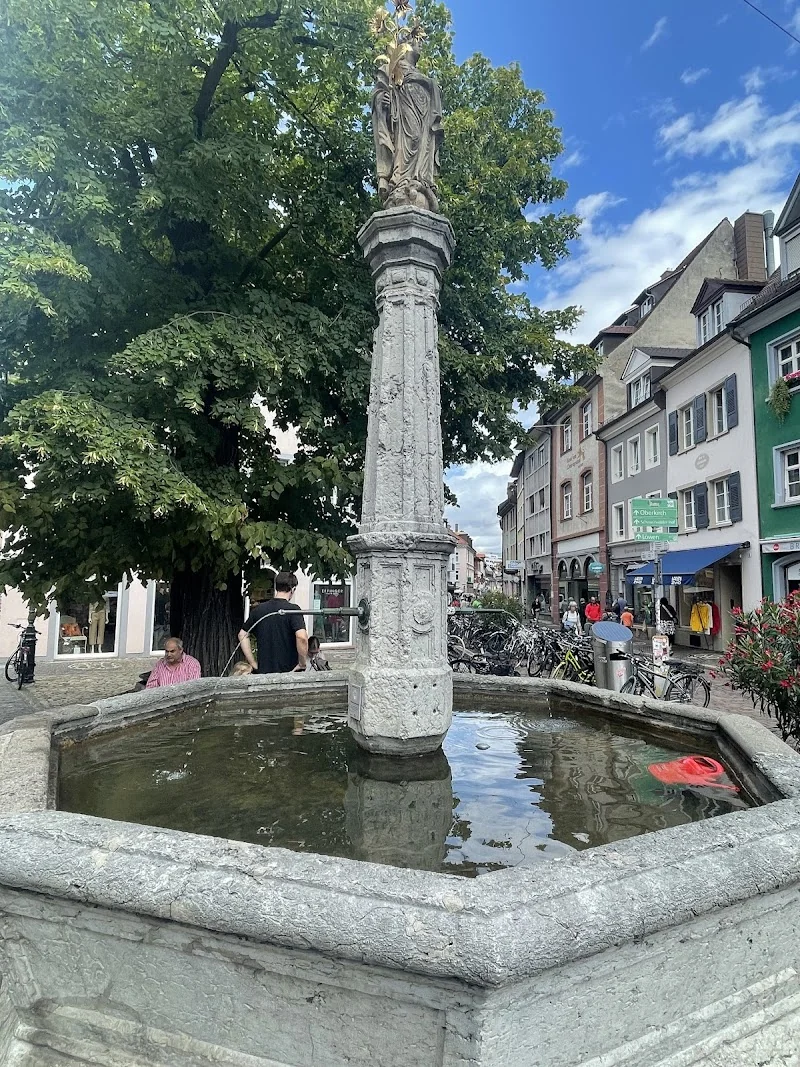
The appearance of the Oberlinden Fountain is characterized very precisely in the official city description: Under the upper linden tree stands a fountain made of shell limestone with a gilded Madonna. This combination makes it easily recognizable. Shell limestone gives the fountain the bright, calm appearance of a classic Freiburg stone element, while the gilded Madonna sets a clear accent in the image. The fountain thus does not appear monumental in the sense of a large representative building but rather fine and urbanly embedded. This fits with Oberlinden as a small-scale, historically grown space. The surroundings also support this impression: The city map mentions the steep tiled roofs, the colorfully painted facades, and the view of the cathedral tower and the Schwabentor. This creates a typical Freiburg motif in which building form, water object, and Old Town backdrop intertwine. Especially in photos or short city descriptions, the fountain is therefore so interesting because it is immediately readable as a Freiburg motif without being intrusive. For visitors, this is important because many seek not only facts at a sight but a strong visual identity. The Oberlinden Fountain offers exactly that: clear materiality, religious-historical imagery, and embedding in a very characteristic cityscape. ([freiburg.de](https://www.freiburg.de/pb/site/Freiburg/get/documents/freiburg/daten/bauen/stadtplanung/04%20Ober-%20und%20Unterlinden.pdf))
The spatial effect of the fountain becomes even stronger when viewed together with the surroundings. The city map describes Oberlinden as an undestroyed part of the upper town that has preserved its original character. The houses are small, the facades colorful, and the roof landscape steep and compact. In this backdrop, the fountain forms a calm focal point where gaze and orientation can converge. The fountain is thus not only an object to be photographed but also an element that structures the atmosphere of the square. From an urban design perspective, this is significant: In historical old towns, it is often fountains, linden trees, facades, and sight axes that shape the character of a place. In the case of the Oberlinden Fountain, it is additionally noteworthy that the gilded Madonna forms a clearly recognizable center. This gives the fountain a strong iconic quality that distinguishes it from many other water points. A search term like Madonna Fountain Freiburg or Shell Limestone Fountain thus leads directly to an image that clearly stands out from any ordinary city fountain. Those who visit Oberlinden experience a place that does not need to be large or loud to make an impression. It is precisely the combination of small form and long history that makes the charm of this place. In a city like Freiburg, which is very strongly perceived through its Old Town images, the Oberlinden Fountain is therefore one of the motifs that one does not just glance at but enjoys looking at longer. ([freiburg.de](https://www.freiburg.de/pb/site/Freiburg/get/documents/freiburg/daten/bauen/stadtplanung/04%20Ober-%20und%20Unterlinden.pdf))
Drinking Water, Streams, and Everyday Life in Public Space
The Oberlinden Fountain is not only a historical gem but also a public drinking water fountain. The youth city planning page of the city of Freiburg generally explains that fresh drinking water flows continuously from many Freiburg fountains and that there are also several drinking water steles in the city area. For the Oberlinden Fountain, this means: It is part of an urban infrastructure that supports quality of life and value of stay in public space. The Freiburg tourism page describes similar drinking water fountains as a contribution to sustainable infrastructure, to the reduction of single-use plastic, and to the provision of free tap water. At the same time, it points out that the water quality is regularly monitored and that the fountains are turned off or dismantled in the cold season for frost protection reasons. This combination of traditional urban element and modern public service is very typical for Freiburg. The Oberlinden Fountain thus does not appear museum-like but is integrated into today's everyday life. Those walking in the Old Town find here not only a beautiful photo motif but also a very practical place to pause briefly, drink, and continue on. For an SEO page, terms like drinking water fountain Freiburg, Oberlinden Fountain, and Old Town are therefore closely interconnected. Because they do not describe three different places but three perspectives on the same place: historical, functional, and urban. ([freiburgxtra.de](https://www.freiburgxtra.de/akteure/trinkwasser-oberlindenbrunnen/))
The water tradition of Freiburg itself also helps to better contextualize the Oberlinden Fountain. The official tourism page for the Freiburg Bächle explains that the clear watercourses of the Dreisam flow through the streets of the Old Town and were already established in the 12th century to supply people with drinking, utility, and firefighting water. This long water tradition is still a defining part of Freiburg's cityscape today. Although the Oberlinden Fountain is not located at one of the major iconic Bächle stations like a monument in itself, it belongs to the same culture of water in public space. This makes it very connectable: It is part of a cityscape where water is not hidden but visible and practical for everyday use. Especially on warm days, this has a special effect because fountains and Bächle then become not only historically interesting but physically tangible. Freiburg conveys a very own city impression at such places: cool, open, small-scale, and yet lively. Therefore, those who visit the Oberlinden Fountain experience not only a monument but also a piece of lived urban culture. This explains why the place remains attractive for both locals and guests alike. It connects short paths, drinking water, Old Town ambiance, and historical identity in a compact space. ([visit.freiburg.de](https://visit.freiburg.de/attraktionen/freiburger-baechle?utm_source=openai))
Oberlindenhock and Walk through the Old Town
The Oberlinden Fountain is also a place of urban life and not just a quiet monument. The official tourism page names it as a central point of the traditional Oberlindenhock, a recurring street festival in the upper Freiburg Old Town. In the current announcement for 2026, the tapping of the keg is explicitly located in front of the Oberlinden Fountain, and the promenade leads from the Schwabentor side through Oberlinden past the fountain to the upper Herrenstraße. This beautifully illustrates how strongly the place is anchored in local experience. Even if the fountain appears historical, it is not cut off from today's urban life. On the contrary: It becomes an anchor point for a festival that bundles music, food, and togetherness in the neighborhood. For visitors, this is particularly interesting because such events often make visible those places that might be overlooked in everyday life. The Oberlinden Fountain gains an additional social dimension through the Hock. It marks not only a historical square but also a meeting point where the city celebrates itself. Additionally, traffic in the area of the festival is adjusted temporarily; this also underscores the central role of the place in public space. Therefore, those searching for Oberlindenhock or Oberlinden Fountain Freiburg are usually looking for a lively, well-visible section of the Old Town where tradition and present merge. ([visit.freiburg.de](https://visit.freiburg.de/oberlindenhock?utm_source=openai))
For a walk, the Oberlinden Fountain is an excellent starting or stopping point. From here, the walk through the upper Old Town can continue with just a few steps, for example, towards Schwabentor, along the small shops and through the historically dense paths of the district. The official city map and the tourist pocket map make it clear that Freiburg has particularly many historical reference points in this area: the Schwabentor, the upper town, the small alleys, and the grown Old Town structure. The Oberlinden Fountain fits into this network as a calm, easily findable anchor. For photography, city tours, or a short cultural stop, this is ideal because one does not have to search or plan for long. Those interested in the city's history can view Oberlinden with knowledge of the oldest plans and the forks in the road; those seeking the charm of the Old Town find colorful facades, small shops, and views of the significant landmarks. Even for short stays, the place is attractive because it is accessible without admission, without complicated paths, and without special hurdles. Such places make an Old Town lively: they are visible, functional, and historical at the same time. The Oberlinden Fountain is therefore more than just a fountain. It is a precise excerpt of what Freiburg essentially represents: water, history, walkability, and a dense but friendly cityscape. ([freiburg.de](https://www.freiburg.de/pb/site/Freiburg/get/documents/freiburg/daten/bauen/stadtplanung/04%20Ober-%20und%20Unterlinden.pdf))
Sources:
Show moreShow less
Oberlinden Fountain | History & Old Town Freiburg
The Oberlinden Fountain is one of those places in Freiburg that seems quiet at first glance and therefore remains long in memory. It is located at the corner of Oberlinden and Herrenstraße in the Old Town, right in the middle of an area that is one of the oldest parts of the city and has preserved its distinctive image to this day. The official city map describes Oberlinden as the center of the upper town, with small parcels, steep tiled roofs, colorful facades, and many small shops. At the same time, the fountain is listed as a drinking water fountain, making it not only a historical urban element but also a functional place in the public space. Those who stand here experience both at once: history and present, cityscape and everyday life, monument and use. The proximity to the Schwabentor, the view of the Old Town silhouette, and the integration into the historical network of paths make the square particularly vivid. This combination of architecture, water tradition, and location is why the Oberlinden Fountain is as interesting for visitors as it is for people discovering the city on foot. ([freiburg.de](https://www.freiburg.de/pb/site/Freiburg/get/documents/freiburg/daten/bauen/stadtplanung/04%20Ober-%20und%20Unterlinden.pdf))
Location and Orientation at the Oberlinden Fountain
Those looking for the Oberlinden Fountain will not find it at a remote edge but right in the historical heart of Freiburg. The official address of the city's youth page explicitly mentions the corner of Oberlinden and Herrenstraße. This is an important hint because the fountain is located in an area that is excellent for exploring on foot and is directly embedded in the narrow network of Freiburg's Old Town. The city map of Freiburg describes Oberlinden as the center of the upper town, meaning the oldest part of the city. There, small plots, steep roofs, and colorful facades shape the image, along with numerous small shops that give the district a lively but not hectic atmosphere to this day. For orientation, it is also helpful that both the tower of the cathedral and the Schwabentor are within sight. This is exactly what gives the place its special charm: one stands at a fountain that does not appear isolated but rather as a junction in a historically grown backdrop. For those who want to find their way around Freiburg for the first time, the fountain can almost be used as a reference point for a walk through the upper Old Town. From here, the city unfolds not along large axes but through short paths, sightlines, small squares, and the dense succession of historical facades. This makes the place particularly pleasant for visitors because it can easily be connected with other sights. ([freiburgxtra.de](https://www.freiburgxtra.de/akteure/trinkwasser-oberlindenbrunnen/))
The surroundings of the fountain tell much about the Freiburg image that many guests seek: narrow, historical, walkable, and at the same time open to everyday life. The official city map points out that Oberlinden emerged from historical forks in the road and appears in the oldest plans. Thus, the place is described not only as a pretty square but as a grown urban remnant from a very early phase of urban development. Especially because Oberlinden was not destroyed in the war, a comparatively unadulterated flair has been preserved here. For the visitor, this means: The fountain stands in an urban space that has not lost its historical structure. The sightlines are also characteristic. The silhouette of the cathedral tower looms in the background, while the Schwabentor is present as one of the most distinctive city gates nearby. This spatial density is typical of Freiburg's Old Town: In just a few steps, one transitions between small-scale buildings, small shops, watercourses, and significant monuments. For an SEO page, this is an important point because search queries like Oberlinden Fountain Freiburg, Old Town Freiburg, or Schwabentor often express the same intention to visit: one seeks a well-accessible, characterful place that can be easily integrated into a city walk. The Oberlinden Fountain meets this expectation very precisely. ([freiburg.de](https://www.freiburg.de/pb/site/Freiburg/get/documents/freiburg/daten/bauen/stadtplanung/04%20Ober-%20und%20Unterlinden.pdf))
History of the Oberlinden Fountain and the Square
The history of the Oberlinden Fountain dates back a long way. In a local account of Freiburg's city history, the fountain is mentioned for the first time in 1535. Thus, it belongs to the older fountain installations of the city, even though its current appearance is of course shaped by later interventions and restorations. The square Oberlinden itself is thought to be even older: The official city map emphasizes that the upper and lower linden trees are already recorded in the oldest plans and emerged from historical forks in the road. Therefore, Oberlinden was not simply a decorative urban space but a grown intersection in medieval traffic and everyday life. This early origin explains why the square is still perceived as particularly authentic today. In such an environment, the fountain is not read as a random individual object but as part of a multifaceted local history. The function of the district is also historically interesting: The city map describes Oberlinden as the center of the upper town, meaning the oldest part of Freiburg, while another contribution classifies the area around the square as a former craftsmen's quarter. This makes it understandable why so much city history remains visible side by side in this place. For visitors, this is exciting because here one not only observes a monument but a small urban excerpt where medieval orientation, later urban development, and current use overlap. ([stadt-land-erleben.de](https://stadt-land-erleben.de/freiburg/s6.htm))
An article from a Freiburg official gazette in 2012 placed the fountain in a broader historical context and spoke of an anniversary: The fountain at Oberlinden celebrated 150 years according to the city newspaper. In the same context, it was highlighted that it had almost escaped wars and unrest unscathed and that its solid construction had contributed to preserving its substance. Particularly interesting is the remark about the shape of the fountain: The basin is made from a single piece and crafted from a light, crack-free stone from the Solothurn area. These details make it clear that the Oberlinden Fountain holds a special position not only because of its age but also due to its craftsmanship quality. From an SEO perspective, this is important because searchers using terms like history Oberlinden Fountain, old fountain Freiburg, or Oberlinden Old Town usually expect exactly this connection of age, material, and urban memory. The fountain thus stands not only for a beautiful corner in Freiburg but for a durable, robust, and historically shaped urban form. That it continues to be prominently present in the district today shows how strongly Freiburg has integrated its historical places into the modern urban space. The Oberlinden Fountain is therefore a good example of how monument substance and everyday use can come together in Freiburg. ([freiburg.de](https://www.freiburg.de/pb/site/Freiburg/get/documents_E368429779/freiburg/daten/news/amtsblatt/pdf/Amtsblatt%20Ausgabe%20590.pdf))
Shell Limestone, Madonna, and Cityscape
The appearance of the Oberlinden Fountain is characterized very precisely in the official city description: Under the upper linden tree stands a fountain made of shell limestone with a gilded Madonna. This combination makes it easily recognizable. Shell limestone gives the fountain the bright, calm appearance of a classic Freiburg stone element, while the gilded Madonna sets a clear accent in the image. The fountain thus does not appear monumental in the sense of a large representative building but rather fine and urbanly embedded. This fits with Oberlinden as a small-scale, historically grown space. The surroundings also support this impression: The city map mentions the steep tiled roofs, the colorfully painted facades, and the view of the cathedral tower and the Schwabentor. This creates a typical Freiburg motif in which building form, water object, and Old Town backdrop intertwine. Especially in photos or short city descriptions, the fountain is therefore so interesting because it is immediately readable as a Freiburg motif without being intrusive. For visitors, this is important because many seek not only facts at a sight but a strong visual identity. The Oberlinden Fountain offers exactly that: clear materiality, religious-historical imagery, and embedding in a very characteristic cityscape. ([freiburg.de](https://www.freiburg.de/pb/site/Freiburg/get/documents/freiburg/daten/bauen/stadtplanung/04%20Ober-%20und%20Unterlinden.pdf))
The spatial effect of the fountain becomes even stronger when viewed together with the surroundings. The city map describes Oberlinden as an undestroyed part of the upper town that has preserved its original character. The houses are small, the facades colorful, and the roof landscape steep and compact. In this backdrop, the fountain forms a calm focal point where gaze and orientation can converge. The fountain is thus not only an object to be photographed but also an element that structures the atmosphere of the square. From an urban design perspective, this is significant: In historical old towns, it is often fountains, linden trees, facades, and sight axes that shape the character of a place. In the case of the Oberlinden Fountain, it is additionally noteworthy that the gilded Madonna forms a clearly recognizable center. This gives the fountain a strong iconic quality that distinguishes it from many other water points. A search term like Madonna Fountain Freiburg or Shell Limestone Fountain thus leads directly to an image that clearly stands out from any ordinary city fountain. Those who visit Oberlinden experience a place that does not need to be large or loud to make an impression. It is precisely the combination of small form and long history that makes the charm of this place. In a city like Freiburg, which is very strongly perceived through its Old Town images, the Oberlinden Fountain is therefore one of the motifs that one does not just glance at but enjoys looking at longer. ([freiburg.de](https://www.freiburg.de/pb/site/Freiburg/get/documents/freiburg/daten/bauen/stadtplanung/04%20Ober-%20und%20Unterlinden.pdf))
Drinking Water, Streams, and Everyday Life in Public Space
The Oberlinden Fountain is not only a historical gem but also a public drinking water fountain. The youth city planning page of the city of Freiburg generally explains that fresh drinking water flows continuously from many Freiburg fountains and that there are also several drinking water steles in the city area. For the Oberlinden Fountain, this means: It is part of an urban infrastructure that supports quality of life and value of stay in public space. The Freiburg tourism page describes similar drinking water fountains as a contribution to sustainable infrastructure, to the reduction of single-use plastic, and to the provision of free tap water. At the same time, it points out that the water quality is regularly monitored and that the fountains are turned off or dismantled in the cold season for frost protection reasons. This combination of traditional urban element and modern public service is very typical for Freiburg. The Oberlinden Fountain thus does not appear museum-like but is integrated into today's everyday life. Those walking in the Old Town find here not only a beautiful photo motif but also a very practical place to pause briefly, drink, and continue on. For an SEO page, terms like drinking water fountain Freiburg, Oberlinden Fountain, and Old Town are therefore closely interconnected. Because they do not describe three different places but three perspectives on the same place: historical, functional, and urban. ([freiburgxtra.de](https://www.freiburgxtra.de/akteure/trinkwasser-oberlindenbrunnen/))
The water tradition of Freiburg itself also helps to better contextualize the Oberlinden Fountain. The official tourism page for the Freiburg Bächle explains that the clear watercourses of the Dreisam flow through the streets of the Old Town and were already established in the 12th century to supply people with drinking, utility, and firefighting water. This long water tradition is still a defining part of Freiburg's cityscape today. Although the Oberlinden Fountain is not located at one of the major iconic Bächle stations like a monument in itself, it belongs to the same culture of water in public space. This makes it very connectable: It is part of a cityscape where water is not hidden but visible and practical for everyday use. Especially on warm days, this has a special effect because fountains and Bächle then become not only historically interesting but physically tangible. Freiburg conveys a very own city impression at such places: cool, open, small-scale, and yet lively. Therefore, those who visit the Oberlinden Fountain experience not only a monument but also a piece of lived urban culture. This explains why the place remains attractive for both locals and guests alike. It connects short paths, drinking water, Old Town ambiance, and historical identity in a compact space. ([visit.freiburg.de](https://visit.freiburg.de/attraktionen/freiburger-baechle?utm_source=openai))
Oberlindenhock and Walk through the Old Town
The Oberlinden Fountain is also a place of urban life and not just a quiet monument. The official tourism page names it as a central point of the traditional Oberlindenhock, a recurring street festival in the upper Freiburg Old Town. In the current announcement for 2026, the tapping of the keg is explicitly located in front of the Oberlinden Fountain, and the promenade leads from the Schwabentor side through Oberlinden past the fountain to the upper Herrenstraße. This beautifully illustrates how strongly the place is anchored in local experience. Even if the fountain appears historical, it is not cut off from today's urban life. On the contrary: It becomes an anchor point for a festival that bundles music, food, and togetherness in the neighborhood. For visitors, this is particularly interesting because such events often make visible those places that might be overlooked in everyday life. The Oberlinden Fountain gains an additional social dimension through the Hock. It marks not only a historical square but also a meeting point where the city celebrates itself. Additionally, traffic in the area of the festival is adjusted temporarily; this also underscores the central role of the place in public space. Therefore, those searching for Oberlindenhock or Oberlinden Fountain Freiburg are usually looking for a lively, well-visible section of the Old Town where tradition and present merge. ([visit.freiburg.de](https://visit.freiburg.de/oberlindenhock?utm_source=openai))
For a walk, the Oberlinden Fountain is an excellent starting or stopping point. From here, the walk through the upper Old Town can continue with just a few steps, for example, towards Schwabentor, along the small shops and through the historically dense paths of the district. The official city map and the tourist pocket map make it clear that Freiburg has particularly many historical reference points in this area: the Schwabentor, the upper town, the small alleys, and the grown Old Town structure. The Oberlinden Fountain fits into this network as a calm, easily findable anchor. For photography, city tours, or a short cultural stop, this is ideal because one does not have to search or plan for long. Those interested in the city's history can view Oberlinden with knowledge of the oldest plans and the forks in the road; those seeking the charm of the Old Town find colorful facades, small shops, and views of the significant landmarks. Even for short stays, the place is attractive because it is accessible without admission, without complicated paths, and without special hurdles. Such places make an Old Town lively: they are visible, functional, and historical at the same time. The Oberlinden Fountain is therefore more than just a fountain. It is a precise excerpt of what Freiburg essentially represents: water, history, walkability, and a dense but friendly cityscape. ([freiburg.de](https://www.freiburg.de/pb/site/Freiburg/get/documents/freiburg/daten/bauen/stadtplanung/04%20Ober-%20und%20Unterlinden.pdf))
Sources:
Oberlinden Fountain | History & Old Town Freiburg
The Oberlinden Fountain is one of those places in Freiburg that seems quiet at first glance and therefore remains long in memory. It is located at the corner of Oberlinden and Herrenstraße in the Old Town, right in the middle of an area that is one of the oldest parts of the city and has preserved its distinctive image to this day. The official city map describes Oberlinden as the center of the upper town, with small parcels, steep tiled roofs, colorful facades, and many small shops. At the same time, the fountain is listed as a drinking water fountain, making it not only a historical urban element but also a functional place in the public space. Those who stand here experience both at once: history and present, cityscape and everyday life, monument and use. The proximity to the Schwabentor, the view of the Old Town silhouette, and the integration into the historical network of paths make the square particularly vivid. This combination of architecture, water tradition, and location is why the Oberlinden Fountain is as interesting for visitors as it is for people discovering the city on foot. ([freiburg.de](https://www.freiburg.de/pb/site/Freiburg/get/documents/freiburg/daten/bauen/stadtplanung/04%20Ober-%20und%20Unterlinden.pdf))
Location and Orientation at the Oberlinden Fountain
Those looking for the Oberlinden Fountain will not find it at a remote edge but right in the historical heart of Freiburg. The official address of the city's youth page explicitly mentions the corner of Oberlinden and Herrenstraße. This is an important hint because the fountain is located in an area that is excellent for exploring on foot and is directly embedded in the narrow network of Freiburg's Old Town. The city map of Freiburg describes Oberlinden as the center of the upper town, meaning the oldest part of the city. There, small plots, steep roofs, and colorful facades shape the image, along with numerous small shops that give the district a lively but not hectic atmosphere to this day. For orientation, it is also helpful that both the tower of the cathedral and the Schwabentor are within sight. This is exactly what gives the place its special charm: one stands at a fountain that does not appear isolated but rather as a junction in a historically grown backdrop. For those who want to find their way around Freiburg for the first time, the fountain can almost be used as a reference point for a walk through the upper Old Town. From here, the city unfolds not along large axes but through short paths, sightlines, small squares, and the dense succession of historical facades. This makes the place particularly pleasant for visitors because it can easily be connected with other sights. ([freiburgxtra.de](https://www.freiburgxtra.de/akteure/trinkwasser-oberlindenbrunnen/))
The surroundings of the fountain tell much about the Freiburg image that many guests seek: narrow, historical, walkable, and at the same time open to everyday life. The official city map points out that Oberlinden emerged from historical forks in the road and appears in the oldest plans. Thus, the place is described not only as a pretty square but as a grown urban remnant from a very early phase of urban development. Especially because Oberlinden was not destroyed in the war, a comparatively unadulterated flair has been preserved here. For the visitor, this means: The fountain stands in an urban space that has not lost its historical structure. The sightlines are also characteristic. The silhouette of the cathedral tower looms in the background, while the Schwabentor is present as one of the most distinctive city gates nearby. This spatial density is typical of Freiburg's Old Town: In just a few steps, one transitions between small-scale buildings, small shops, watercourses, and significant monuments. For an SEO page, this is an important point because search queries like Oberlinden Fountain Freiburg, Old Town Freiburg, or Schwabentor often express the same intention to visit: one seeks a well-accessible, characterful place that can be easily integrated into a city walk. The Oberlinden Fountain meets this expectation very precisely. ([freiburg.de](https://www.freiburg.de/pb/site/Freiburg/get/documents/freiburg/daten/bauen/stadtplanung/04%20Ober-%20und%20Unterlinden.pdf))
History of the Oberlinden Fountain and the Square
The history of the Oberlinden Fountain dates back a long way. In a local account of Freiburg's city history, the fountain is mentioned for the first time in 1535. Thus, it belongs to the older fountain installations of the city, even though its current appearance is of course shaped by later interventions and restorations. The square Oberlinden itself is thought to be even older: The official city map emphasizes that the upper and lower linden trees are already recorded in the oldest plans and emerged from historical forks in the road. Therefore, Oberlinden was not simply a decorative urban space but a grown intersection in medieval traffic and everyday life. This early origin explains why the square is still perceived as particularly authentic today. In such an environment, the fountain is not read as a random individual object but as part of a multifaceted local history. The function of the district is also historically interesting: The city map describes Oberlinden as the center of the upper town, meaning the oldest part of Freiburg, while another contribution classifies the area around the square as a former craftsmen's quarter. This makes it understandable why so much city history remains visible side by side in this place. For visitors, this is exciting because here one not only observes a monument but a small urban excerpt where medieval orientation, later urban development, and current use overlap. ([stadt-land-erleben.de](https://stadt-land-erleben.de/freiburg/s6.htm))
An article from a Freiburg official gazette in 2012 placed the fountain in a broader historical context and spoke of an anniversary: The fountain at Oberlinden celebrated 150 years according to the city newspaper. In the same context, it was highlighted that it had almost escaped wars and unrest unscathed and that its solid construction had contributed to preserving its substance. Particularly interesting is the remark about the shape of the fountain: The basin is made from a single piece and crafted from a light, crack-free stone from the Solothurn area. These details make it clear that the Oberlinden Fountain holds a special position not only because of its age but also due to its craftsmanship quality. From an SEO perspective, this is important because searchers using terms like history Oberlinden Fountain, old fountain Freiburg, or Oberlinden Old Town usually expect exactly this connection of age, material, and urban memory. The fountain thus stands not only for a beautiful corner in Freiburg but for a durable, robust, and historically shaped urban form. That it continues to be prominently present in the district today shows how strongly Freiburg has integrated its historical places into the modern urban space. The Oberlinden Fountain is therefore a good example of how monument substance and everyday use can come together in Freiburg. ([freiburg.de](https://www.freiburg.de/pb/site/Freiburg/get/documents_E368429779/freiburg/daten/news/amtsblatt/pdf/Amtsblatt%20Ausgabe%20590.pdf))
Shell Limestone, Madonna, and Cityscape
The appearance of the Oberlinden Fountain is characterized very precisely in the official city description: Under the upper linden tree stands a fountain made of shell limestone with a gilded Madonna. This combination makes it easily recognizable. Shell limestone gives the fountain the bright, calm appearance of a classic Freiburg stone element, while the gilded Madonna sets a clear accent in the image. The fountain thus does not appear monumental in the sense of a large representative building but rather fine and urbanly embedded. This fits with Oberlinden as a small-scale, historically grown space. The surroundings also support this impression: The city map mentions the steep tiled roofs, the colorfully painted facades, and the view of the cathedral tower and the Schwabentor. This creates a typical Freiburg motif in which building form, water object, and Old Town backdrop intertwine. Especially in photos or short city descriptions, the fountain is therefore so interesting because it is immediately readable as a Freiburg motif without being intrusive. For visitors, this is important because many seek not only facts at a sight but a strong visual identity. The Oberlinden Fountain offers exactly that: clear materiality, religious-historical imagery, and embedding in a very characteristic cityscape. ([freiburg.de](https://www.freiburg.de/pb/site/Freiburg/get/documents/freiburg/daten/bauen/stadtplanung/04%20Ober-%20und%20Unterlinden.pdf))
The spatial effect of the fountain becomes even stronger when viewed together with the surroundings. The city map describes Oberlinden as an undestroyed part of the upper town that has preserved its original character. The houses are small, the facades colorful, and the roof landscape steep and compact. In this backdrop, the fountain forms a calm focal point where gaze and orientation can converge. The fountain is thus not only an object to be photographed but also an element that structures the atmosphere of the square. From an urban design perspective, this is significant: In historical old towns, it is often fountains, linden trees, facades, and sight axes that shape the character of a place. In the case of the Oberlinden Fountain, it is additionally noteworthy that the gilded Madonna forms a clearly recognizable center. This gives the fountain a strong iconic quality that distinguishes it from many other water points. A search term like Madonna Fountain Freiburg or Shell Limestone Fountain thus leads directly to an image that clearly stands out from any ordinary city fountain. Those who visit Oberlinden experience a place that does not need to be large or loud to make an impression. It is precisely the combination of small form and long history that makes the charm of this place. In a city like Freiburg, which is very strongly perceived through its Old Town images, the Oberlinden Fountain is therefore one of the motifs that one does not just glance at but enjoys looking at longer. ([freiburg.de](https://www.freiburg.de/pb/site/Freiburg/get/documents/freiburg/daten/bauen/stadtplanung/04%20Ober-%20und%20Unterlinden.pdf))
Drinking Water, Streams, and Everyday Life in Public Space
The Oberlinden Fountain is not only a historical gem but also a public drinking water fountain. The youth city planning page of the city of Freiburg generally explains that fresh drinking water flows continuously from many Freiburg fountains and that there are also several drinking water steles in the city area. For the Oberlinden Fountain, this means: It is part of an urban infrastructure that supports quality of life and value of stay in public space. The Freiburg tourism page describes similar drinking water fountains as a contribution to sustainable infrastructure, to the reduction of single-use plastic, and to the provision of free tap water. At the same time, it points out that the water quality is regularly monitored and that the fountains are turned off or dismantled in the cold season for frost protection reasons. This combination of traditional urban element and modern public service is very typical for Freiburg. The Oberlinden Fountain thus does not appear museum-like but is integrated into today's everyday life. Those walking in the Old Town find here not only a beautiful photo motif but also a very practical place to pause briefly, drink, and continue on. For an SEO page, terms like drinking water fountain Freiburg, Oberlinden Fountain, and Old Town are therefore closely interconnected. Because they do not describe three different places but three perspectives on the same place: historical, functional, and urban. ([freiburgxtra.de](https://www.freiburgxtra.de/akteure/trinkwasser-oberlindenbrunnen/))
The water tradition of Freiburg itself also helps to better contextualize the Oberlinden Fountain. The official tourism page for the Freiburg Bächle explains that the clear watercourses of the Dreisam flow through the streets of the Old Town and were already established in the 12th century to supply people with drinking, utility, and firefighting water. This long water tradition is still a defining part of Freiburg's cityscape today. Although the Oberlinden Fountain is not located at one of the major iconic Bächle stations like a monument in itself, it belongs to the same culture of water in public space. This makes it very connectable: It is part of a cityscape where water is not hidden but visible and practical for everyday use. Especially on warm days, this has a special effect because fountains and Bächle then become not only historically interesting but physically tangible. Freiburg conveys a very own city impression at such places: cool, open, small-scale, and yet lively. Therefore, those who visit the Oberlinden Fountain experience not only a monument but also a piece of lived urban culture. This explains why the place remains attractive for both locals and guests alike. It connects short paths, drinking water, Old Town ambiance, and historical identity in a compact space. ([visit.freiburg.de](https://visit.freiburg.de/attraktionen/freiburger-baechle?utm_source=openai))
Oberlindenhock and Walk through the Old Town
The Oberlinden Fountain is also a place of urban life and not just a quiet monument. The official tourism page names it as a central point of the traditional Oberlindenhock, a recurring street festival in the upper Freiburg Old Town. In the current announcement for 2026, the tapping of the keg is explicitly located in front of the Oberlinden Fountain, and the promenade leads from the Schwabentor side through Oberlinden past the fountain to the upper Herrenstraße. This beautifully illustrates how strongly the place is anchored in local experience. Even if the fountain appears historical, it is not cut off from today's urban life. On the contrary: It becomes an anchor point for a festival that bundles music, food, and togetherness in the neighborhood. For visitors, this is particularly interesting because such events often make visible those places that might be overlooked in everyday life. The Oberlinden Fountain gains an additional social dimension through the Hock. It marks not only a historical square but also a meeting point where the city celebrates itself. Additionally, traffic in the area of the festival is adjusted temporarily; this also underscores the central role of the place in public space. Therefore, those searching for Oberlindenhock or Oberlinden Fountain Freiburg are usually looking for a lively, well-visible section of the Old Town where tradition and present merge. ([visit.freiburg.de](https://visit.freiburg.de/oberlindenhock?utm_source=openai))
For a walk, the Oberlinden Fountain is an excellent starting or stopping point. From here, the walk through the upper Old Town can continue with just a few steps, for example, towards Schwabentor, along the small shops and through the historically dense paths of the district. The official city map and the tourist pocket map make it clear that Freiburg has particularly many historical reference points in this area: the Schwabentor, the upper town, the small alleys, and the grown Old Town structure. The Oberlinden Fountain fits into this network as a calm, easily findable anchor. For photography, city tours, or a short cultural stop, this is ideal because one does not have to search or plan for long. Those interested in the city's history can view Oberlinden with knowledge of the oldest plans and the forks in the road; those seeking the charm of the Old Town find colorful facades, small shops, and views of the significant landmarks. Even for short stays, the place is attractive because it is accessible without admission, without complicated paths, and without special hurdles. Such places make an Old Town lively: they are visible, functional, and historical at the same time. The Oberlinden Fountain is therefore more than just a fountain. It is a precise excerpt of what Freiburg essentially represents: water, history, walkability, and a dense but friendly cityscape. ([freiburg.de](https://www.freiburg.de/pb/site/Freiburg/get/documents/freiburg/daten/bauen/stadtplanung/04%20Ober-%20und%20Unterlinden.pdf))
Sources:
Frequently Asked Questions
Reviews
Paul Ciprian
22. December 2024
Just a small, common fountain...
Mihai Dan
23. August 2024
So cool.
Stefan Folz
7. January 2026
Beautiful fountain in a wonderful setting, especially during the Christmas season.
Oliverio Guillen Hernández
5. September 2025
It's very pleasant to sit on the benches next to this fountain and see the city gate as well as the buildings, and the fountain has fresh, drinkable water.
Marco Rubertelli
25. November 2024
A fountain in the old town of Freiburg im Breisgau I saw this fountain with my girlfriend during a day trip to Freiburg im Breisgau. It's located in the old town, just past the Schwabentor gate. The octagonal stone base serves as a basin for water that flows constantly from two valveless taps installed on the central column. From the central column rises a pedestal for a religious stone sculpture holding two beautiful golden flowers. Many people stop here to refill their water bottles.