
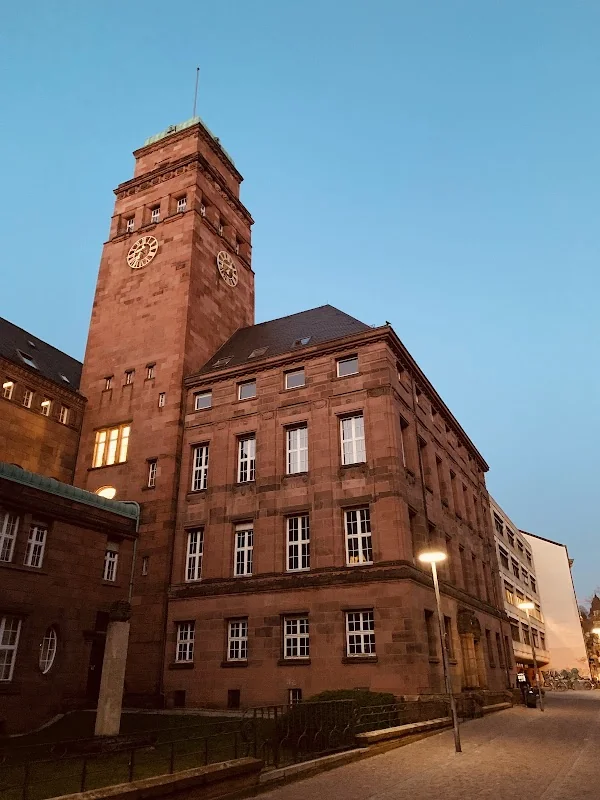
Freiburg im Breisgau
Universität Freiburg, Platz d. Universität 3, 79098 Freiburg im Breisgau, Deutschland
KG III | Lecture Halls & Access
KG III, the lecture building III of the University of Freiburg, is one of those places that can often be found in search engines only with a brief query, but in reality, it is experienced as a hub of the entire university center. The building is located at Platz der Universität 3 in 79098 Freiburg im Breisgau and, together with KG I, KG II, and KG IV, is one of the central buildings of the campus. It is not a classic event venue in the sense of a concert hall, but a university working building with lecture halls, institute rooms, a post office, service points, and pathways for students, faculty, and guests. The university describes KG III as a brutalist building constructed in 1969; this mixture of raw concrete, central location, and academic everyday life shapes the character of the house. ([uni-freiburg.de](https://uni-freiburg.de/lageplaene/kollegiengebaeude-iii/))
For this reason, KG III is searched for so frequently: some users simply want to know the address, others are looking for photos, a specific lecture hall, or the quickest connection from the main train station. Others are interested in the post office, opening hours, parking, or which institutes are located in the building. All of this can be traced on the official university pages: KG III is a building with multiple entrances, with elevators in the west foyer, with clearly documented lecture hall capacities, and with opening hours from Monday to Friday. So, those searching for KG III Freiburg, KG III Uni Freiburg, or Kollegiengebäude III are usually looking for very practical information related to student life in the city center. ([uni-freiburg.de](https://uni-freiburg.de/lageplaene/kollegiengebaeude-iii/))
Why KG III in Freiburg is Searched So Often
The most important classification first: KG III is not a separate event complex, but a central part of the university center of the University of Freiburg. On the university's campus tour, the lecture buildings I, II, III, and IV are explicitly referred to as the central buildings in the university center. This location is a significant part of its search interest, as KG III is located in the middle of the inner-city university area, where many paths intersect and numerous departments, libraries, and lecture halls are concentrated. Those looking for a course, an institute, a room, or a mailing address often end up at this type of building rather than at a single subject institute. In university communication, it is also evident that KG III is visually and functionally understood as part of a coherent campus shaped by the old town environment, the university square, and the neighboring lecture buildings. ([osa.uni-freiburg.de](https://www.osa.uni-freiburg.de/campustour/universitaetszentrum/))
The architecture also contributes to the strong recognizability. The University of Freiburg assigns KG III to brutalism and points out that the building was constructed in 1969. This explains why search queries for photos, architecture, and history appear as frequently as queries for directions or room numbers. Unlike historically decorated university buildings, KG III appears deliberately factual, clear, and massive. This tension between raw concrete, glass surfaces of the reading rooms, and the vibrant university operation makes the building interesting. The official campus tour shows various exterior and interior views, including a view from the north, the view of the reading rooms, and the glass facade of the reading rooms, which summarizes the visual character of the building well. For visitors, KG III is therefore both a point of orientation, a workplace, and a photographic motif. ([osa.uni-freiburg.de](https://www.osa.uni-freiburg.de/campustour/universitaetszentrum/))
For content planning, this means: the most common search intentions revolve around identification, accessibility, and usage. Users want to know if they are in the right building, how to get there, which door to take, where they can park, and on which floor an institute is located. At this point, the official university data is particularly helpful because it not only provides the address but also documents specific entrances, elevators, rooms, and opening hours. This is valuable for SEO because it precisely covers the information needs and does not just provide a general description. ([uni-freiburg.de](https://uni-freiburg.de/lageplaene/kollegiengebaeude-iii/))
Lecture Halls, Rooms, and Key Capacity Information
A central theme at KG III is the lecture halls. The University of Freiburg lists several rooms with exact capacity details on the site plan page. These include HS 3042 with 113 seats, HS 3043 with 88 seats, HS 3044 with 251 seats, HS 3117 with 68 seats, HS 3118 with 129 seats, and HS 3219 with 206 seats. Thus, KG III is not only an institute building but also a place for larger lectures, seminars, exams, and university events. The variety of rooms shows that the building can accommodate both smaller learning formats and significantly larger teaching situations. This is practical for students, as one can find completely different room sizes in the same building depending on the subject and event. ([uni-freiburg.de](https://uni-freiburg.de/lageplaene/kollegiengebaeude-iii/))
Particularly interesting are the details of individual rooms. For HS 3044, the university mentions a 14-step height arrangement, the main part of the lecture hall with 10 steps, a balcony with 4 steps, a step to the lectern, and an existing piano. For HS 3117, it is noted that the room is on the ground floor and has accessible tables. HS 3219 is strongly tiered with 28 steps; there are four variable chairs at the back table. Such details are more than technical side notes because they show how differently the rooms in the building can be used. Those planning a barrier-free event or wanting to know how a room is set up will find very concrete indications here. The fact that the university openly documents this data also speaks to the high usability of the building in teaching operations. ([uni-freiburg.de](https://uni-freiburg.de/lageplaene/kollegiengebaeude-iii/))
For the search intention around KG III lecture halls, it is also relevant that the building does not just have one or two central rooms but a whole series of teaching and event locations. This is why it is frequently mentioned in lecture schedules, seminar announcements, and orientation information. So, if one searches for room 3044, room 3219, or a specific lecture hall number, one quickly ends up at KG III. This combination of room variety and clear numbering is one of the reasons why the building can be well located in many university contexts. The official documentation reduces the risk of ending up in the wrong place and significantly eases orientation in the hectic semester routine. ([uni-freiburg.de](https://uni-freiburg.de/lageplaene/kollegiengebaeude-iii/))
Opening Hours, Access, and Accessibility
KG III is accessible on weekdays; the university states that the opening hours for the lecture building III are Monday to Friday from 07:00 to 20:00. For the university center and the lecture buildings, it is also generally noted that the buildings are usually open from Monday to Friday from 07:00 to 22:00 and Saturday from 07:00 to 13:00, although there may be exceptions depending on the building and usage. For KG III, the specific indication of 07:00 to 20:00 is the most important orientation. Those wanting to attend an event early in the morning or visit a room in the evening should keep these times in mind. ([uni-freiburg.de](https://uni-freiburg.de/universitaet/kontakt-und-wegweiser/oeffnungszeiten/))
The accesses to the building are also precisely documented. The main entrance is located at Karl-Rahner-Platz or Humboldtstraße and is described as a revolving door with a width of 190 centimeters; immediately behind it is an intermediate door with the same characteristics, and next to it is an identical entrance. Other side entrances are located at Platz der Weißen Rose, including a north building access with a door width of 100 centimeters, whose left entrance can be expanded to 200 centimeters, as well as another side entrance with a 180-centimeter revolving door. These details show that KG III is not only formally centrally located but also equipped with several access options. This is helpful for visitors, as one can orient themselves on the appropriate side of the building depending on the target room. ([uni-freiburg.de](https://uni-freiburg.de/lageplaene/kollegiengebaeude-iii/))
Accessibility is also evidenced by concrete data. In the west foyer, there are three elevators, each with described cabin dimensions, door widths, and controls. Additionally, freely accessible restrooms for ladies and gentlemen are indicated on the 1st floor, which are accessible by elevator. The building service can be reached via the gate in lecture building I, room 1001. Such information is particularly important for people with mobility limitations, for parents with strollers, or for visitors who want to prepare for a stay in the building in advance. The university documents not only the functional rooms but also the paths that lead to them. This makes KG III a well-connected building within the university center. ([uni-freiburg.de](https://uni-freiburg.de/lageplaene/kollegiengebaeude-iii/))
Access by Train, Car, and Parking in the University Center
The official directions to the university center are clearly described. From the main train station, one can reach the university center on foot in about five minutes via Eisenbahnstraße. Those who prefer to take the tram can ride lines 1, 3, or 5 towards Bertoldsbrunnen and get off at the Stadttheater/Universitätszentrum stop. This connection is particularly important for KG III because the building is located in the same inner-city university area. The university also emphasizes on its access page that from there, the central buildings of the campus can be easily reached. For visitors entering the building for the first time, the tram connection is often the simplest and least stressful way. ([uni-freiburg.de](https://uni-freiburg.de/universitaet/kontakt-und-wegweiser/anfahrt/))
For access by car, the university recommends the route via Freiburg Mitte, the exit Stadtmitte/Universität, Werthmannstraße, and Rempartstraße for the university center. The university parking garage is mentioned as a parking option. This official recommendation is especially useful because the city center around the university center is densely built up, and while the paths are short, the parking spaces are limited. Those arriving with multiple documents, instruments, or technology will at least find a clearly named destination option. The historical seminar access also points out that parking options are available in the Rempartstraße or at KG IV in the parking garage and underground garage. This illustrates the general parking logic of the campus area: those driving into the university center area should best adhere to the official campus parking solutions and not rely on random street parking. ([uni-freiburg.de](https://uni-freiburg.de/universitaet/kontakt-und-wegweiser/anfahrt/))
For SEO relevance, these search patterns are crucial: KG III parking, KG III access, KG III Uni Freiburg, and KG III Freiburg address are among the most practical intentions. The university provides reliable data for this because it clearly names both the public transport route and the car journey. Those coming from the main train station do not need complicated orientation but can simply follow the Stadttheater connection. Those arriving by car receive a concrete sequence of streets and the recommended parking garage. Thus, KG III is a typical example of an inner-city university location where the arrival itself is already part of the usage routine. ([uni-freiburg.de](https://uni-freiburg.de/universitaet/kontakt-und-wegweiser/anfahrt/))
Institutes, Post Office, and Academic Everyday Life
KG III is not only a building with lecture halls but also a building with strong academic usage. The university and the associated institutes locate there, among others, the Institute of Art History, the German Seminar, parts of the theological and archaeological disciplines, as well as other humanities. The Institute of Art History describes itself as located in the heart of the old town in lecture building III; it works with all epochs of European art history and also deals with photography, new media, and other art forms. The German Seminar explicitly names the lecture building III on the 3rd floor at Platz der Universität 3 as its visitor address. The official computing center page also points out that in KG III, among other things, the areas of German studies, Scandinavian studies, Byzantine studies, the library of German studies, seminar rooms of art history, and even the post office have Wi-Fi coverage. This underscores the density of academic use in the building. ([osa.uni-freiburg.de](https://www.osa.uni-freiburg.de/kunstgeschichte/studienfach/institut/?utm_source=openai))
Particularly the post office is crucial for many search queries. The University of Freiburg mentions a central post office in KG III at Platz der Universität; it is also explained on the lost property page that lost items are forwarded there after a week and stored centrally. Several university units also give KG III as a mailing address, such as the Theological Faculty or other research and coordination offices. For everyday life, this means: KG III is not only a place of learning but also a logistical hub in the university's administrative network. Those looking for a mailing address, file forwarding, or a lost property office will also end up at this building. This dual function of teaching operation and infrastructure is one of the reasons why the term post office KG III Uni Freiburg is searched so frequently. ([uni-freiburg.de](https://uni-freiburg.de/universitaet/verwaltung/service/fundsachen/?utm_source=openai))
The individual institutes also shape the character of the house. The German Seminar states opening hours for 2025/26 from Monday to Thursday 8:00 to 22:00 and Fridays 8:00 to 20:00. The Art History refers to its location in KG III and its teaching and research offerings with excursions, workshops, and practical references. For Christian Archaeology and Byzantine Art History, KG III, 5th floor, room 3501 is documented. Such details show that the building is used by various departments across different floors and does not just represent a single large teaching area. This makes it interesting for students and faculty who come into contact with multiple disciplines, libraries, and office hours. ([uni-freiburg.de](https://uni-freiburg.de/germanistik/institut/?utm_source=openai))
Photos, Architecture, and Special Impressions
Those searching for KG III photos quickly encounter a striking architectural contrast. The official university campus tour shows the building from the north, in combination with KG II and with a view of the glass facade of the reading rooms. At the same time, the university emphasizes that KG III was built in 1969 in the style of brutalism and that the raw concrete shapes its appearance. This mixture of sober materiality and transparent reading room surfaces is central to the perception of the building. The house appears strict and functional on one hand, yet open enough to make the academic everyday life visible. This impression is precisely the first reason many visitors search for photos or a visual classification of KG III. ([osa.uni-freiburg.de](https://www.osa.uni-freiburg.de/campustour/universitaetszentrum/))
In the urban space of Freiburg, KG III is not isolated but is in direct proximity to the other lecture buildings and the university center as a whole. The campus tour describes the lecture buildings I to IV as central buildings of the university center; thus, it becomes clear that KG III is part of a coherent academic ensemble. This also explains why the building appears repeatedly in signposts, lecture schedules, and institute pages. For the perception on-site, this means: one does not only enter a single house but a campus section where architecture, pathways, lecture halls, libraries, and administrative stations interconnect. This is particularly helpful for first-year students and guests, as the university visually and textually supports orientation. ([osa.uni-freiburg.de](https://www.osa.uni-freiburg.de/campustour/universitaetszentrum/))
When describing KG III factually, one should therefore consider both levels together: the hard, visible shell and the flexible interior structure with lecture halls, institutes, post office, restrooms, and elevators. The building is not a decorative solitary but a working building with a clear purpose. At the same time, the reading rooms, facades, and open campus references create a visual language that works very well for photos, social media, and location searches. So, those searching for KG III Freiburg photos, Kollegiengebäude III architecture, or KG III Uni Freiburg are usually looking for exactly this mix: a visual classification, practical directions, and an explanation of why this building is so present in the everyday life of the University of Freiburg. The official pages provide plenty of reliable details and make the house as a place between function, history, and present comprehensible. ([osa.uni-freiburg.de](https://www.osa.uni-freiburg.de/campustour/universitaetszentrum/))
Sources:
- University of Freiburg – Lecture Building III
- University of Freiburg – Directions
- University of Freiburg – Opening Hours
- OSA University of Freiburg – The University Center
- University of Freiburg – German Seminar
- University of Freiburg – Institute of Art History
- University of Freiburg – Lost Property
- University of Freiburg Computing Center – Lecture Building Area
Mehr anzeigenWeniger anzeigen
KG III | Lecture Halls & Access
KG III, the lecture building III of the University of Freiburg, is one of those places that can often be found in search engines only with a brief query, but in reality, it is experienced as a hub of the entire university center. The building is located at Platz der Universität 3 in 79098 Freiburg im Breisgau and, together with KG I, KG II, and KG IV, is one of the central buildings of the campus. It is not a classic event venue in the sense of a concert hall, but a university working building with lecture halls, institute rooms, a post office, service points, and pathways for students, faculty, and guests. The university describes KG III as a brutalist building constructed in 1969; this mixture of raw concrete, central location, and academic everyday life shapes the character of the house. ([uni-freiburg.de](https://uni-freiburg.de/lageplaene/kollegiengebaeude-iii/))
For this reason, KG III is searched for so frequently: some users simply want to know the address, others are looking for photos, a specific lecture hall, or the quickest connection from the main train station. Others are interested in the post office, opening hours, parking, or which institutes are located in the building. All of this can be traced on the official university pages: KG III is a building with multiple entrances, with elevators in the west foyer, with clearly documented lecture hall capacities, and with opening hours from Monday to Friday. So, those searching for KG III Freiburg, KG III Uni Freiburg, or Kollegiengebäude III are usually looking for very practical information related to student life in the city center. ([uni-freiburg.de](https://uni-freiburg.de/lageplaene/kollegiengebaeude-iii/))
Why KG III in Freiburg is Searched So Often
The most important classification first: KG III is not a separate event complex, but a central part of the university center of the University of Freiburg. On the university's campus tour, the lecture buildings I, II, III, and IV are explicitly referred to as the central buildings in the university center. This location is a significant part of its search interest, as KG III is located in the middle of the inner-city university area, where many paths intersect and numerous departments, libraries, and lecture halls are concentrated. Those looking for a course, an institute, a room, or a mailing address often end up at this type of building rather than at a single subject institute. In university communication, it is also evident that KG III is visually and functionally understood as part of a coherent campus shaped by the old town environment, the university square, and the neighboring lecture buildings. ([osa.uni-freiburg.de](https://www.osa.uni-freiburg.de/campustour/universitaetszentrum/))
The architecture also contributes to the strong recognizability. The University of Freiburg assigns KG III to brutalism and points out that the building was constructed in 1969. This explains why search queries for photos, architecture, and history appear as frequently as queries for directions or room numbers. Unlike historically decorated university buildings, KG III appears deliberately factual, clear, and massive. This tension between raw concrete, glass surfaces of the reading rooms, and the vibrant university operation makes the building interesting. The official campus tour shows various exterior and interior views, including a view from the north, the view of the reading rooms, and the glass facade of the reading rooms, which summarizes the visual character of the building well. For visitors, KG III is therefore both a point of orientation, a workplace, and a photographic motif. ([osa.uni-freiburg.de](https://www.osa.uni-freiburg.de/campustour/universitaetszentrum/))
For content planning, this means: the most common search intentions revolve around identification, accessibility, and usage. Users want to know if they are in the right building, how to get there, which door to take, where they can park, and on which floor an institute is located. At this point, the official university data is particularly helpful because it not only provides the address but also documents specific entrances, elevators, rooms, and opening hours. This is valuable for SEO because it precisely covers the information needs and does not just provide a general description. ([uni-freiburg.de](https://uni-freiburg.de/lageplaene/kollegiengebaeude-iii/))
Lecture Halls, Rooms, and Key Capacity Information
A central theme at KG III is the lecture halls. The University of Freiburg lists several rooms with exact capacity details on the site plan page. These include HS 3042 with 113 seats, HS 3043 with 88 seats, HS 3044 with 251 seats, HS 3117 with 68 seats, HS 3118 with 129 seats, and HS 3219 with 206 seats. Thus, KG III is not only an institute building but also a place for larger lectures, seminars, exams, and university events. The variety of rooms shows that the building can accommodate both smaller learning formats and significantly larger teaching situations. This is practical for students, as one can find completely different room sizes in the same building depending on the subject and event. ([uni-freiburg.de](https://uni-freiburg.de/lageplaene/kollegiengebaeude-iii/))
Particularly interesting are the details of individual rooms. For HS 3044, the university mentions a 14-step height arrangement, the main part of the lecture hall with 10 steps, a balcony with 4 steps, a step to the lectern, and an existing piano. For HS 3117, it is noted that the room is on the ground floor and has accessible tables. HS 3219 is strongly tiered with 28 steps; there are four variable chairs at the back table. Such details are more than technical side notes because they show how differently the rooms in the building can be used. Those planning a barrier-free event or wanting to know how a room is set up will find very concrete indications here. The fact that the university openly documents this data also speaks to the high usability of the building in teaching operations. ([uni-freiburg.de](https://uni-freiburg.de/lageplaene/kollegiengebaeude-iii/))
For the search intention around KG III lecture halls, it is also relevant that the building does not just have one or two central rooms but a whole series of teaching and event locations. This is why it is frequently mentioned in lecture schedules, seminar announcements, and orientation information. So, if one searches for room 3044, room 3219, or a specific lecture hall number, one quickly ends up at KG III. This combination of room variety and clear numbering is one of the reasons why the building can be well located in many university contexts. The official documentation reduces the risk of ending up in the wrong place and significantly eases orientation in the hectic semester routine. ([uni-freiburg.de](https://uni-freiburg.de/lageplaene/kollegiengebaeude-iii/))
Opening Hours, Access, and Accessibility
KG III is accessible on weekdays; the university states that the opening hours for the lecture building III are Monday to Friday from 07:00 to 20:00. For the university center and the lecture buildings, it is also generally noted that the buildings are usually open from Monday to Friday from 07:00 to 22:00 and Saturday from 07:00 to 13:00, although there may be exceptions depending on the building and usage. For KG III, the specific indication of 07:00 to 20:00 is the most important orientation. Those wanting to attend an event early in the morning or visit a room in the evening should keep these times in mind. ([uni-freiburg.de](https://uni-freiburg.de/universitaet/kontakt-und-wegweiser/oeffnungszeiten/))
The accesses to the building are also precisely documented. The main entrance is located at Karl-Rahner-Platz or Humboldtstraße and is described as a revolving door with a width of 190 centimeters; immediately behind it is an intermediate door with the same characteristics, and next to it is an identical entrance. Other side entrances are located at Platz der Weißen Rose, including a north building access with a door width of 100 centimeters, whose left entrance can be expanded to 200 centimeters, as well as another side entrance with a 180-centimeter revolving door. These details show that KG III is not only formally centrally located but also equipped with several access options. This is helpful for visitors, as one can orient themselves on the appropriate side of the building depending on the target room. ([uni-freiburg.de](https://uni-freiburg.de/lageplaene/kollegiengebaeude-iii/))
Accessibility is also evidenced by concrete data. In the west foyer, there are three elevators, each with described cabin dimensions, door widths, and controls. Additionally, freely accessible restrooms for ladies and gentlemen are indicated on the 1st floor, which are accessible by elevator. The building service can be reached via the gate in lecture building I, room 1001. Such information is particularly important for people with mobility limitations, for parents with strollers, or for visitors who want to prepare for a stay in the building in advance. The university documents not only the functional rooms but also the paths that lead to them. This makes KG III a well-connected building within the university center. ([uni-freiburg.de](https://uni-freiburg.de/lageplaene/kollegiengebaeude-iii/))
Access by Train, Car, and Parking in the University Center
The official directions to the university center are clearly described. From the main train station, one can reach the university center on foot in about five minutes via Eisenbahnstraße. Those who prefer to take the tram can ride lines 1, 3, or 5 towards Bertoldsbrunnen and get off at the Stadttheater/Universitätszentrum stop. This connection is particularly important for KG III because the building is located in the same inner-city university area. The university also emphasizes on its access page that from there, the central buildings of the campus can be easily reached. For visitors entering the building for the first time, the tram connection is often the simplest and least stressful way. ([uni-freiburg.de](https://uni-freiburg.de/universitaet/kontakt-und-wegweiser/anfahrt/))
For access by car, the university recommends the route via Freiburg Mitte, the exit Stadtmitte/Universität, Werthmannstraße, and Rempartstraße for the university center. The university parking garage is mentioned as a parking option. This official recommendation is especially useful because the city center around the university center is densely built up, and while the paths are short, the parking spaces are limited. Those arriving with multiple documents, instruments, or technology will at least find a clearly named destination option. The historical seminar access also points out that parking options are available in the Rempartstraße or at KG IV in the parking garage and underground garage. This illustrates the general parking logic of the campus area: those driving into the university center area should best adhere to the official campus parking solutions and not rely on random street parking. ([uni-freiburg.de](https://uni-freiburg.de/universitaet/kontakt-und-wegweiser/anfahrt/))
For SEO relevance, these search patterns are crucial: KG III parking, KG III access, KG III Uni Freiburg, and KG III Freiburg address are among the most practical intentions. The university provides reliable data for this because it clearly names both the public transport route and the car journey. Those coming from the main train station do not need complicated orientation but can simply follow the Stadttheater connection. Those arriving by car receive a concrete sequence of streets and the recommended parking garage. Thus, KG III is a typical example of an inner-city university location where the arrival itself is already part of the usage routine. ([uni-freiburg.de](https://uni-freiburg.de/universitaet/kontakt-und-wegweiser/anfahrt/))
Institutes, Post Office, and Academic Everyday Life
KG III is not only a building with lecture halls but also a building with strong academic usage. The university and the associated institutes locate there, among others, the Institute of Art History, the German Seminar, parts of the theological and archaeological disciplines, as well as other humanities. The Institute of Art History describes itself as located in the heart of the old town in lecture building III; it works with all epochs of European art history and also deals with photography, new media, and other art forms. The German Seminar explicitly names the lecture building III on the 3rd floor at Platz der Universität 3 as its visitor address. The official computing center page also points out that in KG III, among other things, the areas of German studies, Scandinavian studies, Byzantine studies, the library of German studies, seminar rooms of art history, and even the post office have Wi-Fi coverage. This underscores the density of academic use in the building. ([osa.uni-freiburg.de](https://www.osa.uni-freiburg.de/kunstgeschichte/studienfach/institut/?utm_source=openai))
Particularly the post office is crucial for many search queries. The University of Freiburg mentions a central post office in KG III at Platz der Universität; it is also explained on the lost property page that lost items are forwarded there after a week and stored centrally. Several university units also give KG III as a mailing address, such as the Theological Faculty or other research and coordination offices. For everyday life, this means: KG III is not only a place of learning but also a logistical hub in the university's administrative network. Those looking for a mailing address, file forwarding, or a lost property office will also end up at this building. This dual function of teaching operation and infrastructure is one of the reasons why the term post office KG III Uni Freiburg is searched so frequently. ([uni-freiburg.de](https://uni-freiburg.de/universitaet/verwaltung/service/fundsachen/?utm_source=openai))
The individual institutes also shape the character of the house. The German Seminar states opening hours for 2025/26 from Monday to Thursday 8:00 to 22:00 and Fridays 8:00 to 20:00. The Art History refers to its location in KG III and its teaching and research offerings with excursions, workshops, and practical references. For Christian Archaeology and Byzantine Art History, KG III, 5th floor, room 3501 is documented. Such details show that the building is used by various departments across different floors and does not just represent a single large teaching area. This makes it interesting for students and faculty who come into contact with multiple disciplines, libraries, and office hours. ([uni-freiburg.de](https://uni-freiburg.de/germanistik/institut/?utm_source=openai))
Photos, Architecture, and Special Impressions
Those searching for KG III photos quickly encounter a striking architectural contrast. The official university campus tour shows the building from the north, in combination with KG II and with a view of the glass facade of the reading rooms. At the same time, the university emphasizes that KG III was built in 1969 in the style of brutalism and that the raw concrete shapes its appearance. This mixture of sober materiality and transparent reading room surfaces is central to the perception of the building. The house appears strict and functional on one hand, yet open enough to make the academic everyday life visible. This impression is precisely the first reason many visitors search for photos or a visual classification of KG III. ([osa.uni-freiburg.de](https://www.osa.uni-freiburg.de/campustour/universitaetszentrum/))
In the urban space of Freiburg, KG III is not isolated but is in direct proximity to the other lecture buildings and the university center as a whole. The campus tour describes the lecture buildings I to IV as central buildings of the university center; thus, it becomes clear that KG III is part of a coherent academic ensemble. This also explains why the building appears repeatedly in signposts, lecture schedules, and institute pages. For the perception on-site, this means: one does not only enter a single house but a campus section where architecture, pathways, lecture halls, libraries, and administrative stations interconnect. This is particularly helpful for first-year students and guests, as the university visually and textually supports orientation. ([osa.uni-freiburg.de](https://www.osa.uni-freiburg.de/campustour/universitaetszentrum/))
When describing KG III factually, one should therefore consider both levels together: the hard, visible shell and the flexible interior structure with lecture halls, institutes, post office, restrooms, and elevators. The building is not a decorative solitary but a working building with a clear purpose. At the same time, the reading rooms, facades, and open campus references create a visual language that works very well for photos, social media, and location searches. So, those searching for KG III Freiburg photos, Kollegiengebäude III architecture, or KG III Uni Freiburg are usually looking for exactly this mix: a visual classification, practical directions, and an explanation of why this building is so present in the everyday life of the University of Freiburg. The official pages provide plenty of reliable details and make the house as a place between function, history, and present comprehensible. ([osa.uni-freiburg.de](https://www.osa.uni-freiburg.de/campustour/universitaetszentrum/))
Sources:
- University of Freiburg – Lecture Building III
- University of Freiburg – Directions
- University of Freiburg – Opening Hours
- OSA University of Freiburg – The University Center
- University of Freiburg – German Seminar
- University of Freiburg – Institute of Art History
- University of Freiburg – Lost Property
- University of Freiburg Computing Center – Lecture Building Area
KG III | Lecture Halls & Access
KG III, the lecture building III of the University of Freiburg, is one of those places that can often be found in search engines only with a brief query, but in reality, it is experienced as a hub of the entire university center. The building is located at Platz der Universität 3 in 79098 Freiburg im Breisgau and, together with KG I, KG II, and KG IV, is one of the central buildings of the campus. It is not a classic event venue in the sense of a concert hall, but a university working building with lecture halls, institute rooms, a post office, service points, and pathways for students, faculty, and guests. The university describes KG III as a brutalist building constructed in 1969; this mixture of raw concrete, central location, and academic everyday life shapes the character of the house. ([uni-freiburg.de](https://uni-freiburg.de/lageplaene/kollegiengebaeude-iii/))
For this reason, KG III is searched for so frequently: some users simply want to know the address, others are looking for photos, a specific lecture hall, or the quickest connection from the main train station. Others are interested in the post office, opening hours, parking, or which institutes are located in the building. All of this can be traced on the official university pages: KG III is a building with multiple entrances, with elevators in the west foyer, with clearly documented lecture hall capacities, and with opening hours from Monday to Friday. So, those searching for KG III Freiburg, KG III Uni Freiburg, or Kollegiengebäude III are usually looking for very practical information related to student life in the city center. ([uni-freiburg.de](https://uni-freiburg.de/lageplaene/kollegiengebaeude-iii/))
Why KG III in Freiburg is Searched So Often
The most important classification first: KG III is not a separate event complex, but a central part of the university center of the University of Freiburg. On the university's campus tour, the lecture buildings I, II, III, and IV are explicitly referred to as the central buildings in the university center. This location is a significant part of its search interest, as KG III is located in the middle of the inner-city university area, where many paths intersect and numerous departments, libraries, and lecture halls are concentrated. Those looking for a course, an institute, a room, or a mailing address often end up at this type of building rather than at a single subject institute. In university communication, it is also evident that KG III is visually and functionally understood as part of a coherent campus shaped by the old town environment, the university square, and the neighboring lecture buildings. ([osa.uni-freiburg.de](https://www.osa.uni-freiburg.de/campustour/universitaetszentrum/))
The architecture also contributes to the strong recognizability. The University of Freiburg assigns KG III to brutalism and points out that the building was constructed in 1969. This explains why search queries for photos, architecture, and history appear as frequently as queries for directions or room numbers. Unlike historically decorated university buildings, KG III appears deliberately factual, clear, and massive. This tension between raw concrete, glass surfaces of the reading rooms, and the vibrant university operation makes the building interesting. The official campus tour shows various exterior and interior views, including a view from the north, the view of the reading rooms, and the glass facade of the reading rooms, which summarizes the visual character of the building well. For visitors, KG III is therefore both a point of orientation, a workplace, and a photographic motif. ([osa.uni-freiburg.de](https://www.osa.uni-freiburg.de/campustour/universitaetszentrum/))
For content planning, this means: the most common search intentions revolve around identification, accessibility, and usage. Users want to know if they are in the right building, how to get there, which door to take, where they can park, and on which floor an institute is located. At this point, the official university data is particularly helpful because it not only provides the address but also documents specific entrances, elevators, rooms, and opening hours. This is valuable for SEO because it precisely covers the information needs and does not just provide a general description. ([uni-freiburg.de](https://uni-freiburg.de/lageplaene/kollegiengebaeude-iii/))
Lecture Halls, Rooms, and Key Capacity Information
A central theme at KG III is the lecture halls. The University of Freiburg lists several rooms with exact capacity details on the site plan page. These include HS 3042 with 113 seats, HS 3043 with 88 seats, HS 3044 with 251 seats, HS 3117 with 68 seats, HS 3118 with 129 seats, and HS 3219 with 206 seats. Thus, KG III is not only an institute building but also a place for larger lectures, seminars, exams, and university events. The variety of rooms shows that the building can accommodate both smaller learning formats and significantly larger teaching situations. This is practical for students, as one can find completely different room sizes in the same building depending on the subject and event. ([uni-freiburg.de](https://uni-freiburg.de/lageplaene/kollegiengebaeude-iii/))
Particularly interesting are the details of individual rooms. For HS 3044, the university mentions a 14-step height arrangement, the main part of the lecture hall with 10 steps, a balcony with 4 steps, a step to the lectern, and an existing piano. For HS 3117, it is noted that the room is on the ground floor and has accessible tables. HS 3219 is strongly tiered with 28 steps; there are four variable chairs at the back table. Such details are more than technical side notes because they show how differently the rooms in the building can be used. Those planning a barrier-free event or wanting to know how a room is set up will find very concrete indications here. The fact that the university openly documents this data also speaks to the high usability of the building in teaching operations. ([uni-freiburg.de](https://uni-freiburg.de/lageplaene/kollegiengebaeude-iii/))
For the search intention around KG III lecture halls, it is also relevant that the building does not just have one or two central rooms but a whole series of teaching and event locations. This is why it is frequently mentioned in lecture schedules, seminar announcements, and orientation information. So, if one searches for room 3044, room 3219, or a specific lecture hall number, one quickly ends up at KG III. This combination of room variety and clear numbering is one of the reasons why the building can be well located in many university contexts. The official documentation reduces the risk of ending up in the wrong place and significantly eases orientation in the hectic semester routine. ([uni-freiburg.de](https://uni-freiburg.de/lageplaene/kollegiengebaeude-iii/))
Opening Hours, Access, and Accessibility
KG III is accessible on weekdays; the university states that the opening hours for the lecture building III are Monday to Friday from 07:00 to 20:00. For the university center and the lecture buildings, it is also generally noted that the buildings are usually open from Monday to Friday from 07:00 to 22:00 and Saturday from 07:00 to 13:00, although there may be exceptions depending on the building and usage. For KG III, the specific indication of 07:00 to 20:00 is the most important orientation. Those wanting to attend an event early in the morning or visit a room in the evening should keep these times in mind. ([uni-freiburg.de](https://uni-freiburg.de/universitaet/kontakt-und-wegweiser/oeffnungszeiten/))
The accesses to the building are also precisely documented. The main entrance is located at Karl-Rahner-Platz or Humboldtstraße and is described as a revolving door with a width of 190 centimeters; immediately behind it is an intermediate door with the same characteristics, and next to it is an identical entrance. Other side entrances are located at Platz der Weißen Rose, including a north building access with a door width of 100 centimeters, whose left entrance can be expanded to 200 centimeters, as well as another side entrance with a 180-centimeter revolving door. These details show that KG III is not only formally centrally located but also equipped with several access options. This is helpful for visitors, as one can orient themselves on the appropriate side of the building depending on the target room. ([uni-freiburg.de](https://uni-freiburg.de/lageplaene/kollegiengebaeude-iii/))
Accessibility is also evidenced by concrete data. In the west foyer, there are three elevators, each with described cabin dimensions, door widths, and controls. Additionally, freely accessible restrooms for ladies and gentlemen are indicated on the 1st floor, which are accessible by elevator. The building service can be reached via the gate in lecture building I, room 1001. Such information is particularly important for people with mobility limitations, for parents with strollers, or for visitors who want to prepare for a stay in the building in advance. The university documents not only the functional rooms but also the paths that lead to them. This makes KG III a well-connected building within the university center. ([uni-freiburg.de](https://uni-freiburg.de/lageplaene/kollegiengebaeude-iii/))
Access by Train, Car, and Parking in the University Center
The official directions to the university center are clearly described. From the main train station, one can reach the university center on foot in about five minutes via Eisenbahnstraße. Those who prefer to take the tram can ride lines 1, 3, or 5 towards Bertoldsbrunnen and get off at the Stadttheater/Universitätszentrum stop. This connection is particularly important for KG III because the building is located in the same inner-city university area. The university also emphasizes on its access page that from there, the central buildings of the campus can be easily reached. For visitors entering the building for the first time, the tram connection is often the simplest and least stressful way. ([uni-freiburg.de](https://uni-freiburg.de/universitaet/kontakt-und-wegweiser/anfahrt/))
For access by car, the university recommends the route via Freiburg Mitte, the exit Stadtmitte/Universität, Werthmannstraße, and Rempartstraße for the university center. The university parking garage is mentioned as a parking option. This official recommendation is especially useful because the city center around the university center is densely built up, and while the paths are short, the parking spaces are limited. Those arriving with multiple documents, instruments, or technology will at least find a clearly named destination option. The historical seminar access also points out that parking options are available in the Rempartstraße or at KG IV in the parking garage and underground garage. This illustrates the general parking logic of the campus area: those driving into the university center area should best adhere to the official campus parking solutions and not rely on random street parking. ([uni-freiburg.de](https://uni-freiburg.de/universitaet/kontakt-und-wegweiser/anfahrt/))
For SEO relevance, these search patterns are crucial: KG III parking, KG III access, KG III Uni Freiburg, and KG III Freiburg address are among the most practical intentions. The university provides reliable data for this because it clearly names both the public transport route and the car journey. Those coming from the main train station do not need complicated orientation but can simply follow the Stadttheater connection. Those arriving by car receive a concrete sequence of streets and the recommended parking garage. Thus, KG III is a typical example of an inner-city university location where the arrival itself is already part of the usage routine. ([uni-freiburg.de](https://uni-freiburg.de/universitaet/kontakt-und-wegweiser/anfahrt/))
Institutes, Post Office, and Academic Everyday Life
KG III is not only a building with lecture halls but also a building with strong academic usage. The university and the associated institutes locate there, among others, the Institute of Art History, the German Seminar, parts of the theological and archaeological disciplines, as well as other humanities. The Institute of Art History describes itself as located in the heart of the old town in lecture building III; it works with all epochs of European art history and also deals with photography, new media, and other art forms. The German Seminar explicitly names the lecture building III on the 3rd floor at Platz der Universität 3 as its visitor address. The official computing center page also points out that in KG III, among other things, the areas of German studies, Scandinavian studies, Byzantine studies, the library of German studies, seminar rooms of art history, and even the post office have Wi-Fi coverage. This underscores the density of academic use in the building. ([osa.uni-freiburg.de](https://www.osa.uni-freiburg.de/kunstgeschichte/studienfach/institut/?utm_source=openai))
Particularly the post office is crucial for many search queries. The University of Freiburg mentions a central post office in KG III at Platz der Universität; it is also explained on the lost property page that lost items are forwarded there after a week and stored centrally. Several university units also give KG III as a mailing address, such as the Theological Faculty or other research and coordination offices. For everyday life, this means: KG III is not only a place of learning but also a logistical hub in the university's administrative network. Those looking for a mailing address, file forwarding, or a lost property office will also end up at this building. This dual function of teaching operation and infrastructure is one of the reasons why the term post office KG III Uni Freiburg is searched so frequently. ([uni-freiburg.de](https://uni-freiburg.de/universitaet/verwaltung/service/fundsachen/?utm_source=openai))
The individual institutes also shape the character of the house. The German Seminar states opening hours for 2025/26 from Monday to Thursday 8:00 to 22:00 and Fridays 8:00 to 20:00. The Art History refers to its location in KG III and its teaching and research offerings with excursions, workshops, and practical references. For Christian Archaeology and Byzantine Art History, KG III, 5th floor, room 3501 is documented. Such details show that the building is used by various departments across different floors and does not just represent a single large teaching area. This makes it interesting for students and faculty who come into contact with multiple disciplines, libraries, and office hours. ([uni-freiburg.de](https://uni-freiburg.de/germanistik/institut/?utm_source=openai))
Photos, Architecture, and Special Impressions
Those searching for KG III photos quickly encounter a striking architectural contrast. The official university campus tour shows the building from the north, in combination with KG II and with a view of the glass facade of the reading rooms. At the same time, the university emphasizes that KG III was built in 1969 in the style of brutalism and that the raw concrete shapes its appearance. This mixture of sober materiality and transparent reading room surfaces is central to the perception of the building. The house appears strict and functional on one hand, yet open enough to make the academic everyday life visible. This impression is precisely the first reason many visitors search for photos or a visual classification of KG III. ([osa.uni-freiburg.de](https://www.osa.uni-freiburg.de/campustour/universitaetszentrum/))
In the urban space of Freiburg, KG III is not isolated but is in direct proximity to the other lecture buildings and the university center as a whole. The campus tour describes the lecture buildings I to IV as central buildings of the university center; thus, it becomes clear that KG III is part of a coherent academic ensemble. This also explains why the building appears repeatedly in signposts, lecture schedules, and institute pages. For the perception on-site, this means: one does not only enter a single house but a campus section where architecture, pathways, lecture halls, libraries, and administrative stations interconnect. This is particularly helpful for first-year students and guests, as the university visually and textually supports orientation. ([osa.uni-freiburg.de](https://www.osa.uni-freiburg.de/campustour/universitaetszentrum/))
When describing KG III factually, one should therefore consider both levels together: the hard, visible shell and the flexible interior structure with lecture halls, institutes, post office, restrooms, and elevators. The building is not a decorative solitary but a working building with a clear purpose. At the same time, the reading rooms, facades, and open campus references create a visual language that works very well for photos, social media, and location searches. So, those searching for KG III Freiburg photos, Kollegiengebäude III architecture, or KG III Uni Freiburg are usually looking for exactly this mix: a visual classification, practical directions, and an explanation of why this building is so present in the everyday life of the University of Freiburg. The official pages provide plenty of reliable details and make the house as a place between function, history, and present comprehensible. ([osa.uni-freiburg.de](https://www.osa.uni-freiburg.de/campustour/universitaetszentrum/))
Sources:
- University of Freiburg – Lecture Building III
- University of Freiburg – Directions
- University of Freiburg – Opening Hours
- OSA University of Freiburg – The University Center
- University of Freiburg – German Seminar
- University of Freiburg – Institute of Art History
- University of Freiburg – Lost Property
- University of Freiburg Computing Center – Lecture Building Area
Upcoming Events
No events found
Frequently Asked Questions
Reviews
No reviews found