
Freiburg im Breisgau
Günterstalstraße 90, 79100 Freiburg im Breisgau-Süd, Deutschland
Holbeinpferd | Photos & current
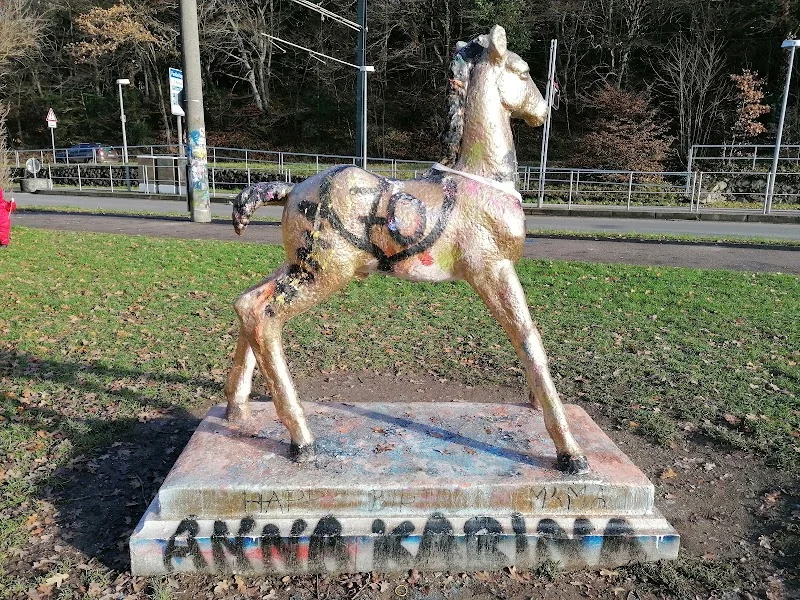
The Holbeinpferd is not just a sculpture in Freiburg, but a small cultural event with constant change, local affection, and a story that goes far beyond an ordinary monument. Those searching for the Holbeinpferd usually mean the famous concrete horse in Wiehre, which has been repainted time and again for decades, making each visit look a little different. The official tourism site describes it as a brightly painted concrete horse in Freiburg-Wiehre, a local art symbol, and a target for creative transformations at night. The facts page adds that it is a concrete sculpture by Werner Gürtner, which has a permanent place in public space and today belongs to the Freiburg Garden Office. This mix of art, humor, and surprise is what makes it appealing: The Holbeinpferd is an object that does not stand still, even though it is firmly anchored. It is one of the motifs known in Freiburg, even if one does not consciously pass by it every day. This makes it particularly strong as a search term for photos, current appearances, history, and the question of whether it can be purchased. Because the answer to all these questions always leads back to the same idea: The Holbeinpferd is a public cult object that constantly reinvents itself and thus never loses its charm. ([visit.freiburg.de](https://visit.freiburg.de/am-holbeinpferd?utm_source=openai))
Holbeinpferd current: Why the cult horse never stays the same for long
Those searching for Holbeinpferd current usually want to see the latest state of this Freiburg cult object. And therein lies the special principle of this attraction: There is no permanent, official final version, but always new versions that emerge at night and become visible as a surprise the next morning. The official tourism site explicitly describes the Holbeinpferd as an object that is repeatedly the target of creative transformations, citing examples like zebra, unicorn, or clown. Thus, the current impression is never just a matter of date, but always a snapshot. The horse is essentially the same concrete sculpture, yet its appearance changes without losing its location or identity. This tension between permanence and change explains why the search query is currently so strong: Visitors want to know what the horse looks like right now, whether it has been painted, which color dominates, or whether it has perhaps become a mythical creature again. The official description also emphasizes that the actions are unofficial but have long since achieved cult status. This means: The appeal lies not in a planned program, but in a spontaneous, vibrant city humor that has become a kind of ritual over the years and decades. Therefore, those who want to experience the Holbeinpferd should not rely on a fixed appearance, but rather accept this interplay. It is probably one of the few places in Freiburg where one can marvel in the morning because the night has rewritten the art. And even if one has seen the horse before, a return visit is worthwhile because the current face of the cult object is only valid for a short time. This is not a weakness, but its greatest strength. ([visit.freiburg.de](https://visit.freiburg.de/am-holbeinpferd?utm_source=openai))
Holbeinpferd photos: The most popular motif in Freiburg's Wiehre
The search for Holbeinpferd photos is completely understandable, as hardly any Freiburg object relies so heavily on the visual as this horse. This is not only due to its unusual shape as a concrete sculpture but especially to its ability to transform. A photo of the Holbeinpferd documents not only a work of art but also a specific state, a specific color, a specific idea, or even a specific humor. The official vita page of the Holbein horse website shows how much the horse lived as a photo motif already in the 1990s: It became the hero of a postcard series, followed by photo exhibitions in Freiburg, and even went to court to clarify whether the work could be used photographically and commercially. The decision at that time clarified that photographs of the unchanged sculpture in public space are generally permissible as long as the appearance is not altered. For visitors, this means primarily one thing: The Holbeinpferd is an open, public image motif that can be photographed, and its appeal lies precisely in the difference between the original artwork and its ever-new paintings. Those who want to take good photos find not only a motif at the Holbeinpferd but also a story that can be conveyed in the image. A gray horse on a traffic island that can become a zebra, unicorn, or clown at night is so strong photographically because it never appears banal. It is simultaneously ironic, poetic, and locally rooted. Even those who only make a short stop in Freiburg take home a small piece of city identity with a photo of the Holbeinpferd. And that is precisely why the motif remains so popular today: It is easily accessible, unmistakable, and always a little different than expected. ([holbein-pferd.de](https://www.holbein-pferd.de/vita/?utm_source=openai))
Holbeinpferd history: From concrete horse to Freiburg landmark
The history of the Holbeinpferd begins much more inconspicuously than its current cult status would suggest. According to official information, the horse sculpture was created in 1936; the facts page names the sculptor Werner Gürtner, born in 1907 and died in 1991. Initially, the work was sold to a private individual and later transferred to the city of Freiburg or the Garden Office. Later, at the request of the then mayor in the 1950s, the figure received the signature W.G. The location described by the facts page is situated between Holbeinstraße, Hans-Thoma-Straße, and Günterstalstraße, on a small patch of grass in Wiehre, and the official tourism site refers to the corner of Günterstalstraße and Holbeinplatz. Thus, the Holbeinpferd is not randomly located there, but firmly anchored in a specific Freiburg neighborhood. Its dimensions make it clear that it is neither a monumental large sculpture nor an easily overlooked small object: It stands 1.90 meters high, 1.90 meters long, is made of concrete, and weighs about a ton. This mix of everyday size and material-related weight contributes to its impact. In the 1980s, it was restored multiple times, including in 1981, 1985, and 1987, and thus received new life again and again. Even an accident in 1990, when a female driver rammed the horse sculpture off its pedestal, is now part of the turbulent history of the object. In the mid-1990s, postcards, photo exhibitions, and finally the legal dispute over the commercial use of images followed. All this shows: The Holbeinpferd is not just a pretty city motif, but a work with a verifiable biography, full of intermediate stages, restorations, and public attention. This very history makes it one of the most remarkable art objects in the Freiburg urban space. It is an example of how a comparatively small concrete figure can become a symbol of urban culture, memory, and local character. ([holbein-pferd.de](https://www.holbein-pferd.de/facts/))
Holbeinpferd for sale? Ownership, copyright, and public art
The question of whether the Holbeinpferd can be purchased often arises because the name sounds almost like a product online. In fact, however, the Holbeinpferd is not an art object that can be regularly acquired, but a public sculpture owned by the Freiburg Garden Office. This ownership information is directly stated on the official facts page. So if someone is looking for a purchase, they do not come across a shop, but rather the logic of public space: The work is firmly in its place, freely accessible, and part of the cityscape. This also explains why the discussion in the 1990s was more about photos, rights, and revenues than about selling the figure itself. The vita page reports on the dispute over whether one can take photos of the Holbein horse for commercial purposes. The court clarified at that time that the creation of photographs of the unchanged sculpture in public space is permissible. For classification, it is important not to read this decision as an invitation to misunderstanding: It concerns the photographic use of the public sculpture, not a purchase of the original. The material and size also emphasize the character of the work: concrete, about a ton heavy, 1.90 meters high, and placed on a firm pedestal in Wiehre. It is not a portable souvenir but part of the urban infrastructure and culture. Those who still want to take the Holbeinpferd home think more in terms of postcards, pictures, or memories rather than ownership transfer. The fact that there was a postcard series and photo exhibitions in the 1990s shows how strongly the image of the horse was marketed without the sculpture itself becoming a commodity. For the search intent of buying, the important answer is therefore clear: The real Holbeinpferd is public, communal, and culturally anchored, not privately transferable. ([holbein-pferd.de](https://www.holbein-pferd.de/facts/))
Holbeinpferd Freiburg: Location, Holbeinstraße stop, and arrival
The Holbeinpferd is located in the Freiburg district of Wiehre and is surprisingly easy to reach for many visitors. The official tourism site lists the address as Holbeinstraße 79100 Freiburg and describes the location as freely accessible at all times. The facts page specifies the location on a small patch of grass between Holbeinstraße, Hans-Thoma-Straße, and Günterstalstraße. For arrival, it is particularly important that the Freiburg Transport AG designates the Holbeinstraße stop as a stop on the city tram line 2. The line page shows line 2 with the route Günterstal - Bertoldsbrunnen - Hauptbahnhof - Brühl; the stop page shows Holbeinstraße as a specific station of line 2. This makes the journey very easy for guests: One takes the tram to the appropriate stop and is then already in the immediate vicinity of the artwork. Because the Holbeinpferd is an object in public space, there are no entry times, no tickets, and no barriers. This openness is part of its impact. Those who come see the sculpture in the everyday life of the city, between tram, residential area, and green strip. This fits well with the character of Wiehre, as here Freiburg is not a tourist backdrop but a lived urban space. Practically, this also means: For photos, short visits, or a small walk, the Holbeinpferd is perfectly suitable because one does not have to plan long. Once the location is understood, the visit almost automatically becomes part of a city tour, a route to the tram, or a short detour between two appointments. Particularly helpful for orientation is the connection of the official address information with public transport information. Thus, a search term like Holbeinpferd Freiburg quickly becomes a concretely findable point on the city map. Therefore, those who want to see the horse do not need special opening hours or reservations, but only the way to the Holbeinstraße stop or a walk through Wiehre. ([visit.freiburg.de](https://visit.freiburg.de/am-holbeinpferd?utm_source=openai))
Holbeinpferdchen and Holbein Pferdle: Names, humor, and identity
The Holbeinpferd is known not only for its paintings but also for the affectionate names with which it is referred to in Freiburg. Holbeinpferdchen and Holbein Pferdle are more than just cute variants; they show that the object has linguistically arrived in the everyday life of the city. The Alemannic diminutive form Pferdle means essentially little horse and is a good example of how local language and local art understanding come together. On the official Holbein horse page, the work is even described with the subtitle chameleon in horse form. This fits perfectly, as a chameleon stands for adaptability, change, and color, and these are precisely the qualities many people associate with the Holbeinpferd. It is not just an object to look at, but a cultural play with recognition and surprise. The official tourism site emphasizes that the nightly transformations reflect creativity, wit, and sometimes even social criticism. This turns the horse into a small public forum where humor, city feeling, and spontaneous art come together. The term Holbeinpferdchen sounds almost as if the city is deliberately trying to make the work smaller to bring it closer to the people. In reality, it is precisely this linguistic closeness that shows how deeply the horse is anchored in everyday life. It is a sight that is not only photographed but also named, commented on, and passed on with a wink. Those from Freiburg immediately recognize a piece of home in the name; those from outside feel in the name the mix of down-to-earthness and individuality. The Holbeinpferd is thus a good example of how a work of art can become a sign of identity without losing its lightness. It remains art in public space, but with a human, almost familial tone. This very language makes the difference between a mere object and a true cult symbol. ([de.wikipedia.org](https://de.wikipedia.org/wiki/Holbeinpferd?utm_source=openai))
Sources:
Mehr anzeigenWeniger anzeigen
Holbeinpferd | Photos & current
The Holbeinpferd is not just a sculpture in Freiburg, but a small cultural event with constant change, local affection, and a story that goes far beyond an ordinary monument. Those searching for the Holbeinpferd usually mean the famous concrete horse in Wiehre, which has been repainted time and again for decades, making each visit look a little different. The official tourism site describes it as a brightly painted concrete horse in Freiburg-Wiehre, a local art symbol, and a target for creative transformations at night. The facts page adds that it is a concrete sculpture by Werner Gürtner, which has a permanent place in public space and today belongs to the Freiburg Garden Office. This mix of art, humor, and surprise is what makes it appealing: The Holbeinpferd is an object that does not stand still, even though it is firmly anchored. It is one of the motifs known in Freiburg, even if one does not consciously pass by it every day. This makes it particularly strong as a search term for photos, current appearances, history, and the question of whether it can be purchased. Because the answer to all these questions always leads back to the same idea: The Holbeinpferd is a public cult object that constantly reinvents itself and thus never loses its charm. ([visit.freiburg.de](https://visit.freiburg.de/am-holbeinpferd?utm_source=openai))
Holbeinpferd current: Why the cult horse never stays the same for long
Those searching for Holbeinpferd current usually want to see the latest state of this Freiburg cult object. And therein lies the special principle of this attraction: There is no permanent, official final version, but always new versions that emerge at night and become visible as a surprise the next morning. The official tourism site explicitly describes the Holbeinpferd as an object that is repeatedly the target of creative transformations, citing examples like zebra, unicorn, or clown. Thus, the current impression is never just a matter of date, but always a snapshot. The horse is essentially the same concrete sculpture, yet its appearance changes without losing its location or identity. This tension between permanence and change explains why the search query is currently so strong: Visitors want to know what the horse looks like right now, whether it has been painted, which color dominates, or whether it has perhaps become a mythical creature again. The official description also emphasizes that the actions are unofficial but have long since achieved cult status. This means: The appeal lies not in a planned program, but in a spontaneous, vibrant city humor that has become a kind of ritual over the years and decades. Therefore, those who want to experience the Holbeinpferd should not rely on a fixed appearance, but rather accept this interplay. It is probably one of the few places in Freiburg where one can marvel in the morning because the night has rewritten the art. And even if one has seen the horse before, a return visit is worthwhile because the current face of the cult object is only valid for a short time. This is not a weakness, but its greatest strength. ([visit.freiburg.de](https://visit.freiburg.de/am-holbeinpferd?utm_source=openai))
Holbeinpferd photos: The most popular motif in Freiburg's Wiehre
The search for Holbeinpferd photos is completely understandable, as hardly any Freiburg object relies so heavily on the visual as this horse. This is not only due to its unusual shape as a concrete sculpture but especially to its ability to transform. A photo of the Holbeinpferd documents not only a work of art but also a specific state, a specific color, a specific idea, or even a specific humor. The official vita page of the Holbein horse website shows how much the horse lived as a photo motif already in the 1990s: It became the hero of a postcard series, followed by photo exhibitions in Freiburg, and even went to court to clarify whether the work could be used photographically and commercially. The decision at that time clarified that photographs of the unchanged sculpture in public space are generally permissible as long as the appearance is not altered. For visitors, this means primarily one thing: The Holbeinpferd is an open, public image motif that can be photographed, and its appeal lies precisely in the difference between the original artwork and its ever-new paintings. Those who want to take good photos find not only a motif at the Holbeinpferd but also a story that can be conveyed in the image. A gray horse on a traffic island that can become a zebra, unicorn, or clown at night is so strong photographically because it never appears banal. It is simultaneously ironic, poetic, and locally rooted. Even those who only make a short stop in Freiburg take home a small piece of city identity with a photo of the Holbeinpferd. And that is precisely why the motif remains so popular today: It is easily accessible, unmistakable, and always a little different than expected. ([holbein-pferd.de](https://www.holbein-pferd.de/vita/?utm_source=openai))
Holbeinpferd history: From concrete horse to Freiburg landmark
The history of the Holbeinpferd begins much more inconspicuously than its current cult status would suggest. According to official information, the horse sculpture was created in 1936; the facts page names the sculptor Werner Gürtner, born in 1907 and died in 1991. Initially, the work was sold to a private individual and later transferred to the city of Freiburg or the Garden Office. Later, at the request of the then mayor in the 1950s, the figure received the signature W.G. The location described by the facts page is situated between Holbeinstraße, Hans-Thoma-Straße, and Günterstalstraße, on a small patch of grass in Wiehre, and the official tourism site refers to the corner of Günterstalstraße and Holbeinplatz. Thus, the Holbeinpferd is not randomly located there, but firmly anchored in a specific Freiburg neighborhood. Its dimensions make it clear that it is neither a monumental large sculpture nor an easily overlooked small object: It stands 1.90 meters high, 1.90 meters long, is made of concrete, and weighs about a ton. This mix of everyday size and material-related weight contributes to its impact. In the 1980s, it was restored multiple times, including in 1981, 1985, and 1987, and thus received new life again and again. Even an accident in 1990, when a female driver rammed the horse sculpture off its pedestal, is now part of the turbulent history of the object. In the mid-1990s, postcards, photo exhibitions, and finally the legal dispute over the commercial use of images followed. All this shows: The Holbeinpferd is not just a pretty city motif, but a work with a verifiable biography, full of intermediate stages, restorations, and public attention. This very history makes it one of the most remarkable art objects in the Freiburg urban space. It is an example of how a comparatively small concrete figure can become a symbol of urban culture, memory, and local character. ([holbein-pferd.de](https://www.holbein-pferd.de/facts/))
Holbeinpferd for sale? Ownership, copyright, and public art
The question of whether the Holbeinpferd can be purchased often arises because the name sounds almost like a product online. In fact, however, the Holbeinpferd is not an art object that can be regularly acquired, but a public sculpture owned by the Freiburg Garden Office. This ownership information is directly stated on the official facts page. So if someone is looking for a purchase, they do not come across a shop, but rather the logic of public space: The work is firmly in its place, freely accessible, and part of the cityscape. This also explains why the discussion in the 1990s was more about photos, rights, and revenues than about selling the figure itself. The vita page reports on the dispute over whether one can take photos of the Holbein horse for commercial purposes. The court clarified at that time that the creation of photographs of the unchanged sculpture in public space is permissible. For classification, it is important not to read this decision as an invitation to misunderstanding: It concerns the photographic use of the public sculpture, not a purchase of the original. The material and size also emphasize the character of the work: concrete, about a ton heavy, 1.90 meters high, and placed on a firm pedestal in Wiehre. It is not a portable souvenir but part of the urban infrastructure and culture. Those who still want to take the Holbeinpferd home think more in terms of postcards, pictures, or memories rather than ownership transfer. The fact that there was a postcard series and photo exhibitions in the 1990s shows how strongly the image of the horse was marketed without the sculpture itself becoming a commodity. For the search intent of buying, the important answer is therefore clear: The real Holbeinpferd is public, communal, and culturally anchored, not privately transferable. ([holbein-pferd.de](https://www.holbein-pferd.de/facts/))
Holbeinpferd Freiburg: Location, Holbeinstraße stop, and arrival
The Holbeinpferd is located in the Freiburg district of Wiehre and is surprisingly easy to reach for many visitors. The official tourism site lists the address as Holbeinstraße 79100 Freiburg and describes the location as freely accessible at all times. The facts page specifies the location on a small patch of grass between Holbeinstraße, Hans-Thoma-Straße, and Günterstalstraße. For arrival, it is particularly important that the Freiburg Transport AG designates the Holbeinstraße stop as a stop on the city tram line 2. The line page shows line 2 with the route Günterstal - Bertoldsbrunnen - Hauptbahnhof - Brühl; the stop page shows Holbeinstraße as a specific station of line 2. This makes the journey very easy for guests: One takes the tram to the appropriate stop and is then already in the immediate vicinity of the artwork. Because the Holbeinpferd is an object in public space, there are no entry times, no tickets, and no barriers. This openness is part of its impact. Those who come see the sculpture in the everyday life of the city, between tram, residential area, and green strip. This fits well with the character of Wiehre, as here Freiburg is not a tourist backdrop but a lived urban space. Practically, this also means: For photos, short visits, or a small walk, the Holbeinpferd is perfectly suitable because one does not have to plan long. Once the location is understood, the visit almost automatically becomes part of a city tour, a route to the tram, or a short detour between two appointments. Particularly helpful for orientation is the connection of the official address information with public transport information. Thus, a search term like Holbeinpferd Freiburg quickly becomes a concretely findable point on the city map. Therefore, those who want to see the horse do not need special opening hours or reservations, but only the way to the Holbeinstraße stop or a walk through Wiehre. ([visit.freiburg.de](https://visit.freiburg.de/am-holbeinpferd?utm_source=openai))
Holbeinpferdchen and Holbein Pferdle: Names, humor, and identity
The Holbeinpferd is known not only for its paintings but also for the affectionate names with which it is referred to in Freiburg. Holbeinpferdchen and Holbein Pferdle are more than just cute variants; they show that the object has linguistically arrived in the everyday life of the city. The Alemannic diminutive form Pferdle means essentially little horse and is a good example of how local language and local art understanding come together. On the official Holbein horse page, the work is even described with the subtitle chameleon in horse form. This fits perfectly, as a chameleon stands for adaptability, change, and color, and these are precisely the qualities many people associate with the Holbeinpferd. It is not just an object to look at, but a cultural play with recognition and surprise. The official tourism site emphasizes that the nightly transformations reflect creativity, wit, and sometimes even social criticism. This turns the horse into a small public forum where humor, city feeling, and spontaneous art come together. The term Holbeinpferdchen sounds almost as if the city is deliberately trying to make the work smaller to bring it closer to the people. In reality, it is precisely this linguistic closeness that shows how deeply the horse is anchored in everyday life. It is a sight that is not only photographed but also named, commented on, and passed on with a wink. Those from Freiburg immediately recognize a piece of home in the name; those from outside feel in the name the mix of down-to-earthness and individuality. The Holbeinpferd is thus a good example of how a work of art can become a sign of identity without losing its lightness. It remains art in public space, but with a human, almost familial tone. This very language makes the difference between a mere object and a true cult symbol. ([de.wikipedia.org](https://de.wikipedia.org/wiki/Holbeinpferd?utm_source=openai))
Sources:
Holbeinpferd | Photos & current
The Holbeinpferd is not just a sculpture in Freiburg, but a small cultural event with constant change, local affection, and a story that goes far beyond an ordinary monument. Those searching for the Holbeinpferd usually mean the famous concrete horse in Wiehre, which has been repainted time and again for decades, making each visit look a little different. The official tourism site describes it as a brightly painted concrete horse in Freiburg-Wiehre, a local art symbol, and a target for creative transformations at night. The facts page adds that it is a concrete sculpture by Werner Gürtner, which has a permanent place in public space and today belongs to the Freiburg Garden Office. This mix of art, humor, and surprise is what makes it appealing: The Holbeinpferd is an object that does not stand still, even though it is firmly anchored. It is one of the motifs known in Freiburg, even if one does not consciously pass by it every day. This makes it particularly strong as a search term for photos, current appearances, history, and the question of whether it can be purchased. Because the answer to all these questions always leads back to the same idea: The Holbeinpferd is a public cult object that constantly reinvents itself and thus never loses its charm. ([visit.freiburg.de](https://visit.freiburg.de/am-holbeinpferd?utm_source=openai))
Holbeinpferd current: Why the cult horse never stays the same for long
Those searching for Holbeinpferd current usually want to see the latest state of this Freiburg cult object. And therein lies the special principle of this attraction: There is no permanent, official final version, but always new versions that emerge at night and become visible as a surprise the next morning. The official tourism site explicitly describes the Holbeinpferd as an object that is repeatedly the target of creative transformations, citing examples like zebra, unicorn, or clown. Thus, the current impression is never just a matter of date, but always a snapshot. The horse is essentially the same concrete sculpture, yet its appearance changes without losing its location or identity. This tension between permanence and change explains why the search query is currently so strong: Visitors want to know what the horse looks like right now, whether it has been painted, which color dominates, or whether it has perhaps become a mythical creature again. The official description also emphasizes that the actions are unofficial but have long since achieved cult status. This means: The appeal lies not in a planned program, but in a spontaneous, vibrant city humor that has become a kind of ritual over the years and decades. Therefore, those who want to experience the Holbeinpferd should not rely on a fixed appearance, but rather accept this interplay. It is probably one of the few places in Freiburg where one can marvel in the morning because the night has rewritten the art. And even if one has seen the horse before, a return visit is worthwhile because the current face of the cult object is only valid for a short time. This is not a weakness, but its greatest strength. ([visit.freiburg.de](https://visit.freiburg.de/am-holbeinpferd?utm_source=openai))
Holbeinpferd photos: The most popular motif in Freiburg's Wiehre
The search for Holbeinpferd photos is completely understandable, as hardly any Freiburg object relies so heavily on the visual as this horse. This is not only due to its unusual shape as a concrete sculpture but especially to its ability to transform. A photo of the Holbeinpferd documents not only a work of art but also a specific state, a specific color, a specific idea, or even a specific humor. The official vita page of the Holbein horse website shows how much the horse lived as a photo motif already in the 1990s: It became the hero of a postcard series, followed by photo exhibitions in Freiburg, and even went to court to clarify whether the work could be used photographically and commercially. The decision at that time clarified that photographs of the unchanged sculpture in public space are generally permissible as long as the appearance is not altered. For visitors, this means primarily one thing: The Holbeinpferd is an open, public image motif that can be photographed, and its appeal lies precisely in the difference between the original artwork and its ever-new paintings. Those who want to take good photos find not only a motif at the Holbeinpferd but also a story that can be conveyed in the image. A gray horse on a traffic island that can become a zebra, unicorn, or clown at night is so strong photographically because it never appears banal. It is simultaneously ironic, poetic, and locally rooted. Even those who only make a short stop in Freiburg take home a small piece of city identity with a photo of the Holbeinpferd. And that is precisely why the motif remains so popular today: It is easily accessible, unmistakable, and always a little different than expected. ([holbein-pferd.de](https://www.holbein-pferd.de/vita/?utm_source=openai))
Holbeinpferd history: From concrete horse to Freiburg landmark
The history of the Holbeinpferd begins much more inconspicuously than its current cult status would suggest. According to official information, the horse sculpture was created in 1936; the facts page names the sculptor Werner Gürtner, born in 1907 and died in 1991. Initially, the work was sold to a private individual and later transferred to the city of Freiburg or the Garden Office. Later, at the request of the then mayor in the 1950s, the figure received the signature W.G. The location described by the facts page is situated between Holbeinstraße, Hans-Thoma-Straße, and Günterstalstraße, on a small patch of grass in Wiehre, and the official tourism site refers to the corner of Günterstalstraße and Holbeinplatz. Thus, the Holbeinpferd is not randomly located there, but firmly anchored in a specific Freiburg neighborhood. Its dimensions make it clear that it is neither a monumental large sculpture nor an easily overlooked small object: It stands 1.90 meters high, 1.90 meters long, is made of concrete, and weighs about a ton. This mix of everyday size and material-related weight contributes to its impact. In the 1980s, it was restored multiple times, including in 1981, 1985, and 1987, and thus received new life again and again. Even an accident in 1990, when a female driver rammed the horse sculpture off its pedestal, is now part of the turbulent history of the object. In the mid-1990s, postcards, photo exhibitions, and finally the legal dispute over the commercial use of images followed. All this shows: The Holbeinpferd is not just a pretty city motif, but a work with a verifiable biography, full of intermediate stages, restorations, and public attention. This very history makes it one of the most remarkable art objects in the Freiburg urban space. It is an example of how a comparatively small concrete figure can become a symbol of urban culture, memory, and local character. ([holbein-pferd.de](https://www.holbein-pferd.de/facts/))
Holbeinpferd for sale? Ownership, copyright, and public art
The question of whether the Holbeinpferd can be purchased often arises because the name sounds almost like a product online. In fact, however, the Holbeinpferd is not an art object that can be regularly acquired, but a public sculpture owned by the Freiburg Garden Office. This ownership information is directly stated on the official facts page. So if someone is looking for a purchase, they do not come across a shop, but rather the logic of public space: The work is firmly in its place, freely accessible, and part of the cityscape. This also explains why the discussion in the 1990s was more about photos, rights, and revenues than about selling the figure itself. The vita page reports on the dispute over whether one can take photos of the Holbein horse for commercial purposes. The court clarified at that time that the creation of photographs of the unchanged sculpture in public space is permissible. For classification, it is important not to read this decision as an invitation to misunderstanding: It concerns the photographic use of the public sculpture, not a purchase of the original. The material and size also emphasize the character of the work: concrete, about a ton heavy, 1.90 meters high, and placed on a firm pedestal in Wiehre. It is not a portable souvenir but part of the urban infrastructure and culture. Those who still want to take the Holbeinpferd home think more in terms of postcards, pictures, or memories rather than ownership transfer. The fact that there was a postcard series and photo exhibitions in the 1990s shows how strongly the image of the horse was marketed without the sculpture itself becoming a commodity. For the search intent of buying, the important answer is therefore clear: The real Holbeinpferd is public, communal, and culturally anchored, not privately transferable. ([holbein-pferd.de](https://www.holbein-pferd.de/facts/))
Holbeinpferd Freiburg: Location, Holbeinstraße stop, and arrival
The Holbeinpferd is located in the Freiburg district of Wiehre and is surprisingly easy to reach for many visitors. The official tourism site lists the address as Holbeinstraße 79100 Freiburg and describes the location as freely accessible at all times. The facts page specifies the location on a small patch of grass between Holbeinstraße, Hans-Thoma-Straße, and Günterstalstraße. For arrival, it is particularly important that the Freiburg Transport AG designates the Holbeinstraße stop as a stop on the city tram line 2. The line page shows line 2 with the route Günterstal - Bertoldsbrunnen - Hauptbahnhof - Brühl; the stop page shows Holbeinstraße as a specific station of line 2. This makes the journey very easy for guests: One takes the tram to the appropriate stop and is then already in the immediate vicinity of the artwork. Because the Holbeinpferd is an object in public space, there are no entry times, no tickets, and no barriers. This openness is part of its impact. Those who come see the sculpture in the everyday life of the city, between tram, residential area, and green strip. This fits well with the character of Wiehre, as here Freiburg is not a tourist backdrop but a lived urban space. Practically, this also means: For photos, short visits, or a small walk, the Holbeinpferd is perfectly suitable because one does not have to plan long. Once the location is understood, the visit almost automatically becomes part of a city tour, a route to the tram, or a short detour between two appointments. Particularly helpful for orientation is the connection of the official address information with public transport information. Thus, a search term like Holbeinpferd Freiburg quickly becomes a concretely findable point on the city map. Therefore, those who want to see the horse do not need special opening hours or reservations, but only the way to the Holbeinstraße stop or a walk through Wiehre. ([visit.freiburg.de](https://visit.freiburg.de/am-holbeinpferd?utm_source=openai))
Holbeinpferdchen and Holbein Pferdle: Names, humor, and identity
The Holbeinpferd is known not only for its paintings but also for the affectionate names with which it is referred to in Freiburg. Holbeinpferdchen and Holbein Pferdle are more than just cute variants; they show that the object has linguistically arrived in the everyday life of the city. The Alemannic diminutive form Pferdle means essentially little horse and is a good example of how local language and local art understanding come together. On the official Holbein horse page, the work is even described with the subtitle chameleon in horse form. This fits perfectly, as a chameleon stands for adaptability, change, and color, and these are precisely the qualities many people associate with the Holbeinpferd. It is not just an object to look at, but a cultural play with recognition and surprise. The official tourism site emphasizes that the nightly transformations reflect creativity, wit, and sometimes even social criticism. This turns the horse into a small public forum where humor, city feeling, and spontaneous art come together. The term Holbeinpferdchen sounds almost as if the city is deliberately trying to make the work smaller to bring it closer to the people. In reality, it is precisely this linguistic closeness that shows how deeply the horse is anchored in everyday life. It is a sight that is not only photographed but also named, commented on, and passed on with a wink. Those from Freiburg immediately recognize a piece of home in the name; those from outside feel in the name the mix of down-to-earthness and individuality. The Holbeinpferd is thus a good example of how a work of art can become a sign of identity without losing its lightness. It remains art in public space, but with a human, almost familial tone. This very language makes the difference between a mere object and a true cult symbol. ([de.wikipedia.org](https://de.wikipedia.org/wiki/Holbeinpferd?utm_source=openai))
Sources:
Frequently Asked Questions
Reviews
No reviews found