
Münsterplatz 24, Freiburg im Breisgau
Münsterplatz 24, 79098 Freiburg im Breisgau, Germany
Historical Merchant Hall Freiburg | History & Events
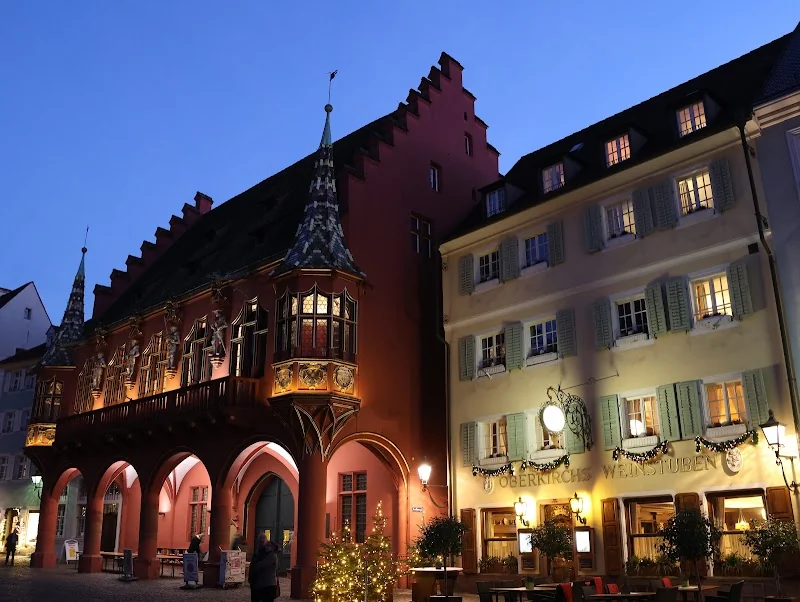
The Historical Merchant Hall at Münsterplatz is one of those places where Freiburg becomes not only visible but also tangible. The location in the old town makes it clear why this address is so often sought after: The building stands prominently on the south side of Münsterplatz, its red facade acting as a historical color accent in the cityscape and connecting centuries-old history with its current use as an exclusive event location. The house is operated by FWTM on behalf of the city of Freiburg, and it is precisely this connection of urban heritage, professional event management, and extraordinary architecture that makes it particularly appealing. Those looking for historical merchants hall photos, a stylish venue for conferences, a place with character, or a location with tourist appeal will find exactly what they need here. The house is not an anonymous event space but a landmark that fascinates from the outside and convinces inside with representative rooms, a courtyard, and strong historical references. For visitors, organizers, and photographers, the Historical Merchant Hall is equally a magnet because it connects history, atmosphere, and function in a rarely successful way. ([historischeskaufhaus.freiburg.de](https://historischeskaufhaus.freiburg.de/en/about-us))
History and Architecture at Münsterplatz
The history of the Historical Merchant Hall is closely linked to the development of Freiburg itself. As early as 1378, a merchant hall is mentioned in the city, and between 1520 and 1532, the New Merchant Hall was built at Münsterplatz, which would shape urban trade, taxes, and social exchange for centuries. The facade design with sculptures and coats of arms from 1530 and 1531 is not only decorative but intentionally representative: it refers to the Habsburgs and thus to the political and economic classification of Freiburg at that time. The visible imagery of the front creates an immediate impression of power, self-understanding, and urban ambition to this day. For this reason, the building is more than just a beautiful photo motif; it is a historical document in stone that tells the ambitions of an old trading city. At the same time, the current use shows that the monument has not been frozen in time but has been continuously reinterpreted and sensibly repurposed over the centuries. This makes the visit particularly valuable because history here does not end as a backdrop but continues to live as part of everyday life. ([historischeskaufhaus.freiburg.de](https://historischeskaufhaus.freiburg.de/ueber-uns))
Those who take a closer look at the chronological development will recognize how multifaceted the house has been shaped. Following the construction of 1520/32, the spiral staircase in the courtyard was completed in 1532, and in 1550, the balcony was added. Later, in 1776, the Redoutenhaus was added with a staircase leading to the merchant hall. In the 19th century, the appearance changed again when the building was historically redesigned between 1880 and 1884. In 1924/25, it was reverted to its state before 1880, before a political use also became visible in the decades after World War II: in 1946, the Advisory State Assembly for Baden met here, and from 1947 to 1952, the Baden State Parliament. Between 1987 and 1991, the house was extensively renovated. This sequence shows that the merchant hall was never just a monument but always remained a place of work, representation, and encounter. Particularly noteworthy is that it is still the seat of the city market office, from which the market masters oversee the market taking place around the Münster. The building thus remains anchored in the urban everyday life of Freiburg. ([historischeskaufhaus.freiburg.de](https://historischeskaufhaus.freiburg.de/ueber-uns))
Emperor's Hall, Rococo Hall, Fireplace Room, and Historical Parlor
With its four rooms, foyer, and courtyard, the Historical Merchant Hall offers a remarkable variety for differently sized formats. The Emperor's Hall is the largest and most ceremonial room in the house: it accommodates 290 people in row seating, 115 in parliamentary style, 170 at banquets, and up to 350 guests at receptions. With an area of 270 square meters, it is the central space for lectures, congresses, concerts, and formal occasions. The Rococo Hall is smaller but particularly charming: its 18th-century ceiling ornamentation, chinoiserie details, Venetian chandeliers, and mirrors create an elegant, almost playful atmosphere for smaller receptions, workshops, or cultural formats. The Fireplace Room, in turn, thrives on its open fireplace, which refers to the 15th century and the Freiburg master builder. It is suitable for discussions, readings, and working groups with up to 75 people and feels particularly personal. Finally, the Historical Parlor is an intimate room in a historicist style, conceived in the 19th century and used for smaller, representative meetings. This creates a graduated room offering in the house, ranging from grand appearances to confidential conversations. ([historischeskaufhaus.freiburg.de](https://historischeskaufhaus.freiburg.de/en/rooms))
It is the details that make the rooms so strong. The Emperor's Hall conveys an aura with its mighty wooden columns and historical stucco ceiling that reminds one of princes, city fathers, and classical solemnity. The Rococo Hall tells a different story with its ornamental lightness: here, the representative heritage is not heavy but bright, playful, and stylish. The Fireplace Room combines historical substance with a very direct, almost homely experience, as the open fire gives the room warmth and focus at the same time. Additionally, there is direct access to the courtyard, which facilitates group work and the transition between indoor and outdoor spaces. The Historical Parlor, on the other hand, is intentionally kept small, making it ideal for formats where closeness, discreet conversation atmosphere, and special design are required. The courtyard further expands the spectrum, as it can be used as a stylish lounge, reception area, or open-air option. Thus, a house is created that not only looks beautiful but also gives organizers real planning freedom. For companies, cultural institutions, and private clients, this is both rare and valuable. ([historischeskaufhaus.freiburg.de](https://historischeskaufhaus.freiburg.de/en/rooms/kaminsaal))
Events, Tickets, and Formats for Every Occasion
The Historical Merchant Hall is designed as a traditional conference and event address and is used exactly as such. The house is suitable for congresses, conferences, lectures, readings, receptions, company celebrations, workshops, evening events, and classical concerts. The official presentation emphasizes that particularly demanding formats find their place here because the rooms, the equipment, and the support together create a coherent stage. Premium catering is available upon request, as are additional services such as special furnishings, decoration, floral arrangements, or technical concepts for live and digital formats. This makes the house not only historical but also contemporary and professional. For organizers, this means: the historical framework is not an obstacle but the actual added value. Guests do not experience an arbitrary location but a place with character, history, and a clear representative claim. Precisely for this reason, the merchant hall is so well suited for formats where atmosphere and external impact play a significant role. Those looking for a high-quality setting for science, business, or culture will find a location here that visibly enhances the occasion and makes it unmistakable in the best sense. ([historischeskaufhaus.freiburg.de](https://historischeskaufhaus.freiburg.de/en/formats))
For visitors, the processes are also well organized. Tickets and vouchers for events are available in the online ticket shop of FWTM as well as at various Reservix advance sales points in Freiburg, such as the Tourist Information at Rathausplatz, VAG Pluspunkt, Messe Freiburg, and the BZ ticket service. At concerts, readings, and similar formats, a cloakroom service is usually offered; bags and backpacks larger than DIN A4 must be checked. This is a small but important piece of information for a relaxed visit. Those traveling from outside also benefit from the event ticket of Deutsche Bahn, which facilitates sustainable travel and makes the journey more attractive for participants of business events or congresses. The fact that the house is located in the city center is both practical and trendsetting: one arrives in the old town, can still stay in the city center before the event, and experiences the building as part of a vibrant urban space. Thus, the location becomes not only an event venue but also a starting point for a whole Freiburg experience. Especially for users looking for tickets, events, or programs, the merchant hall is therefore an address of high relevance and clear organization. ([historischeskaufhaus.freiburg.de](https://historischeskaufhaus.freiburg.de/en/info-center/visitor-information))
Access, Parking, and Arrival by Train, Bus, and Bicycle
The journey to the Historical Merchant Hall is well described and can be planned in various ways. By train, Freiburg can be easily reached from the north and south of Europe; the journey from Frankfurt or Zurich takes about two hours, and from Paris about two and a half hours. From the main train station, tram lines 1, 2, 3, and 5 go to Bertoldsbrunnen, from where it is just a few minutes' walk to Münsterplatz. Long-distance bus travelers also benefit from the location, as the bus station at the main train station connects to the inner-city lines or a roughly ten-minute walk through the city center. Those arriving by bicycle will find a Frelo station about 400 meters away at Karlsplatz. This is a clear advantage for a city center location, as it combines environmentally friendly mobility, short distances, and easy orientation. Visitor information also shows that the house is not isolated at the edge but is directly integrated into Freiburg's tourist infrastructure. This is particularly pleasant for guests who wish to combine the event with a city tour, a market visit, or a stroll through the old town. ([historischeskaufhaus.freiburg.de](https://historischeskaufhaus.freiburg.de/en/info-center/visitor-information))
By car, the journey usually takes place via the A5 Frankfurt-Basel with the Freiburg-Mitte exit or via the A81 and B31 from the east. From the motorway feeder Mitte to the Historical Merchant Hall, it takes about ten minutes towards the old town. At the same time, it is important to know that there are no parking spaces directly at the building because the house is located in the pedestrian zone of the city center. Visitors should therefore plan with parking garages in the vicinity; the Schlossberg parking garage is only a few minutes' walk away. This information is particularly relevant for guests arriving with heavy equipment, in groups, or for evening events. It is also practical that the historical location deliberately slows down the arrival: if one cannot park directly at the door, one automatically moves through the old town and experiences the building first in the urban context. This makes the journey not only functional but almost atmospheric. Those searching for parking, access, or location in the old town will receive an honest, clear answer here: central, easily accessible, but without its own parking spaces directly at the house. ([historischeskaufhaus.freiburg.de](https://historischeskaufhaus.freiburg.de/en/info-center/visitor-information))
Accessibility, Visitor Information, and Practical Tips
The Historical Merchant Hall is only partially accessible due to its historical architecture and location in the old town. Nevertheless, the location strives to make as many areas accessible as possible. Wheelchair users can reach the event rooms via the lift in the courtyard, but only with the support of staff. It should be noted that the courtyard is paved with cobblestones. In the Emperor's Hall, the stage can be accessed via an adjustable ramp, which is particularly helpful for events with speeches, presentations, or artistic contributions. Additionally, the team offers further support upon request, such as special furnishings, sign language interpreters, or materials in Braille. This information shows that accessibility is not formulated here as a blanket promise but as individual, realistic assistance in a listed environment. Especially in a location with such a strong historical character, this is an important point, as visitors should know in advance which paths are possible and where help is needed. For organizers, this results in a clear picture: the house is accessible but not fully modernized, but has deliberately remained historical. ([historischeskaufhaus.freiburg.de](https://historischeskaufhaus.freiburg.de/en/info-center/accessibility))
Practical tips also include information from the visitor area that significantly facilitates the stay. Tickets and vouchers are available online, and the advance sales points in Freiburg also allow for purchases without digital booking. There is a clear cloakroom rule for bags and backpacks, which ensures order and safety at events with a high number of visitors. Those arriving by Deutsche Bahn can use the sustainable event offers, and those traveling within Freiburg also benefit from the congress ticket as a public transport ticket in the RVF area. This is a real added value, especially for conferences and congresses, as participants can easily switch between the train station, hotel, city center, and event venue. It is also important for private visitors that the house is located in the middle of the urban fabric: everything essential is close, but the historical backdrop creates a special calm and concentration. Thus, a simple visit becomes a well-planned, comfortable, and atmospheric stay. Those seeking practical information will find here a location that is professionally organized while still preserving its historical character. ([historischeskaufhaus.freiburg.de](https://historischeskaufhaus.freiburg.de/en/info-center/visitor-information))
Photos, Courtyard, and the Special Experience at Münsterplatz
The Historical Merchant Hall is one of the most photogenic buildings in Freiburg. The deep red facade, richly decorated bay windows, coats of arms, sculptures, and the clear location at Münsterplatz create a strong visual impact that works from a distance. For this reason, the place repeatedly appears in searches for historical merchants hall photos or simply for images of the Münster and Freiburg's old town. The building contrasts with the stricter architecture of the Münster opposite and thus offers an exciting interplay of form, color, and historical consciousness. The west and south views convey different impressions: sometimes the house appears representative and almost courtly, sometimes lively and urban. Those who take a photo of the building not only capture a sight but also a whole narrative about Freiburg's old trading and administrative function. Particularly impressive is how the facade interacts with the vibrant Münsterplatz, where market, city life, and tourism overlap. This creates a motif that has immediate recognition value for both travelers and event guests. ([visit.freiburg.de](https://visit.freiburg.de/freiburg-fuehlen/moderne-architektur))
Inside, the house also offers strong images and clear experiences. The Emperor's Hall is predestined for recordings of lectures, concerts, and festive receptions, while the Rococo Hall, with its ornaments and chandeliers, provides a particularly elegant setting. The Fireplace Room, on the other hand, feels more intimate and human, which is well conveyed in photos of conversation situations, smaller readings, or workshops. Finally, the courtyard is the perfect connection between history and openness: half protected, partially outdoors, and ideal for receptions or summer formats. Additionally, there is a view of the surroundings, as Freiburg's old town with market, gastronomy, and short distances to other sights lies around Münsterplatz. Those who wish to gain an impression in advance can also virtually explore the rooms and the courtyard, thus developing a sense of atmosphere and proportions before booking. This makes the location particularly transparent and planable. Overall, the Historical Merchant Hall is not only a place for events but also a photo motif, a city experience, and a historical symbol that makes Freiburg readable in just a few glimpses. ([historischeskaufhaus.freiburg.de](https://historischeskaufhaus.freiburg.de/en/rooms/rokokosaal))
Sources:
Show moreShow less
Historical Merchant Hall Freiburg | History & Events
The Historical Merchant Hall at Münsterplatz is one of those places where Freiburg becomes not only visible but also tangible. The location in the old town makes it clear why this address is so often sought after: The building stands prominently on the south side of Münsterplatz, its red facade acting as a historical color accent in the cityscape and connecting centuries-old history with its current use as an exclusive event location. The house is operated by FWTM on behalf of the city of Freiburg, and it is precisely this connection of urban heritage, professional event management, and extraordinary architecture that makes it particularly appealing. Those looking for historical merchants hall photos, a stylish venue for conferences, a place with character, or a location with tourist appeal will find exactly what they need here. The house is not an anonymous event space but a landmark that fascinates from the outside and convinces inside with representative rooms, a courtyard, and strong historical references. For visitors, organizers, and photographers, the Historical Merchant Hall is equally a magnet because it connects history, atmosphere, and function in a rarely successful way. ([historischeskaufhaus.freiburg.de](https://historischeskaufhaus.freiburg.de/en/about-us))
History and Architecture at Münsterplatz
The history of the Historical Merchant Hall is closely linked to the development of Freiburg itself. As early as 1378, a merchant hall is mentioned in the city, and between 1520 and 1532, the New Merchant Hall was built at Münsterplatz, which would shape urban trade, taxes, and social exchange for centuries. The facade design with sculptures and coats of arms from 1530 and 1531 is not only decorative but intentionally representative: it refers to the Habsburgs and thus to the political and economic classification of Freiburg at that time. The visible imagery of the front creates an immediate impression of power, self-understanding, and urban ambition to this day. For this reason, the building is more than just a beautiful photo motif; it is a historical document in stone that tells the ambitions of an old trading city. At the same time, the current use shows that the monument has not been frozen in time but has been continuously reinterpreted and sensibly repurposed over the centuries. This makes the visit particularly valuable because history here does not end as a backdrop but continues to live as part of everyday life. ([historischeskaufhaus.freiburg.de](https://historischeskaufhaus.freiburg.de/ueber-uns))
Those who take a closer look at the chronological development will recognize how multifaceted the house has been shaped. Following the construction of 1520/32, the spiral staircase in the courtyard was completed in 1532, and in 1550, the balcony was added. Later, in 1776, the Redoutenhaus was added with a staircase leading to the merchant hall. In the 19th century, the appearance changed again when the building was historically redesigned between 1880 and 1884. In 1924/25, it was reverted to its state before 1880, before a political use also became visible in the decades after World War II: in 1946, the Advisory State Assembly for Baden met here, and from 1947 to 1952, the Baden State Parliament. Between 1987 and 1991, the house was extensively renovated. This sequence shows that the merchant hall was never just a monument but always remained a place of work, representation, and encounter. Particularly noteworthy is that it is still the seat of the city market office, from which the market masters oversee the market taking place around the Münster. The building thus remains anchored in the urban everyday life of Freiburg. ([historischeskaufhaus.freiburg.de](https://historischeskaufhaus.freiburg.de/ueber-uns))
Emperor's Hall, Rococo Hall, Fireplace Room, and Historical Parlor
With its four rooms, foyer, and courtyard, the Historical Merchant Hall offers a remarkable variety for differently sized formats. The Emperor's Hall is the largest and most ceremonial room in the house: it accommodates 290 people in row seating, 115 in parliamentary style, 170 at banquets, and up to 350 guests at receptions. With an area of 270 square meters, it is the central space for lectures, congresses, concerts, and formal occasions. The Rococo Hall is smaller but particularly charming: its 18th-century ceiling ornamentation, chinoiserie details, Venetian chandeliers, and mirrors create an elegant, almost playful atmosphere for smaller receptions, workshops, or cultural formats. The Fireplace Room, in turn, thrives on its open fireplace, which refers to the 15th century and the Freiburg master builder. It is suitable for discussions, readings, and working groups with up to 75 people and feels particularly personal. Finally, the Historical Parlor is an intimate room in a historicist style, conceived in the 19th century and used for smaller, representative meetings. This creates a graduated room offering in the house, ranging from grand appearances to confidential conversations. ([historischeskaufhaus.freiburg.de](https://historischeskaufhaus.freiburg.de/en/rooms))
It is the details that make the rooms so strong. The Emperor's Hall conveys an aura with its mighty wooden columns and historical stucco ceiling that reminds one of princes, city fathers, and classical solemnity. The Rococo Hall tells a different story with its ornamental lightness: here, the representative heritage is not heavy but bright, playful, and stylish. The Fireplace Room combines historical substance with a very direct, almost homely experience, as the open fire gives the room warmth and focus at the same time. Additionally, there is direct access to the courtyard, which facilitates group work and the transition between indoor and outdoor spaces. The Historical Parlor, on the other hand, is intentionally kept small, making it ideal for formats where closeness, discreet conversation atmosphere, and special design are required. The courtyard further expands the spectrum, as it can be used as a stylish lounge, reception area, or open-air option. Thus, a house is created that not only looks beautiful but also gives organizers real planning freedom. For companies, cultural institutions, and private clients, this is both rare and valuable. ([historischeskaufhaus.freiburg.de](https://historischeskaufhaus.freiburg.de/en/rooms/kaminsaal))
Events, Tickets, and Formats for Every Occasion
The Historical Merchant Hall is designed as a traditional conference and event address and is used exactly as such. The house is suitable for congresses, conferences, lectures, readings, receptions, company celebrations, workshops, evening events, and classical concerts. The official presentation emphasizes that particularly demanding formats find their place here because the rooms, the equipment, and the support together create a coherent stage. Premium catering is available upon request, as are additional services such as special furnishings, decoration, floral arrangements, or technical concepts for live and digital formats. This makes the house not only historical but also contemporary and professional. For organizers, this means: the historical framework is not an obstacle but the actual added value. Guests do not experience an arbitrary location but a place with character, history, and a clear representative claim. Precisely for this reason, the merchant hall is so well suited for formats where atmosphere and external impact play a significant role. Those looking for a high-quality setting for science, business, or culture will find a location here that visibly enhances the occasion and makes it unmistakable in the best sense. ([historischeskaufhaus.freiburg.de](https://historischeskaufhaus.freiburg.de/en/formats))
For visitors, the processes are also well organized. Tickets and vouchers for events are available in the online ticket shop of FWTM as well as at various Reservix advance sales points in Freiburg, such as the Tourist Information at Rathausplatz, VAG Pluspunkt, Messe Freiburg, and the BZ ticket service. At concerts, readings, and similar formats, a cloakroom service is usually offered; bags and backpacks larger than DIN A4 must be checked. This is a small but important piece of information for a relaxed visit. Those traveling from outside also benefit from the event ticket of Deutsche Bahn, which facilitates sustainable travel and makes the journey more attractive for participants of business events or congresses. The fact that the house is located in the city center is both practical and trendsetting: one arrives in the old town, can still stay in the city center before the event, and experiences the building as part of a vibrant urban space. Thus, the location becomes not only an event venue but also a starting point for a whole Freiburg experience. Especially for users looking for tickets, events, or programs, the merchant hall is therefore an address of high relevance and clear organization. ([historischeskaufhaus.freiburg.de](https://historischeskaufhaus.freiburg.de/en/info-center/visitor-information))
Access, Parking, and Arrival by Train, Bus, and Bicycle
The journey to the Historical Merchant Hall is well described and can be planned in various ways. By train, Freiburg can be easily reached from the north and south of Europe; the journey from Frankfurt or Zurich takes about two hours, and from Paris about two and a half hours. From the main train station, tram lines 1, 2, 3, and 5 go to Bertoldsbrunnen, from where it is just a few minutes' walk to Münsterplatz. Long-distance bus travelers also benefit from the location, as the bus station at the main train station connects to the inner-city lines or a roughly ten-minute walk through the city center. Those arriving by bicycle will find a Frelo station about 400 meters away at Karlsplatz. This is a clear advantage for a city center location, as it combines environmentally friendly mobility, short distances, and easy orientation. Visitor information also shows that the house is not isolated at the edge but is directly integrated into Freiburg's tourist infrastructure. This is particularly pleasant for guests who wish to combine the event with a city tour, a market visit, or a stroll through the old town. ([historischeskaufhaus.freiburg.de](https://historischeskaufhaus.freiburg.de/en/info-center/visitor-information))
By car, the journey usually takes place via the A5 Frankfurt-Basel with the Freiburg-Mitte exit or via the A81 and B31 from the east. From the motorway feeder Mitte to the Historical Merchant Hall, it takes about ten minutes towards the old town. At the same time, it is important to know that there are no parking spaces directly at the building because the house is located in the pedestrian zone of the city center. Visitors should therefore plan with parking garages in the vicinity; the Schlossberg parking garage is only a few minutes' walk away. This information is particularly relevant for guests arriving with heavy equipment, in groups, or for evening events. It is also practical that the historical location deliberately slows down the arrival: if one cannot park directly at the door, one automatically moves through the old town and experiences the building first in the urban context. This makes the journey not only functional but almost atmospheric. Those searching for parking, access, or location in the old town will receive an honest, clear answer here: central, easily accessible, but without its own parking spaces directly at the house. ([historischeskaufhaus.freiburg.de](https://historischeskaufhaus.freiburg.de/en/info-center/visitor-information))
Accessibility, Visitor Information, and Practical Tips
The Historical Merchant Hall is only partially accessible due to its historical architecture and location in the old town. Nevertheless, the location strives to make as many areas accessible as possible. Wheelchair users can reach the event rooms via the lift in the courtyard, but only with the support of staff. It should be noted that the courtyard is paved with cobblestones. In the Emperor's Hall, the stage can be accessed via an adjustable ramp, which is particularly helpful for events with speeches, presentations, or artistic contributions. Additionally, the team offers further support upon request, such as special furnishings, sign language interpreters, or materials in Braille. This information shows that accessibility is not formulated here as a blanket promise but as individual, realistic assistance in a listed environment. Especially in a location with such a strong historical character, this is an important point, as visitors should know in advance which paths are possible and where help is needed. For organizers, this results in a clear picture: the house is accessible but not fully modernized, but has deliberately remained historical. ([historischeskaufhaus.freiburg.de](https://historischeskaufhaus.freiburg.de/en/info-center/accessibility))
Practical tips also include information from the visitor area that significantly facilitates the stay. Tickets and vouchers are available online, and the advance sales points in Freiburg also allow for purchases without digital booking. There is a clear cloakroom rule for bags and backpacks, which ensures order and safety at events with a high number of visitors. Those arriving by Deutsche Bahn can use the sustainable event offers, and those traveling within Freiburg also benefit from the congress ticket as a public transport ticket in the RVF area. This is a real added value, especially for conferences and congresses, as participants can easily switch between the train station, hotel, city center, and event venue. It is also important for private visitors that the house is located in the middle of the urban fabric: everything essential is close, but the historical backdrop creates a special calm and concentration. Thus, a simple visit becomes a well-planned, comfortable, and atmospheric stay. Those seeking practical information will find here a location that is professionally organized while still preserving its historical character. ([historischeskaufhaus.freiburg.de](https://historischeskaufhaus.freiburg.de/en/info-center/visitor-information))
Photos, Courtyard, and the Special Experience at Münsterplatz
The Historical Merchant Hall is one of the most photogenic buildings in Freiburg. The deep red facade, richly decorated bay windows, coats of arms, sculptures, and the clear location at Münsterplatz create a strong visual impact that works from a distance. For this reason, the place repeatedly appears in searches for historical merchants hall photos or simply for images of the Münster and Freiburg's old town. The building contrasts with the stricter architecture of the Münster opposite and thus offers an exciting interplay of form, color, and historical consciousness. The west and south views convey different impressions: sometimes the house appears representative and almost courtly, sometimes lively and urban. Those who take a photo of the building not only capture a sight but also a whole narrative about Freiburg's old trading and administrative function. Particularly impressive is how the facade interacts with the vibrant Münsterplatz, where market, city life, and tourism overlap. This creates a motif that has immediate recognition value for both travelers and event guests. ([visit.freiburg.de](https://visit.freiburg.de/freiburg-fuehlen/moderne-architektur))
Inside, the house also offers strong images and clear experiences. The Emperor's Hall is predestined for recordings of lectures, concerts, and festive receptions, while the Rococo Hall, with its ornaments and chandeliers, provides a particularly elegant setting. The Fireplace Room, on the other hand, feels more intimate and human, which is well conveyed in photos of conversation situations, smaller readings, or workshops. Finally, the courtyard is the perfect connection between history and openness: half protected, partially outdoors, and ideal for receptions or summer formats. Additionally, there is a view of the surroundings, as Freiburg's old town with market, gastronomy, and short distances to other sights lies around Münsterplatz. Those who wish to gain an impression in advance can also virtually explore the rooms and the courtyard, thus developing a sense of atmosphere and proportions before booking. This makes the location particularly transparent and planable. Overall, the Historical Merchant Hall is not only a place for events but also a photo motif, a city experience, and a historical symbol that makes Freiburg readable in just a few glimpses. ([historischeskaufhaus.freiburg.de](https://historischeskaufhaus.freiburg.de/en/rooms/rokokosaal))
Sources:
Historical Merchant Hall Freiburg | History & Events
The Historical Merchant Hall at Münsterplatz is one of those places where Freiburg becomes not only visible but also tangible. The location in the old town makes it clear why this address is so often sought after: The building stands prominently on the south side of Münsterplatz, its red facade acting as a historical color accent in the cityscape and connecting centuries-old history with its current use as an exclusive event location. The house is operated by FWTM on behalf of the city of Freiburg, and it is precisely this connection of urban heritage, professional event management, and extraordinary architecture that makes it particularly appealing. Those looking for historical merchants hall photos, a stylish venue for conferences, a place with character, or a location with tourist appeal will find exactly what they need here. The house is not an anonymous event space but a landmark that fascinates from the outside and convinces inside with representative rooms, a courtyard, and strong historical references. For visitors, organizers, and photographers, the Historical Merchant Hall is equally a magnet because it connects history, atmosphere, and function in a rarely successful way. ([historischeskaufhaus.freiburg.de](https://historischeskaufhaus.freiburg.de/en/about-us))
History and Architecture at Münsterplatz
The history of the Historical Merchant Hall is closely linked to the development of Freiburg itself. As early as 1378, a merchant hall is mentioned in the city, and between 1520 and 1532, the New Merchant Hall was built at Münsterplatz, which would shape urban trade, taxes, and social exchange for centuries. The facade design with sculptures and coats of arms from 1530 and 1531 is not only decorative but intentionally representative: it refers to the Habsburgs and thus to the political and economic classification of Freiburg at that time. The visible imagery of the front creates an immediate impression of power, self-understanding, and urban ambition to this day. For this reason, the building is more than just a beautiful photo motif; it is a historical document in stone that tells the ambitions of an old trading city. At the same time, the current use shows that the monument has not been frozen in time but has been continuously reinterpreted and sensibly repurposed over the centuries. This makes the visit particularly valuable because history here does not end as a backdrop but continues to live as part of everyday life. ([historischeskaufhaus.freiburg.de](https://historischeskaufhaus.freiburg.de/ueber-uns))
Those who take a closer look at the chronological development will recognize how multifaceted the house has been shaped. Following the construction of 1520/32, the spiral staircase in the courtyard was completed in 1532, and in 1550, the balcony was added. Later, in 1776, the Redoutenhaus was added with a staircase leading to the merchant hall. In the 19th century, the appearance changed again when the building was historically redesigned between 1880 and 1884. In 1924/25, it was reverted to its state before 1880, before a political use also became visible in the decades after World War II: in 1946, the Advisory State Assembly for Baden met here, and from 1947 to 1952, the Baden State Parliament. Between 1987 and 1991, the house was extensively renovated. This sequence shows that the merchant hall was never just a monument but always remained a place of work, representation, and encounter. Particularly noteworthy is that it is still the seat of the city market office, from which the market masters oversee the market taking place around the Münster. The building thus remains anchored in the urban everyday life of Freiburg. ([historischeskaufhaus.freiburg.de](https://historischeskaufhaus.freiburg.de/ueber-uns))
Emperor's Hall, Rococo Hall, Fireplace Room, and Historical Parlor
With its four rooms, foyer, and courtyard, the Historical Merchant Hall offers a remarkable variety for differently sized formats. The Emperor's Hall is the largest and most ceremonial room in the house: it accommodates 290 people in row seating, 115 in parliamentary style, 170 at banquets, and up to 350 guests at receptions. With an area of 270 square meters, it is the central space for lectures, congresses, concerts, and formal occasions. The Rococo Hall is smaller but particularly charming: its 18th-century ceiling ornamentation, chinoiserie details, Venetian chandeliers, and mirrors create an elegant, almost playful atmosphere for smaller receptions, workshops, or cultural formats. The Fireplace Room, in turn, thrives on its open fireplace, which refers to the 15th century and the Freiburg master builder. It is suitable for discussions, readings, and working groups with up to 75 people and feels particularly personal. Finally, the Historical Parlor is an intimate room in a historicist style, conceived in the 19th century and used for smaller, representative meetings. This creates a graduated room offering in the house, ranging from grand appearances to confidential conversations. ([historischeskaufhaus.freiburg.de](https://historischeskaufhaus.freiburg.de/en/rooms))
It is the details that make the rooms so strong. The Emperor's Hall conveys an aura with its mighty wooden columns and historical stucco ceiling that reminds one of princes, city fathers, and classical solemnity. The Rococo Hall tells a different story with its ornamental lightness: here, the representative heritage is not heavy but bright, playful, and stylish. The Fireplace Room combines historical substance with a very direct, almost homely experience, as the open fire gives the room warmth and focus at the same time. Additionally, there is direct access to the courtyard, which facilitates group work and the transition between indoor and outdoor spaces. The Historical Parlor, on the other hand, is intentionally kept small, making it ideal for formats where closeness, discreet conversation atmosphere, and special design are required. The courtyard further expands the spectrum, as it can be used as a stylish lounge, reception area, or open-air option. Thus, a house is created that not only looks beautiful but also gives organizers real planning freedom. For companies, cultural institutions, and private clients, this is both rare and valuable. ([historischeskaufhaus.freiburg.de](https://historischeskaufhaus.freiburg.de/en/rooms/kaminsaal))
Events, Tickets, and Formats for Every Occasion
The Historical Merchant Hall is designed as a traditional conference and event address and is used exactly as such. The house is suitable for congresses, conferences, lectures, readings, receptions, company celebrations, workshops, evening events, and classical concerts. The official presentation emphasizes that particularly demanding formats find their place here because the rooms, the equipment, and the support together create a coherent stage. Premium catering is available upon request, as are additional services such as special furnishings, decoration, floral arrangements, or technical concepts for live and digital formats. This makes the house not only historical but also contemporary and professional. For organizers, this means: the historical framework is not an obstacle but the actual added value. Guests do not experience an arbitrary location but a place with character, history, and a clear representative claim. Precisely for this reason, the merchant hall is so well suited for formats where atmosphere and external impact play a significant role. Those looking for a high-quality setting for science, business, or culture will find a location here that visibly enhances the occasion and makes it unmistakable in the best sense. ([historischeskaufhaus.freiburg.de](https://historischeskaufhaus.freiburg.de/en/formats))
For visitors, the processes are also well organized. Tickets and vouchers for events are available in the online ticket shop of FWTM as well as at various Reservix advance sales points in Freiburg, such as the Tourist Information at Rathausplatz, VAG Pluspunkt, Messe Freiburg, and the BZ ticket service. At concerts, readings, and similar formats, a cloakroom service is usually offered; bags and backpacks larger than DIN A4 must be checked. This is a small but important piece of information for a relaxed visit. Those traveling from outside also benefit from the event ticket of Deutsche Bahn, which facilitates sustainable travel and makes the journey more attractive for participants of business events or congresses. The fact that the house is located in the city center is both practical and trendsetting: one arrives in the old town, can still stay in the city center before the event, and experiences the building as part of a vibrant urban space. Thus, the location becomes not only an event venue but also a starting point for a whole Freiburg experience. Especially for users looking for tickets, events, or programs, the merchant hall is therefore an address of high relevance and clear organization. ([historischeskaufhaus.freiburg.de](https://historischeskaufhaus.freiburg.de/en/info-center/visitor-information))
Access, Parking, and Arrival by Train, Bus, and Bicycle
The journey to the Historical Merchant Hall is well described and can be planned in various ways. By train, Freiburg can be easily reached from the north and south of Europe; the journey from Frankfurt or Zurich takes about two hours, and from Paris about two and a half hours. From the main train station, tram lines 1, 2, 3, and 5 go to Bertoldsbrunnen, from where it is just a few minutes' walk to Münsterplatz. Long-distance bus travelers also benefit from the location, as the bus station at the main train station connects to the inner-city lines or a roughly ten-minute walk through the city center. Those arriving by bicycle will find a Frelo station about 400 meters away at Karlsplatz. This is a clear advantage for a city center location, as it combines environmentally friendly mobility, short distances, and easy orientation. Visitor information also shows that the house is not isolated at the edge but is directly integrated into Freiburg's tourist infrastructure. This is particularly pleasant for guests who wish to combine the event with a city tour, a market visit, or a stroll through the old town. ([historischeskaufhaus.freiburg.de](https://historischeskaufhaus.freiburg.de/en/info-center/visitor-information))
By car, the journey usually takes place via the A5 Frankfurt-Basel with the Freiburg-Mitte exit or via the A81 and B31 from the east. From the motorway feeder Mitte to the Historical Merchant Hall, it takes about ten minutes towards the old town. At the same time, it is important to know that there are no parking spaces directly at the building because the house is located in the pedestrian zone of the city center. Visitors should therefore plan with parking garages in the vicinity; the Schlossberg parking garage is only a few minutes' walk away. This information is particularly relevant for guests arriving with heavy equipment, in groups, or for evening events. It is also practical that the historical location deliberately slows down the arrival: if one cannot park directly at the door, one automatically moves through the old town and experiences the building first in the urban context. This makes the journey not only functional but almost atmospheric. Those searching for parking, access, or location in the old town will receive an honest, clear answer here: central, easily accessible, but without its own parking spaces directly at the house. ([historischeskaufhaus.freiburg.de](https://historischeskaufhaus.freiburg.de/en/info-center/visitor-information))
Accessibility, Visitor Information, and Practical Tips
The Historical Merchant Hall is only partially accessible due to its historical architecture and location in the old town. Nevertheless, the location strives to make as many areas accessible as possible. Wheelchair users can reach the event rooms via the lift in the courtyard, but only with the support of staff. It should be noted that the courtyard is paved with cobblestones. In the Emperor's Hall, the stage can be accessed via an adjustable ramp, which is particularly helpful for events with speeches, presentations, or artistic contributions. Additionally, the team offers further support upon request, such as special furnishings, sign language interpreters, or materials in Braille. This information shows that accessibility is not formulated here as a blanket promise but as individual, realistic assistance in a listed environment. Especially in a location with such a strong historical character, this is an important point, as visitors should know in advance which paths are possible and where help is needed. For organizers, this results in a clear picture: the house is accessible but not fully modernized, but has deliberately remained historical. ([historischeskaufhaus.freiburg.de](https://historischeskaufhaus.freiburg.de/en/info-center/accessibility))
Practical tips also include information from the visitor area that significantly facilitates the stay. Tickets and vouchers are available online, and the advance sales points in Freiburg also allow for purchases without digital booking. There is a clear cloakroom rule for bags and backpacks, which ensures order and safety at events with a high number of visitors. Those arriving by Deutsche Bahn can use the sustainable event offers, and those traveling within Freiburg also benefit from the congress ticket as a public transport ticket in the RVF area. This is a real added value, especially for conferences and congresses, as participants can easily switch between the train station, hotel, city center, and event venue. It is also important for private visitors that the house is located in the middle of the urban fabric: everything essential is close, but the historical backdrop creates a special calm and concentration. Thus, a simple visit becomes a well-planned, comfortable, and atmospheric stay. Those seeking practical information will find here a location that is professionally organized while still preserving its historical character. ([historischeskaufhaus.freiburg.de](https://historischeskaufhaus.freiburg.de/en/info-center/visitor-information))
Photos, Courtyard, and the Special Experience at Münsterplatz
The Historical Merchant Hall is one of the most photogenic buildings in Freiburg. The deep red facade, richly decorated bay windows, coats of arms, sculptures, and the clear location at Münsterplatz create a strong visual impact that works from a distance. For this reason, the place repeatedly appears in searches for historical merchants hall photos or simply for images of the Münster and Freiburg's old town. The building contrasts with the stricter architecture of the Münster opposite and thus offers an exciting interplay of form, color, and historical consciousness. The west and south views convey different impressions: sometimes the house appears representative and almost courtly, sometimes lively and urban. Those who take a photo of the building not only capture a sight but also a whole narrative about Freiburg's old trading and administrative function. Particularly impressive is how the facade interacts with the vibrant Münsterplatz, where market, city life, and tourism overlap. This creates a motif that has immediate recognition value for both travelers and event guests. ([visit.freiburg.de](https://visit.freiburg.de/freiburg-fuehlen/moderne-architektur))
Inside, the house also offers strong images and clear experiences. The Emperor's Hall is predestined for recordings of lectures, concerts, and festive receptions, while the Rococo Hall, with its ornaments and chandeliers, provides a particularly elegant setting. The Fireplace Room, on the other hand, feels more intimate and human, which is well conveyed in photos of conversation situations, smaller readings, or workshops. Finally, the courtyard is the perfect connection between history and openness: half protected, partially outdoors, and ideal for receptions or summer formats. Additionally, there is a view of the surroundings, as Freiburg's old town with market, gastronomy, and short distances to other sights lies around Münsterplatz. Those who wish to gain an impression in advance can also virtually explore the rooms and the courtyard, thus developing a sense of atmosphere and proportions before booking. This makes the location particularly transparent and planable. Overall, the Historical Merchant Hall is not only a place for events but also a photo motif, a city experience, and a historical symbol that makes Freiburg readable in just a few glimpses. ([historischeskaufhaus.freiburg.de](https://historischeskaufhaus.freiburg.de/en/rooms/rokokosaal))
Sources:
Upcoming Events
No events found
Frequently Asked Questions
Reviews
UnDiplomatic Wife
10. February 2026
This striking red building really captured our attention because of the vibrant colors, ornate statues, turrets & bay windows with intricate gold details. The statues are 4 Habsburg emperors—Maximilian I, Charles V, Ferdinand I, and Rudolph II. As we got nearer we saw that there was a flea market or Flohmarkt. I loved one of the paintings. I wish we had the courage to go inside but we were not sure if it was open to the public. They started building it in the 14th century and it was completed in 1530. It was the city’s administrative/commercial hub. The building is amazingly well preserved.
Mike Z
11. October 2025
Part of Freiburg’s medieval past, red Gothic building with elaborate facade and ornate details is contrasting with strict Cathedral located just across the street.
Loki
9. June 2025
This striking historic building captures attention with its vibrant red façade, intricate gold detailing, and elegant bay windows. The steep, tiled roof and ornate statues add to its grandeur, while the arched entrances create a sense of openness and welcome. The overall design beautifully blends Gothic and Renaissance elements, offering a strong sense of character and historical richness. Easily the most visually striking building in the Münsterplatz.
akbar afdhal
23. May 2024
This building is situated in the historic old town, adjacent to the cathedral. Erected circa the 1400s (cmiiw), it remains remarkably well-preserved to this day. Our visit to this edifice was occasioned by a conference. The interior is splendid, featuring bright illumination and retaining an exquisite elegance with its antique charm.
Traveler
21. July 2025
Very impressive building with a distinct red color- The building was completed in 1532.