
Oberkirch
Am Marktpl., 77704 Oberkirch, Deutschland
At the Market Square Oberkirch | Parking & Weekly Market
At the Market Square in Oberkirch, the compact city center meets historical atmosphere, short distances, and a surprisingly versatile use. Visitors to the square experience not only a central point of orientation but also a part of the grown city core, which is closely connected to the history of Oberkirch. The city describes Oberkirch as a wine town in the Ortenau at the entrance to the Renchtal with picturesque old town corners, and this image also shapes the surroundings of the market square. At the same time, the square is practically organized: The city's parking guidance system directs visitors straight to the central parking areas, including the market square with an underground garage. Just a few steps away are the Tourist Information at Market Square 2a, the Community Center at Market Square 3, and several stations of the historical city tour. Thus, this place connects everyday function, urban experience, and identity in a compact space. Those who want to get to know Oberkirch start here not at an arbitrary point but at an area that links city center, movement, history, and encounters. ([oberkirch.de](https://www.oberkirch.de/de/buerger/oberkirch/stadtplan/virtueller-stadtrundgang/))
Access, Parking, and Central Accessibility
For many visitors, the first question at the Market Square in Oberkirch is quite pragmatic: Where do I park, and how do I get there as comfortably as possible? This is where the location shows its strength. According to the city, there are over 1,000 centrally located public parking spaces available in the Oberkirch city center, distributed across six main parking lots via a parking guidance system. The market square itself is an important component, as there is a parking lot with an underground garage and a total of 324 parking spaces. For an inner-city area of this size, this is a noticeable advantage because visitors can usually reach their destination without long walks. Especially for a square that serves as a weekly market area, meeting point, and starting point for city tours, this accessibility is an essential part of its quality. The city also emphasizes that additional parking spaces are marked in the streets around the city center and can be used by residents and customers. This creates a parking structure that makes visits manageable and practical. ([oberkirch.de](https://www.oberkirch.de/de/wirtschaft/innenstadt/parken-in-oberkirch))
The approach from outside is also clearly described. Those arriving by car drive from the A5 via the Appenweier exit onto the B28 towards Appenweier and Oberkirch. From there, it is about ten kilometers according to the city, passing Nußbach and Zusenhofen; just before Oberkirch, you reach a roundabout where you can choose between Oberkirch-Nußbach, the center, and Weststadt. By train, Offenburg is the nearest IC and ICE stop. From there, it takes about 20 minutes with the Ortenau S-Bahn to Oberkirch station or alternatively with bus line 7137 from the central bus station in Offenburg. For visitors to the market square, this combination of car, train, and bus is particularly valuable because it makes the square easily accessible not only for locals but also for day visitors and excursionists. The central location is thus not only felt but also supported infrastructurally. ([oberkirch.de](https://www.oberkirch.de/de/buerger/oberkirch/anreise))
Weekly Market, Meeting Point, and Temporary Events
The market square of Oberkirch is not an empty representation space but a place with actual use. In the city's inner-city development concept, it is currently primarily used for the weekly market. At the same time, there is potential for further temporary activities and events, especially for smaller events and workshops during the summer months. This classification is important because it shows that the square is not reduced to a single function. It is a market-related area, a city stage, and a place to stay at the same time. For visitors, this means: Those arriving at the market square should not only look for fixed sights but also observe the everyday life of the city. This change between regular operation and temporary activation makes the place interesting. The city explicitly understands the square as a lively meeting point that attracts visitors and invites active use. Thus, the market square in Oberkirch is an example of how a historical urban space can continue to function in everyday life without losing its character. ([oberkirch.de](https://www.oberkirch.de/fileadmin/Dateien/Cross7/Startseite/Wirtschaft_und_Umwelt/Innenstadt/Innenstadtentwicklung/Innenstadtentwicklungskonzept/Innenstadtentwicklungskonzept_-_Gesamtdokumentation.pdf))
The fact that the market square functions as a meeting point is also due to its location within the network of Oberkirch's city center. The paths are short, the city center is compact, and various uses are located close together. The Community Center at Market Square 3 is a good example of how social encounters take place directly at this location. The city describes the facility as an open meeting point for young and old, where coffee, reading newspapers, and changing exhibitions come together. This gives the square an additional social dimension that goes beyond trade and transit. Visitors experience not just an area here but a place where city life unfolds concretely. In conjunction with the weekly market, possible smaller events, and the short distances to the surrounding facilities, an environment is created that is suitable for both quick errands and a relaxed city stroll. This mix of function and atmosphere makes the market square attractive. ([oberkirch.de](https://www.oberkirch.de/de/buerger/leben-und-wohnen/buergertreff))
Historical City Center and Established Market Tradition
To truly understand the market square in Oberkirch, it is worth looking at the city's history. The city of Oberkirch explains that around the year 1400, a highly regarded market developed, and Oberkirch became the so-called main town of the bishopric of Strasbourg's territory. At that time, the city was not only an administrative seat but also an economic center for the residents of the Sasbach, Acher, and Renchtal valleys. This is the historical background of today's market square: it is part of an urban space where market and urbanity were closely linked early on. The historical significance is still felt today in the structure of the old town, which Oberkirch itself describes as a place with picturesque old town corners. Thus, the market square is not simply a modern square with a historical backdrop but an area that has a long tradition of trade, supply, and public life. Those who visit the square are moving in a space whose function has grown over centuries and has continually adapted. ([oberkirch.de](https://www.oberkirch.de/de/buerger/oberkirch/historisches/))
The architectural history around the market square also tells of change and renewal. The city wall was used in many places as a house wall from the inside and, starting in 1820, from the outside; as a result, it has been partially preserved, including at the market square and at the Löwengasse parking lot. This information makes it clear that the market square cannot be viewed in isolation but is embedded in a historically dense structure. The historical heritage is also visible in the surrounding area, for example, through the Old Town Hall, which was built in the last years of the bishopric of Strasbourg's rule in 1802 and later housed administration, primary school, and inn. Today, it houses the City Gallery and the Heimat- und Grimmelshausen Museum. When visitors stand at the market square, they experience not only an open space but also the traces of a city that has been repeatedly destroyed, rebuilt, and newly developed. This layering makes the square atmospherically interesting and gives it depth. ([oberkirch.de](https://www.oberkirch.de/de/buerger/oberkirch/stadtplan/virtueller-stadtrundgang/21.-reste-der-alten-stadtmauer))
Sights and Tours Around the Market Square
One of the greatest advantages of the market square is its role as a starting and orientation point for explorations. The historical city stroll through Oberkirch begins and ends at the Tourist Information at Market Square 2a. From there, the tour leads through the historical city center to a series of stations, including Mühlbach, city wall, Romantic Hotel Zur Oberen Linde, Upper City Gate, Nepomuk Fountain, City Palace, Old Town Hall, Gasthaus Sonne, Kirchgätter, Probstei building, Church Square, Catholic Church, House zum Greifen, Lion Fountain, August-Ganther Fountain, Office House, Lower Gate, Protestant Church, Old Hospital, Tannery building, remains of the old city wall, houses in the Bachanlage, s freche hus, and Winzer Fountain. This enumeration already shows how closely the market square is connected to the historical core. Therefore, those who choose the square as a starting point have direct access to a city tour with much substance without having to search for long paths first. For guests who want to orient themselves for the first time, this is a clear advantage. ([oberkirch.de](https://www.oberkirch.de/fileadmin/Dateien/Dateien/Geschichte/stadtbummel.pdf))
Additionally, the market square serves as a starting point for walks and hikes in the surrounding area. The city records the market square as the starting point for the wine trail, which is about 9.0 kilometers long, with a height difference of 100 meters and twelve information and explanation boards. Other hikes also begin here and lead, for example, to the Schauenburg, into the vineyards, or on longer circular routes through the Renchtal. In the city's descriptions, the market square is repeatedly mentioned as the starting point from which one leaves the city center and directly transitions into the landscape. This makes the square attractive for active visitors who want to combine a city visit with nature and views. Particularly appealing is the combination of an urban beginning and a landscape-shaped destination: first historical center, then wine trail, viewpoints, or castle ruins. Thus, those who start at the market square are not only beginning a path but also a small perspective shift between city, vines, and heights. ([oberkirch.de](https://www.oberkirch.de/de/freizeit/aktivitaeten/naturlehrpfade/weinlehrpfad?utm_source=openai))
Practical Orientation for the Visit On-Site
Practically speaking, the market square in Oberkirch is a place where one can easily orient oneself. The Tourist Information at Market Square 2a serves as the starting and ending point of the historical city stroll, which significantly eases orientation for guests. In close proximity is also the Community Center at Market Square 3, described as an open meeting point. This creates a small network around the square of information, encounters, and public life. For visitors, this is helpful because they can accomplish several things simultaneously at a central point: gather information, start the city tour, visit the weekly market, or simply plan a stay in the city center. The city also emphasizes that there are numerous marked parking spaces around the city center and a parking guidance system organizes traffic. This is particularly important for guests who do not know Oberkirch and are looking for a clear starting point. The market square fulfills this function in a very direct way. ([oberkirch.de](https://www.oberkirch.de/fileadmin/Dateien/Dateien/Geschichte/stadtbummel.pdf))
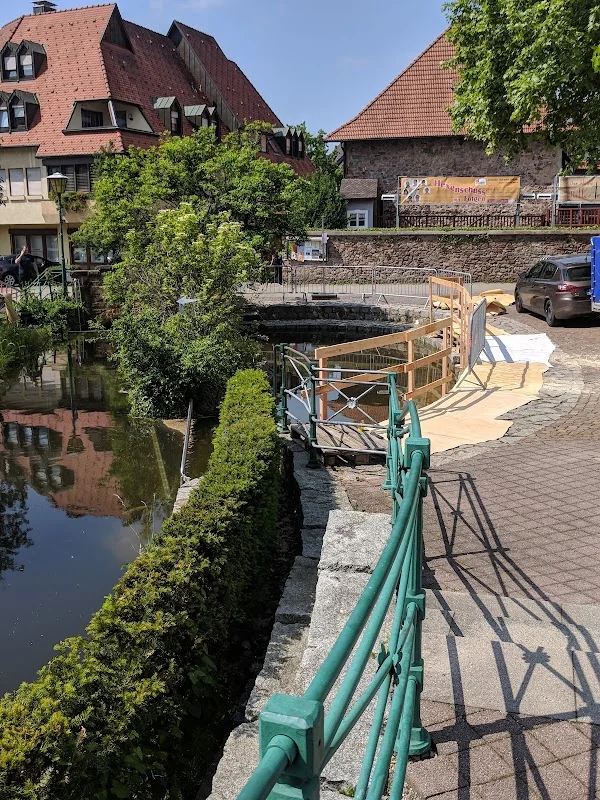
The immediate surroundings also support a pleasant stay. In the city's inner-city concepts, an urban recreational area with water is described between the market square and Südring, which is intended to remain a green retreat. Additionally, the city points out that the Bachanlage appears as a very appealing old town area. This means for the visitor: The market square is not just a traffic or market area but part of an urban space where urban use and quality of stay complement each other. Especially on warm days, this mix is advantageous because one finds a quiet area to linger after visiting the market, strolling through the city, or hiking. Those who want to experience Oberkirch on short paths get a good impression of the city overall at the market square: historical substance, functioning infrastructure, social meeting points, and a nearby countryside with paths, vines, and viewpoints. The square thus represents what makes Oberkirch a city of short distances and a lively city center. ([oberkirch.de](https://www.oberkirch.de/fileadmin/Dateien/Cross7/Startseite/Wirtschaft_und_Umwelt/Innenstadt/Innenstadtentwicklung/Innenstadtentwicklungskonzept/Innenstadtentwicklungskonzept_-_Gesamtdokumentation.pdf))
Sources:
Show moreShow less
At the Market Square Oberkirch | Parking & Weekly Market
At the Market Square in Oberkirch, the compact city center meets historical atmosphere, short distances, and a surprisingly versatile use. Visitors to the square experience not only a central point of orientation but also a part of the grown city core, which is closely connected to the history of Oberkirch. The city describes Oberkirch as a wine town in the Ortenau at the entrance to the Renchtal with picturesque old town corners, and this image also shapes the surroundings of the market square. At the same time, the square is practically organized: The city's parking guidance system directs visitors straight to the central parking areas, including the market square with an underground garage. Just a few steps away are the Tourist Information at Market Square 2a, the Community Center at Market Square 3, and several stations of the historical city tour. Thus, this place connects everyday function, urban experience, and identity in a compact space. Those who want to get to know Oberkirch start here not at an arbitrary point but at an area that links city center, movement, history, and encounters. ([oberkirch.de](https://www.oberkirch.de/de/buerger/oberkirch/stadtplan/virtueller-stadtrundgang/))
Access, Parking, and Central Accessibility
For many visitors, the first question at the Market Square in Oberkirch is quite pragmatic: Where do I park, and how do I get there as comfortably as possible? This is where the location shows its strength. According to the city, there are over 1,000 centrally located public parking spaces available in the Oberkirch city center, distributed across six main parking lots via a parking guidance system. The market square itself is an important component, as there is a parking lot with an underground garage and a total of 324 parking spaces. For an inner-city area of this size, this is a noticeable advantage because visitors can usually reach their destination without long walks. Especially for a square that serves as a weekly market area, meeting point, and starting point for city tours, this accessibility is an essential part of its quality. The city also emphasizes that additional parking spaces are marked in the streets around the city center and can be used by residents and customers. This creates a parking structure that makes visits manageable and practical. ([oberkirch.de](https://www.oberkirch.de/de/wirtschaft/innenstadt/parken-in-oberkirch))
The approach from outside is also clearly described. Those arriving by car drive from the A5 via the Appenweier exit onto the B28 towards Appenweier and Oberkirch. From there, it is about ten kilometers according to the city, passing Nußbach and Zusenhofen; just before Oberkirch, you reach a roundabout where you can choose between Oberkirch-Nußbach, the center, and Weststadt. By train, Offenburg is the nearest IC and ICE stop. From there, it takes about 20 minutes with the Ortenau S-Bahn to Oberkirch station or alternatively with bus line 7137 from the central bus station in Offenburg. For visitors to the market square, this combination of car, train, and bus is particularly valuable because it makes the square easily accessible not only for locals but also for day visitors and excursionists. The central location is thus not only felt but also supported infrastructurally. ([oberkirch.de](https://www.oberkirch.de/de/buerger/oberkirch/anreise))
Weekly Market, Meeting Point, and Temporary Events
The market square of Oberkirch is not an empty representation space but a place with actual use. In the city's inner-city development concept, it is currently primarily used for the weekly market. At the same time, there is potential for further temporary activities and events, especially for smaller events and workshops during the summer months. This classification is important because it shows that the square is not reduced to a single function. It is a market-related area, a city stage, and a place to stay at the same time. For visitors, this means: Those arriving at the market square should not only look for fixed sights but also observe the everyday life of the city. This change between regular operation and temporary activation makes the place interesting. The city explicitly understands the square as a lively meeting point that attracts visitors and invites active use. Thus, the market square in Oberkirch is an example of how a historical urban space can continue to function in everyday life without losing its character. ([oberkirch.de](https://www.oberkirch.de/fileadmin/Dateien/Cross7/Startseite/Wirtschaft_und_Umwelt/Innenstadt/Innenstadtentwicklung/Innenstadtentwicklungskonzept/Innenstadtentwicklungskonzept_-_Gesamtdokumentation.pdf))
The fact that the market square functions as a meeting point is also due to its location within the network of Oberkirch's city center. The paths are short, the city center is compact, and various uses are located close together. The Community Center at Market Square 3 is a good example of how social encounters take place directly at this location. The city describes the facility as an open meeting point for young and old, where coffee, reading newspapers, and changing exhibitions come together. This gives the square an additional social dimension that goes beyond trade and transit. Visitors experience not just an area here but a place where city life unfolds concretely. In conjunction with the weekly market, possible smaller events, and the short distances to the surrounding facilities, an environment is created that is suitable for both quick errands and a relaxed city stroll. This mix of function and atmosphere makes the market square attractive. ([oberkirch.de](https://www.oberkirch.de/de/buerger/leben-und-wohnen/buergertreff))
Historical City Center and Established Market Tradition
To truly understand the market square in Oberkirch, it is worth looking at the city's history. The city of Oberkirch explains that around the year 1400, a highly regarded market developed, and Oberkirch became the so-called main town of the bishopric of Strasbourg's territory. At that time, the city was not only an administrative seat but also an economic center for the residents of the Sasbach, Acher, and Renchtal valleys. This is the historical background of today's market square: it is part of an urban space where market and urbanity were closely linked early on. The historical significance is still felt today in the structure of the old town, which Oberkirch itself describes as a place with picturesque old town corners. Thus, the market square is not simply a modern square with a historical backdrop but an area that has a long tradition of trade, supply, and public life. Those who visit the square are moving in a space whose function has grown over centuries and has continually adapted. ([oberkirch.de](https://www.oberkirch.de/de/buerger/oberkirch/historisches/))
The architectural history around the market square also tells of change and renewal. The city wall was used in many places as a house wall from the inside and, starting in 1820, from the outside; as a result, it has been partially preserved, including at the market square and at the Löwengasse parking lot. This information makes it clear that the market square cannot be viewed in isolation but is embedded in a historically dense structure. The historical heritage is also visible in the surrounding area, for example, through the Old Town Hall, which was built in the last years of the bishopric of Strasbourg's rule in 1802 and later housed administration, primary school, and inn. Today, it houses the City Gallery and the Heimat- und Grimmelshausen Museum. When visitors stand at the market square, they experience not only an open space but also the traces of a city that has been repeatedly destroyed, rebuilt, and newly developed. This layering makes the square atmospherically interesting and gives it depth. ([oberkirch.de](https://www.oberkirch.de/de/buerger/oberkirch/stadtplan/virtueller-stadtrundgang/21.-reste-der-alten-stadtmauer))
Sights and Tours Around the Market Square
One of the greatest advantages of the market square is its role as a starting and orientation point for explorations. The historical city stroll through Oberkirch begins and ends at the Tourist Information at Market Square 2a. From there, the tour leads through the historical city center to a series of stations, including Mühlbach, city wall, Romantic Hotel Zur Oberen Linde, Upper City Gate, Nepomuk Fountain, City Palace, Old Town Hall, Gasthaus Sonne, Kirchgätter, Probstei building, Church Square, Catholic Church, House zum Greifen, Lion Fountain, August-Ganther Fountain, Office House, Lower Gate, Protestant Church, Old Hospital, Tannery building, remains of the old city wall, houses in the Bachanlage, s freche hus, and Winzer Fountain. This enumeration already shows how closely the market square is connected to the historical core. Therefore, those who choose the square as a starting point have direct access to a city tour with much substance without having to search for long paths first. For guests who want to orient themselves for the first time, this is a clear advantage. ([oberkirch.de](https://www.oberkirch.de/fileadmin/Dateien/Dateien/Geschichte/stadtbummel.pdf))
Additionally, the market square serves as a starting point for walks and hikes in the surrounding area. The city records the market square as the starting point for the wine trail, which is about 9.0 kilometers long, with a height difference of 100 meters and twelve information and explanation boards. Other hikes also begin here and lead, for example, to the Schauenburg, into the vineyards, or on longer circular routes through the Renchtal. In the city's descriptions, the market square is repeatedly mentioned as the starting point from which one leaves the city center and directly transitions into the landscape. This makes the square attractive for active visitors who want to combine a city visit with nature and views. Particularly appealing is the combination of an urban beginning and a landscape-shaped destination: first historical center, then wine trail, viewpoints, or castle ruins. Thus, those who start at the market square are not only beginning a path but also a small perspective shift between city, vines, and heights. ([oberkirch.de](https://www.oberkirch.de/de/freizeit/aktivitaeten/naturlehrpfade/weinlehrpfad?utm_source=openai))
Practical Orientation for the Visit On-Site
Practically speaking, the market square in Oberkirch is a place where one can easily orient oneself. The Tourist Information at Market Square 2a serves as the starting and ending point of the historical city stroll, which significantly eases orientation for guests. In close proximity is also the Community Center at Market Square 3, described as an open meeting point. This creates a small network around the square of information, encounters, and public life. For visitors, this is helpful because they can accomplish several things simultaneously at a central point: gather information, start the city tour, visit the weekly market, or simply plan a stay in the city center. The city also emphasizes that there are numerous marked parking spaces around the city center and a parking guidance system organizes traffic. This is particularly important for guests who do not know Oberkirch and are looking for a clear starting point. The market square fulfills this function in a very direct way. ([oberkirch.de](https://www.oberkirch.de/fileadmin/Dateien/Dateien/Geschichte/stadtbummel.pdf))
The immediate surroundings also support a pleasant stay. In the city's inner-city concepts, an urban recreational area with water is described between the market square and Südring, which is intended to remain a green retreat. Additionally, the city points out that the Bachanlage appears as a very appealing old town area. This means for the visitor: The market square is not just a traffic or market area but part of an urban space where urban use and quality of stay complement each other. Especially on warm days, this mix is advantageous because one finds a quiet area to linger after visiting the market, strolling through the city, or hiking. Those who want to experience Oberkirch on short paths get a good impression of the city overall at the market square: historical substance, functioning infrastructure, social meeting points, and a nearby countryside with paths, vines, and viewpoints. The square thus represents what makes Oberkirch a city of short distances and a lively city center. ([oberkirch.de](https://www.oberkirch.de/fileadmin/Dateien/Cross7/Startseite/Wirtschaft_und_Umwelt/Innenstadt/Innenstadtentwicklung/Innenstadtentwicklungskonzept/Innenstadtentwicklungskonzept_-_Gesamtdokumentation.pdf))
Sources:
At the Market Square Oberkirch | Parking & Weekly Market
At the Market Square in Oberkirch, the compact city center meets historical atmosphere, short distances, and a surprisingly versatile use. Visitors to the square experience not only a central point of orientation but also a part of the grown city core, which is closely connected to the history of Oberkirch. The city describes Oberkirch as a wine town in the Ortenau at the entrance to the Renchtal with picturesque old town corners, and this image also shapes the surroundings of the market square. At the same time, the square is practically organized: The city's parking guidance system directs visitors straight to the central parking areas, including the market square with an underground garage. Just a few steps away are the Tourist Information at Market Square 2a, the Community Center at Market Square 3, and several stations of the historical city tour. Thus, this place connects everyday function, urban experience, and identity in a compact space. Those who want to get to know Oberkirch start here not at an arbitrary point but at an area that links city center, movement, history, and encounters. ([oberkirch.de](https://www.oberkirch.de/de/buerger/oberkirch/stadtplan/virtueller-stadtrundgang/))
Access, Parking, and Central Accessibility
For many visitors, the first question at the Market Square in Oberkirch is quite pragmatic: Where do I park, and how do I get there as comfortably as possible? This is where the location shows its strength. According to the city, there are over 1,000 centrally located public parking spaces available in the Oberkirch city center, distributed across six main parking lots via a parking guidance system. The market square itself is an important component, as there is a parking lot with an underground garage and a total of 324 parking spaces. For an inner-city area of this size, this is a noticeable advantage because visitors can usually reach their destination without long walks. Especially for a square that serves as a weekly market area, meeting point, and starting point for city tours, this accessibility is an essential part of its quality. The city also emphasizes that additional parking spaces are marked in the streets around the city center and can be used by residents and customers. This creates a parking structure that makes visits manageable and practical. ([oberkirch.de](https://www.oberkirch.de/de/wirtschaft/innenstadt/parken-in-oberkirch))
The approach from outside is also clearly described. Those arriving by car drive from the A5 via the Appenweier exit onto the B28 towards Appenweier and Oberkirch. From there, it is about ten kilometers according to the city, passing Nußbach and Zusenhofen; just before Oberkirch, you reach a roundabout where you can choose between Oberkirch-Nußbach, the center, and Weststadt. By train, Offenburg is the nearest IC and ICE stop. From there, it takes about 20 minutes with the Ortenau S-Bahn to Oberkirch station or alternatively with bus line 7137 from the central bus station in Offenburg. For visitors to the market square, this combination of car, train, and bus is particularly valuable because it makes the square easily accessible not only for locals but also for day visitors and excursionists. The central location is thus not only felt but also supported infrastructurally. ([oberkirch.de](https://www.oberkirch.de/de/buerger/oberkirch/anreise))
Weekly Market, Meeting Point, and Temporary Events
The market square of Oberkirch is not an empty representation space but a place with actual use. In the city's inner-city development concept, it is currently primarily used for the weekly market. At the same time, there is potential for further temporary activities and events, especially for smaller events and workshops during the summer months. This classification is important because it shows that the square is not reduced to a single function. It is a market-related area, a city stage, and a place to stay at the same time. For visitors, this means: Those arriving at the market square should not only look for fixed sights but also observe the everyday life of the city. This change between regular operation and temporary activation makes the place interesting. The city explicitly understands the square as a lively meeting point that attracts visitors and invites active use. Thus, the market square in Oberkirch is an example of how a historical urban space can continue to function in everyday life without losing its character. ([oberkirch.de](https://www.oberkirch.de/fileadmin/Dateien/Cross7/Startseite/Wirtschaft_und_Umwelt/Innenstadt/Innenstadtentwicklung/Innenstadtentwicklungskonzept/Innenstadtentwicklungskonzept_-_Gesamtdokumentation.pdf))
The fact that the market square functions as a meeting point is also due to its location within the network of Oberkirch's city center. The paths are short, the city center is compact, and various uses are located close together. The Community Center at Market Square 3 is a good example of how social encounters take place directly at this location. The city describes the facility as an open meeting point for young and old, where coffee, reading newspapers, and changing exhibitions come together. This gives the square an additional social dimension that goes beyond trade and transit. Visitors experience not just an area here but a place where city life unfolds concretely. In conjunction with the weekly market, possible smaller events, and the short distances to the surrounding facilities, an environment is created that is suitable for both quick errands and a relaxed city stroll. This mix of function and atmosphere makes the market square attractive. ([oberkirch.de](https://www.oberkirch.de/de/buerger/leben-und-wohnen/buergertreff))
Historical City Center and Established Market Tradition
To truly understand the market square in Oberkirch, it is worth looking at the city's history. The city of Oberkirch explains that around the year 1400, a highly regarded market developed, and Oberkirch became the so-called main town of the bishopric of Strasbourg's territory. At that time, the city was not only an administrative seat but also an economic center for the residents of the Sasbach, Acher, and Renchtal valleys. This is the historical background of today's market square: it is part of an urban space where market and urbanity were closely linked early on. The historical significance is still felt today in the structure of the old town, which Oberkirch itself describes as a place with picturesque old town corners. Thus, the market square is not simply a modern square with a historical backdrop but an area that has a long tradition of trade, supply, and public life. Those who visit the square are moving in a space whose function has grown over centuries and has continually adapted. ([oberkirch.de](https://www.oberkirch.de/de/buerger/oberkirch/historisches/))
The architectural history around the market square also tells of change and renewal. The city wall was used in many places as a house wall from the inside and, starting in 1820, from the outside; as a result, it has been partially preserved, including at the market square and at the Löwengasse parking lot. This information makes it clear that the market square cannot be viewed in isolation but is embedded in a historically dense structure. The historical heritage is also visible in the surrounding area, for example, through the Old Town Hall, which was built in the last years of the bishopric of Strasbourg's rule in 1802 and later housed administration, primary school, and inn. Today, it houses the City Gallery and the Heimat- und Grimmelshausen Museum. When visitors stand at the market square, they experience not only an open space but also the traces of a city that has been repeatedly destroyed, rebuilt, and newly developed. This layering makes the square atmospherically interesting and gives it depth. ([oberkirch.de](https://www.oberkirch.de/de/buerger/oberkirch/stadtplan/virtueller-stadtrundgang/21.-reste-der-alten-stadtmauer))
Sights and Tours Around the Market Square
One of the greatest advantages of the market square is its role as a starting and orientation point for explorations. The historical city stroll through Oberkirch begins and ends at the Tourist Information at Market Square 2a. From there, the tour leads through the historical city center to a series of stations, including Mühlbach, city wall, Romantic Hotel Zur Oberen Linde, Upper City Gate, Nepomuk Fountain, City Palace, Old Town Hall, Gasthaus Sonne, Kirchgätter, Probstei building, Church Square, Catholic Church, House zum Greifen, Lion Fountain, August-Ganther Fountain, Office House, Lower Gate, Protestant Church, Old Hospital, Tannery building, remains of the old city wall, houses in the Bachanlage, s freche hus, and Winzer Fountain. This enumeration already shows how closely the market square is connected to the historical core. Therefore, those who choose the square as a starting point have direct access to a city tour with much substance without having to search for long paths first. For guests who want to orient themselves for the first time, this is a clear advantage. ([oberkirch.de](https://www.oberkirch.de/fileadmin/Dateien/Dateien/Geschichte/stadtbummel.pdf))
Additionally, the market square serves as a starting point for walks and hikes in the surrounding area. The city records the market square as the starting point for the wine trail, which is about 9.0 kilometers long, with a height difference of 100 meters and twelve information and explanation boards. Other hikes also begin here and lead, for example, to the Schauenburg, into the vineyards, or on longer circular routes through the Renchtal. In the city's descriptions, the market square is repeatedly mentioned as the starting point from which one leaves the city center and directly transitions into the landscape. This makes the square attractive for active visitors who want to combine a city visit with nature and views. Particularly appealing is the combination of an urban beginning and a landscape-shaped destination: first historical center, then wine trail, viewpoints, or castle ruins. Thus, those who start at the market square are not only beginning a path but also a small perspective shift between city, vines, and heights. ([oberkirch.de](https://www.oberkirch.de/de/freizeit/aktivitaeten/naturlehrpfade/weinlehrpfad?utm_source=openai))
Practical Orientation for the Visit On-Site
Practically speaking, the market square in Oberkirch is a place where one can easily orient oneself. The Tourist Information at Market Square 2a serves as the starting and ending point of the historical city stroll, which significantly eases orientation for guests. In close proximity is also the Community Center at Market Square 3, described as an open meeting point. This creates a small network around the square of information, encounters, and public life. For visitors, this is helpful because they can accomplish several things simultaneously at a central point: gather information, start the city tour, visit the weekly market, or simply plan a stay in the city center. The city also emphasizes that there are numerous marked parking spaces around the city center and a parking guidance system organizes traffic. This is particularly important for guests who do not know Oberkirch and are looking for a clear starting point. The market square fulfills this function in a very direct way. ([oberkirch.de](https://www.oberkirch.de/fileadmin/Dateien/Dateien/Geschichte/stadtbummel.pdf))
The immediate surroundings also support a pleasant stay. In the city's inner-city concepts, an urban recreational area with water is described between the market square and Südring, which is intended to remain a green retreat. Additionally, the city points out that the Bachanlage appears as a very appealing old town area. This means for the visitor: The market square is not just a traffic or market area but part of an urban space where urban use and quality of stay complement each other. Especially on warm days, this mix is advantageous because one finds a quiet area to linger after visiting the market, strolling through the city, or hiking. Those who want to experience Oberkirch on short paths get a good impression of the city overall at the market square: historical substance, functioning infrastructure, social meeting points, and a nearby countryside with paths, vines, and viewpoints. The square thus represents what makes Oberkirch a city of short distances and a lively city center. ([oberkirch.de](https://www.oberkirch.de/fileadmin/Dateien/Cross7/Startseite/Wirtschaft_und_Umwelt/Innenstadt/Innenstadtentwicklung/Innenstadtentwicklungskonzept/Innenstadtentwicklungskonzept_-_Gesamtdokumentation.pdf))
Sources:
Upcoming Events
No events found
Frequently Asked Questions
Reviews
No reviews found