
Freiburg im Breisgau
Stadtstraße 10, 79104 Freiburg im Breisgau, Deutschland
Old Cemetery Freiburg im Breisgau | Opening Hours & Photos
The Old Cemetery Freiburg im Breisgau is one of those places that you don't just visit, but experience consciously. Between Stadtstraße and Karlstraße lies a quiet, green area that today is perceived as a sight, a historical park cemetery, and a cultural-historical memorial at the same time. Those interested in Freiburg's past will find here not an ordinary green space, but a place where city history, art history, and personal memories overlap in a special way. The official Freiburg page describes the Old Cemetery as an incomparable green oasis with historical tombs and an impressive sense of seclusion right in the city; the historical classification as the former main cemetery and its high cultural-historical significance are also emphasized by the monument protection side and the support association. ([visit.freiburg.de](https://visit.freiburg.de/alter-friedhof))
Especially because many people search for photos, images, opening hours, history, and special graves, the Old Cemetery is a place with multiple layers: It is quiet, beautiful, educational, and at the same time of great symbolic depth. The park character with old trees, the Michaels Chapel, the numerous tombs, and the names of significant Freiburg families and personalities make the walk varied. At the same time, the place remains manageable and approachable, as the paths are clear, the entrances are easy to find, and the facility is open daily. Those who want to get to know Freiburg not just as an old town with the cathedral and cafés will discover a very different, more contemplative side of the city here. ([visit.freiburg.de](https://visit.freiburg.de/alter-friedhof))
Opening Hours, Location, and Barrier-Free Access
For most visitors, the practical part of planning begins with the opening hours and location. Here, the Old Cemetery is pleasantly uncomplicated: The official visitor page states daily from 07:00 to 20:00, for Monday to Sunday as well as holidays. This makes the place suitable for both an early walk and a visit in the evening when the city becomes a bit quieter. The address of the visitor area is given as Stadtstraße 8 in Freiburg im Breisgau, and the facility is located north of the old town. Those who know the city will quickly notice: The Old Cemetery is very close to the center, but surprisingly shielded by its walls and the enclosed area. This contrast makes the place so special. Despite its location in the middle of Freiburg, entering creates a feeling of peace and retreat, which is explicitly emphasized in the official description. ([visit.freiburg.de](https://visit.freiburg.de/alter-friedhof))
Also in terms of accessibility, the Old Cemetery impresses with pragmatic details. The Freiburg tourism page points out ground-level access via Stadtstraße and Karlstraße; the support association mentions several entrances on both streets. This is helpful for visitors, as the walk can be flexibly designed and the entry is possible not just at a single point. Those who want to avoid steps or are traveling with a stroller, walking aid, or wheelchair will find clear orientation. The facility is not designed as a modern event space, but as a historical site, and that is why simple, ground-level access is particularly valuable. Also for people who just want to stop by briefly or take a break during lunch, the access is pleasantly direct. The combination of a central location, open access, and regulated opening hours makes the Old Cemetery a place that can be visited both spontaneously and purposefully. ([visit.freiburg.de](https://visit.freiburg.de/alter-friedhof))
History of the Old Cemetery from 1683 to 1872
The historical dimension of the Old Cemetery is the core of its special reputation. According to the support association, the facility was the main cemetery of the city of Freiburg between 1683 and 1872. Thus, it was a central place of urban life and death for almost 190 years, going far beyond a simple burial site. The official history page describes the Old Cemetery as an extraordinary treasure with supra-regional cultural-historical significance. Today, only a few cemeteries from the 17th to 19th centuries in Germany have been preserved in this completeness. This explains why this place is important not only locally but also for those interested in art and cultural history from other regions. ([alter-friedhof-freiburg.de](https://www.alter-friedhof-freiburg.de/geschichte/))
It is particularly interesting that the Old Cemetery can also be read as a document of art, history, and mindset. The support association points out that the gravestones commemorate Freiburg families and personalities and historical events of regional and supra-regional significance. The monument protection side emphasizes that the high-quality tombs are not only art-historically valuable but also mark the resting places of notable citizens of the city. Thus, walking through the facility, one does not read an abstract table history, but a very concrete form of urban development: family names, career paths, political and cultural roles, religious changes, and memories of revolutions or wars. In this sense, the Old Cemetery is not a closed museum space but a grown layer of history in the open air. The enclosed park facility makes these layers not heavy but accessible. It is precisely the slow walking between the tombs that changes perception: from years, family names, and symbols emerges a vivid picture of Freiburg's past. ([alter-friedhof-freiburg.de](https://www.alter-friedhof-freiburg.de/geschichte/))
Tombs, Personalities, and Historical Symbolism
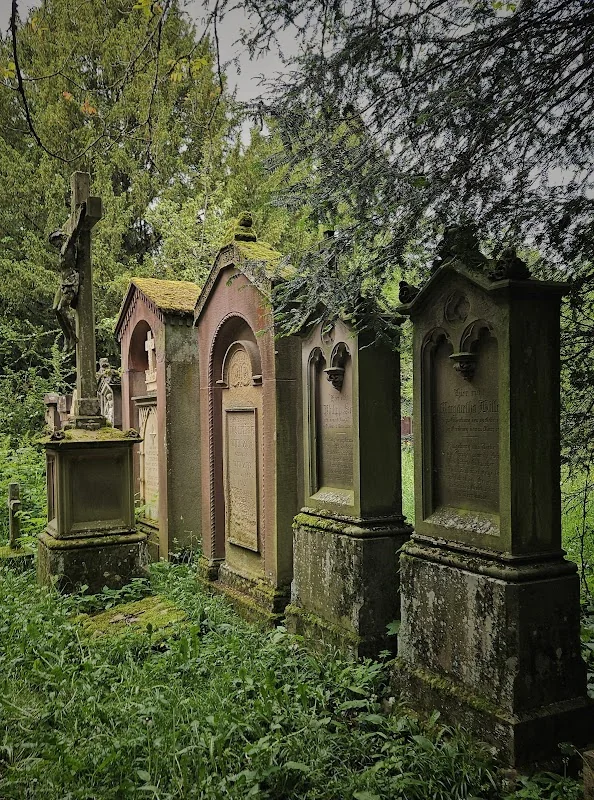
A large part of the fascination of the Old Cemetery lies in the tombs themselves. The support association speaks of about 1,150 tombs, and the official tour describes over 1,100 monuments, ranging from magnificent stone monuments to filigree metal crosses to simple wooden crosses. This diversity is not only aesthetically exciting but also culturally historically significant because it shows how burial culture has changed over the centuries. Those who visit the place encounter not a single form of commemoration but a whole typology of tomb art. That is why the Old Cemetery is so interesting for people looking for images and photos: There are not only individual motifs but numerous small details, inscriptions, and material contrasts that reveal themselves anew during the slow walk through the facility. ([alter-friedhof-freiburg.de](https://www.alter-friedhof-freiburg.de/lage-und-grundriss/))
The personalities mentioned there also make the cemetery a place of Freiburg's memory culture. The support association mentions families such as von Kageneck, von Gleichenstein, and von Reck, as well as bourgeois families like Pyhrr, Krebs, Keller, Ganter, Federer, Marbe, Brenzinger, and Buisson. Furthermore, individuals who have worked in Freiburg as university professors, scholars, publishers, politicians, or artists are highlighted. Notable names include Johann Christian Wentzinger, Karl von Rotteck, Bartholomä Herder, Hermann Meinrad Poppen, Joseph Anselm Feuerbach, Johann Georg Jacobi, Alexander Ecker, and Thaddäus Rinderle. For visitors, this is exciting because it shows a historical network of family, education, religion, politics, and art. The tombs thus tell not only of individual persons but of a bourgeois and academic urban society that has shaped Freiburg over generations. ([alter-friedhof-freiburg.de](https://www.alter-friedhof-freiburg.de/geschichte/))
In addition, there is the symbolic level of tomb art. The history page describes symbols of mourning and comforting messages, such as putto figures, depictions of death as the brother of sleep, angels as companions of the soul, or death youths. Christian motifs and ancient elements appear side by side, for example, the cross, resurrection scenes, the eye of God, a bent extinguishing torch, or the butterfly. This mixture of religious, classicist, and emotional imagery makes the Old Cemetery an open-air textbook of symbolism. For visitors who take their time, a quiet but very dense imagery opens up. It is not loud and not spectacular in the modern sense, but it has a depth that many people remember for a long time. ([alter-friedhof-freiburg.de](https://www.alter-friedhof-freiburg.de/geschichte/))
Michaels Chapel, Park Character, and Special Monuments
The Michaels Chapel is one of the most important landmarks in the Old Cemetery. The official Freiburg page mentions it as a structure from 1720, which was heavily damaged in World War II but was then rebuilt authentically. Thus, the chapel stands not only for historical continuity but also for the willingness to restore significant buildings after loss and destruction. For the visitor, it acts as a calm anchor in the center of the facility, and it enhances the impression that the cemetery is not only a place of remembrance but also an architectural ensemble. In conjunction with the tombs and the tree population, a space is created that is both sacred, historical, and scenic. ([visit.freiburg.de](https://visit.freiburg.de/alter-friedhof))
The park character is as important for the Old Cemetery as its historical substance. The official description speaks of a green oasis with old, shade-giving trees, park benches for the lunch break, and a high cemetery portal or wall that creates a feeling of seclusion in the middle of the city. The support association mentions a size of 2.65 hectares and refers to the listed stock with about 1,150 tombs and other special elements. This also includes the monument to the storm Lothar from December 26, 1999, which is mentioned in the location overview. The facility thus combines nature, memory, monument preservation, and later additions in a common historical space. This makes the cemetery interesting for visitors who do not just want to see individual graves but also want to understand the development of a place that has changed over centuries while still preserving its core. ([visit.freiburg.de](https://visit.freiburg.de/alter-friedhof))
From a monument preservation perspective, the Old Cemetery is also remarkable. The German Foundation for Monument Protection emphasizes the art-historical quality of the tombs and their urban historical significance as resting places of notable citizens. This shows that the place plays a role not only in local city marketing but is also considered worthy of preservation from a professional perspective. For visitors, this classification is important because it explains why the cemetery is treated with such care. The facility is not a backdrop but a protected cultural asset. Those who walk here move through a space where restored stones, historical chapel, old trees, and quiet paths are consciously held together. It is precisely this combination of beauty and protection that makes the Old Cemetery a place where one automatically slows down and looks more closely. ([denkmalschutz.de](https://www.denkmalschutz.de/denkmal/alter-friedhof-freiburg.html?utm_source=openai))
Access, Entrances, and Barrier-Free Access
For everyone who wants to visit the Old Cemetery practically, the accesses on Stadtstraße and Karlstraße are particularly important. The Freiburg tourism page mentions ground-level access via both streets, and the support association confirms several entrances on Stadtstraße and Karlstraße. This is helpful because the place does not function like a closed event space but like an open, historical area with different entry options. Those coming from the center or the northern districts can easily incorporate the visit into a walk through the surroundings. The location north of the old town also makes the Old Cemetery easily combinable with other Freiburg destinations. It is close enough to be integrated into a city stroll, yet far enough away from the hustle and bustle to offer real peace. ([visit.freiburg.de](https://visit.freiburg.de/alter-friedhof))
Barrier-free access is also a plus point. The official note on ground-level access means that the cemetery is not only better accessible for cultural-historical walks but also for people with limited mobility. This is not a given for a historical site. Additionally, the walk does not lead extensively over slopes or complicated paths but unfolds over the historical structure of the facility. For visitors looking for access, parking options, or uncomplicated entry, this combination is advantageous. Although the Old Cemetery is not a classic auto location with a large parking lot like a trade fair hall, its central location in the urban space and good footpaths make it easily accessible. Those who combine the visit with public transport or a city walk particularly benefit from the compact location. ([visit.freiburg.de](https://visit.freiburg.de/alter-friedhof))
Visual orientation is also clear. The Old Cemetery is listed in Freiburg as a sight that is well known in the city and is located near other notable places. This makes it easy to assess the visit: One does not come for a long program but for a conscious stay between few but very dense impressions. This character makes the facility attractive in everyday life. Those with limited time can only look at one section; those who are more intensely interested can walk slowly through the historical areas and take in the details of the tombs, the chapel, and the trees. For internal planning, it is important: The place is open, manageable, and very well suited for a quiet visit. ([visit.freiburg.de](https://visit.freiburg.de/alter-friedhof))
Guided Tours, Photos, and Quiet Walks in the Green
The many search queries for photos and tours are easily understandable at the Old Cemetery, as the place offers an amazing variety of motifs and stories in a small space. The official city page offers guided tours that start at the entrance on Stadtstraße. These not only visit famous graves but also explain the historical development of the place. According to the tour description, a testimony of historical tomb art with over 1,100 tombs rests here, and the tour leads among other things to the grave of Johann Christian Wentzinger, to the Michaels Chapel, to the Lothar Plane Tree, and to a memorial stone for the revolutionaries of 1848/1849. This is particularly interesting for visitors because the cemetery thus becomes not only a quiet park but an narratable urban space. ([visit.freiburg.de](https://visit.freiburg.de/fuehrung-alter-friedhof?utm_source=openai))
It is precisely the mixture of nature and culture that makes the Old Cemetery so adaptable for different types of visitors. Some come because of the historical personalities, others because of the atmosphere, and still others because of the tomb art or the opportunity to find an unusually quiet place in the city center. The official description speaks of old trees, shade, park benches, and the feeling of complete seclusion in the middle of the city. This explains why the place is suitable for both a slow walk and a guided discovery tour. Those who want to take pictures will find a variety of structures here: stone, metal, moss, tree bark, wall, chapel, and light-shadow contrasts. For a good understanding of the place, it is helpful to see it not only as a cemetery but as a historical park facility where Freiburg's past is visible and remains quiet at the same time. ([visit.freiburg.de](https://visit.freiburg.de/alter-friedhof))
A visit is also worthwhile because the Old Cemetery has a rare completeness. The support association and the monument protection side make it clear that the place is preserved as an ensemble, not just as a collection of individual tombstones. You can feel this on-site: The paths, the walls, the chapel, the trees, and the tombs together create a special atmosphere. Those who truly want to get to know Freiburg should not just check off this place in passing. A conscious walk shows how strongly city history, memory culture, and landscape can mutually shape each other. Therefore, the Old Cemetery is a good place for all who do not just want to tick off sights during a city trip but seek a moment of peace. Here, no loud experience is created, but a lasting impression. ([denkmalschutz.de](https://www.denkmalschutz.de/denkmal/alter-friedhof-freiburg.html?utm_source=openai))
Sources:
- Old Cemetery Freiburg - Official Freiburg Tourism Page
- Old Cemetery Freiburg - History of the Support Association
- Old Cemetery Freiburg - Location and Layout of the Support Association
- Guided Tour Old Cemetery - Official Freiburg Tourism Page
- German Foundation for Monument Protection - Old Cemetery Freiburg
- Old Cemetery Freiburg - English official page
Show moreShow less
Old Cemetery Freiburg im Breisgau | Opening Hours & Photos
The Old Cemetery Freiburg im Breisgau is one of those places that you don't just visit, but experience consciously. Between Stadtstraße and Karlstraße lies a quiet, green area that today is perceived as a sight, a historical park cemetery, and a cultural-historical memorial at the same time. Those interested in Freiburg's past will find here not an ordinary green space, but a place where city history, art history, and personal memories overlap in a special way. The official Freiburg page describes the Old Cemetery as an incomparable green oasis with historical tombs and an impressive sense of seclusion right in the city; the historical classification as the former main cemetery and its high cultural-historical significance are also emphasized by the monument protection side and the support association. ([visit.freiburg.de](https://visit.freiburg.de/alter-friedhof))
Especially because many people search for photos, images, opening hours, history, and special graves, the Old Cemetery is a place with multiple layers: It is quiet, beautiful, educational, and at the same time of great symbolic depth. The park character with old trees, the Michaels Chapel, the numerous tombs, and the names of significant Freiburg families and personalities make the walk varied. At the same time, the place remains manageable and approachable, as the paths are clear, the entrances are easy to find, and the facility is open daily. Those who want to get to know Freiburg not just as an old town with the cathedral and cafés will discover a very different, more contemplative side of the city here. ([visit.freiburg.de](https://visit.freiburg.de/alter-friedhof))
Opening Hours, Location, and Barrier-Free Access
For most visitors, the practical part of planning begins with the opening hours and location. Here, the Old Cemetery is pleasantly uncomplicated: The official visitor page states daily from 07:00 to 20:00, for Monday to Sunday as well as holidays. This makes the place suitable for both an early walk and a visit in the evening when the city becomes a bit quieter. The address of the visitor area is given as Stadtstraße 8 in Freiburg im Breisgau, and the facility is located north of the old town. Those who know the city will quickly notice: The Old Cemetery is very close to the center, but surprisingly shielded by its walls and the enclosed area. This contrast makes the place so special. Despite its location in the middle of Freiburg, entering creates a feeling of peace and retreat, which is explicitly emphasized in the official description. ([visit.freiburg.de](https://visit.freiburg.de/alter-friedhof))
Also in terms of accessibility, the Old Cemetery impresses with pragmatic details. The Freiburg tourism page points out ground-level access via Stadtstraße and Karlstraße; the support association mentions several entrances on both streets. This is helpful for visitors, as the walk can be flexibly designed and the entry is possible not just at a single point. Those who want to avoid steps or are traveling with a stroller, walking aid, or wheelchair will find clear orientation. The facility is not designed as a modern event space, but as a historical site, and that is why simple, ground-level access is particularly valuable. Also for people who just want to stop by briefly or take a break during lunch, the access is pleasantly direct. The combination of a central location, open access, and regulated opening hours makes the Old Cemetery a place that can be visited both spontaneously and purposefully. ([visit.freiburg.de](https://visit.freiburg.de/alter-friedhof))
History of the Old Cemetery from 1683 to 1872
The historical dimension of the Old Cemetery is the core of its special reputation. According to the support association, the facility was the main cemetery of the city of Freiburg between 1683 and 1872. Thus, it was a central place of urban life and death for almost 190 years, going far beyond a simple burial site. The official history page describes the Old Cemetery as an extraordinary treasure with supra-regional cultural-historical significance. Today, only a few cemeteries from the 17th to 19th centuries in Germany have been preserved in this completeness. This explains why this place is important not only locally but also for those interested in art and cultural history from other regions. ([alter-friedhof-freiburg.de](https://www.alter-friedhof-freiburg.de/geschichte/))
It is particularly interesting that the Old Cemetery can also be read as a document of art, history, and mindset. The support association points out that the gravestones commemorate Freiburg families and personalities and historical events of regional and supra-regional significance. The monument protection side emphasizes that the high-quality tombs are not only art-historically valuable but also mark the resting places of notable citizens of the city. Thus, walking through the facility, one does not read an abstract table history, but a very concrete form of urban development: family names, career paths, political and cultural roles, religious changes, and memories of revolutions or wars. In this sense, the Old Cemetery is not a closed museum space but a grown layer of history in the open air. The enclosed park facility makes these layers not heavy but accessible. It is precisely the slow walking between the tombs that changes perception: from years, family names, and symbols emerges a vivid picture of Freiburg's past. ([alter-friedhof-freiburg.de](https://www.alter-friedhof-freiburg.de/geschichte/))
Tombs, Personalities, and Historical Symbolism
A large part of the fascination of the Old Cemetery lies in the tombs themselves. The support association speaks of about 1,150 tombs, and the official tour describes over 1,100 monuments, ranging from magnificent stone monuments to filigree metal crosses to simple wooden crosses. This diversity is not only aesthetically exciting but also culturally historically significant because it shows how burial culture has changed over the centuries. Those who visit the place encounter not a single form of commemoration but a whole typology of tomb art. That is why the Old Cemetery is so interesting for people looking for images and photos: There are not only individual motifs but numerous small details, inscriptions, and material contrasts that reveal themselves anew during the slow walk through the facility. ([alter-friedhof-freiburg.de](https://www.alter-friedhof-freiburg.de/lage-und-grundriss/))
The personalities mentioned there also make the cemetery a place of Freiburg's memory culture. The support association mentions families such as von Kageneck, von Gleichenstein, and von Reck, as well as bourgeois families like Pyhrr, Krebs, Keller, Ganter, Federer, Marbe, Brenzinger, and Buisson. Furthermore, individuals who have worked in Freiburg as university professors, scholars, publishers, politicians, or artists are highlighted. Notable names include Johann Christian Wentzinger, Karl von Rotteck, Bartholomä Herder, Hermann Meinrad Poppen, Joseph Anselm Feuerbach, Johann Georg Jacobi, Alexander Ecker, and Thaddäus Rinderle. For visitors, this is exciting because it shows a historical network of family, education, religion, politics, and art. The tombs thus tell not only of individual persons but of a bourgeois and academic urban society that has shaped Freiburg over generations. ([alter-friedhof-freiburg.de](https://www.alter-friedhof-freiburg.de/geschichte/))
In addition, there is the symbolic level of tomb art. The history page describes symbols of mourning and comforting messages, such as putto figures, depictions of death as the brother of sleep, angels as companions of the soul, or death youths. Christian motifs and ancient elements appear side by side, for example, the cross, resurrection scenes, the eye of God, a bent extinguishing torch, or the butterfly. This mixture of religious, classicist, and emotional imagery makes the Old Cemetery an open-air textbook of symbolism. For visitors who take their time, a quiet but very dense imagery opens up. It is not loud and not spectacular in the modern sense, but it has a depth that many people remember for a long time. ([alter-friedhof-freiburg.de](https://www.alter-friedhof-freiburg.de/geschichte/))
Michaels Chapel, Park Character, and Special Monuments
The Michaels Chapel is one of the most important landmarks in the Old Cemetery. The official Freiburg page mentions it as a structure from 1720, which was heavily damaged in World War II but was then rebuilt authentically. Thus, the chapel stands not only for historical continuity but also for the willingness to restore significant buildings after loss and destruction. For the visitor, it acts as a calm anchor in the center of the facility, and it enhances the impression that the cemetery is not only a place of remembrance but also an architectural ensemble. In conjunction with the tombs and the tree population, a space is created that is both sacred, historical, and scenic. ([visit.freiburg.de](https://visit.freiburg.de/alter-friedhof))
The park character is as important for the Old Cemetery as its historical substance. The official description speaks of a green oasis with old, shade-giving trees, park benches for the lunch break, and a high cemetery portal or wall that creates a feeling of seclusion in the middle of the city. The support association mentions a size of 2.65 hectares and refers to the listed stock with about 1,150 tombs and other special elements. This also includes the monument to the storm Lothar from December 26, 1999, which is mentioned in the location overview. The facility thus combines nature, memory, monument preservation, and later additions in a common historical space. This makes the cemetery interesting for visitors who do not just want to see individual graves but also want to understand the development of a place that has changed over centuries while still preserving its core. ([visit.freiburg.de](https://visit.freiburg.de/alter-friedhof))
From a monument preservation perspective, the Old Cemetery is also remarkable. The German Foundation for Monument Protection emphasizes the art-historical quality of the tombs and their urban historical significance as resting places of notable citizens. This shows that the place plays a role not only in local city marketing but is also considered worthy of preservation from a professional perspective. For visitors, this classification is important because it explains why the cemetery is treated with such care. The facility is not a backdrop but a protected cultural asset. Those who walk here move through a space where restored stones, historical chapel, old trees, and quiet paths are consciously held together. It is precisely this combination of beauty and protection that makes the Old Cemetery a place where one automatically slows down and looks more closely. ([denkmalschutz.de](https://www.denkmalschutz.de/denkmal/alter-friedhof-freiburg.html?utm_source=openai))
Access, Entrances, and Barrier-Free Access
For everyone who wants to visit the Old Cemetery practically, the accesses on Stadtstraße and Karlstraße are particularly important. The Freiburg tourism page mentions ground-level access via both streets, and the support association confirms several entrances on Stadtstraße and Karlstraße. This is helpful because the place does not function like a closed event space but like an open, historical area with different entry options. Those coming from the center or the northern districts can easily incorporate the visit into a walk through the surroundings. The location north of the old town also makes the Old Cemetery easily combinable with other Freiburg destinations. It is close enough to be integrated into a city stroll, yet far enough away from the hustle and bustle to offer real peace. ([visit.freiburg.de](https://visit.freiburg.de/alter-friedhof))
Barrier-free access is also a plus point. The official note on ground-level access means that the cemetery is not only better accessible for cultural-historical walks but also for people with limited mobility. This is not a given for a historical site. Additionally, the walk does not lead extensively over slopes or complicated paths but unfolds over the historical structure of the facility. For visitors looking for access, parking options, or uncomplicated entry, this combination is advantageous. Although the Old Cemetery is not a classic auto location with a large parking lot like a trade fair hall, its central location in the urban space and good footpaths make it easily accessible. Those who combine the visit with public transport or a city walk particularly benefit from the compact location. ([visit.freiburg.de](https://visit.freiburg.de/alter-friedhof))
Visual orientation is also clear. The Old Cemetery is listed in Freiburg as a sight that is well known in the city and is located near other notable places. This makes it easy to assess the visit: One does not come for a long program but for a conscious stay between few but very dense impressions. This character makes the facility attractive in everyday life. Those with limited time can only look at one section; those who are more intensely interested can walk slowly through the historical areas and take in the details of the tombs, the chapel, and the trees. For internal planning, it is important: The place is open, manageable, and very well suited for a quiet visit. ([visit.freiburg.de](https://visit.freiburg.de/alter-friedhof))
Guided Tours, Photos, and Quiet Walks in the Green
The many search queries for photos and tours are easily understandable at the Old Cemetery, as the place offers an amazing variety of motifs and stories in a small space. The official city page offers guided tours that start at the entrance on Stadtstraße. These not only visit famous graves but also explain the historical development of the place. According to the tour description, a testimony of historical tomb art with over 1,100 tombs rests here, and the tour leads among other things to the grave of Johann Christian Wentzinger, to the Michaels Chapel, to the Lothar Plane Tree, and to a memorial stone for the revolutionaries of 1848/1849. This is particularly interesting for visitors because the cemetery thus becomes not only a quiet park but an narratable urban space. ([visit.freiburg.de](https://visit.freiburg.de/fuehrung-alter-friedhof?utm_source=openai))
It is precisely the mixture of nature and culture that makes the Old Cemetery so adaptable for different types of visitors. Some come because of the historical personalities, others because of the atmosphere, and still others because of the tomb art or the opportunity to find an unusually quiet place in the city center. The official description speaks of old trees, shade, park benches, and the feeling of complete seclusion in the middle of the city. This explains why the place is suitable for both a slow walk and a guided discovery tour. Those who want to take pictures will find a variety of structures here: stone, metal, moss, tree bark, wall, chapel, and light-shadow contrasts. For a good understanding of the place, it is helpful to see it not only as a cemetery but as a historical park facility where Freiburg's past is visible and remains quiet at the same time. ([visit.freiburg.de](https://visit.freiburg.de/alter-friedhof))
A visit is also worthwhile because the Old Cemetery has a rare completeness. The support association and the monument protection side make it clear that the place is preserved as an ensemble, not just as a collection of individual tombstones. You can feel this on-site: The paths, the walls, the chapel, the trees, and the tombs together create a special atmosphere. Those who truly want to get to know Freiburg should not just check off this place in passing. A conscious walk shows how strongly city history, memory culture, and landscape can mutually shape each other. Therefore, the Old Cemetery is a good place for all who do not just want to tick off sights during a city trip but seek a moment of peace. Here, no loud experience is created, but a lasting impression. ([denkmalschutz.de](https://www.denkmalschutz.de/denkmal/alter-friedhof-freiburg.html?utm_source=openai))
Sources:
- Old Cemetery Freiburg - Official Freiburg Tourism Page
- Old Cemetery Freiburg - History of the Support Association
- Old Cemetery Freiburg - Location and Layout of the Support Association
- Guided Tour Old Cemetery - Official Freiburg Tourism Page
- German Foundation for Monument Protection - Old Cemetery Freiburg
- Old Cemetery Freiburg - English official page
Old Cemetery Freiburg im Breisgau | Opening Hours & Photos
The Old Cemetery Freiburg im Breisgau is one of those places that you don't just visit, but experience consciously. Between Stadtstraße and Karlstraße lies a quiet, green area that today is perceived as a sight, a historical park cemetery, and a cultural-historical memorial at the same time. Those interested in Freiburg's past will find here not an ordinary green space, but a place where city history, art history, and personal memories overlap in a special way. The official Freiburg page describes the Old Cemetery as an incomparable green oasis with historical tombs and an impressive sense of seclusion right in the city; the historical classification as the former main cemetery and its high cultural-historical significance are also emphasized by the monument protection side and the support association. ([visit.freiburg.de](https://visit.freiburg.de/alter-friedhof))
Especially because many people search for photos, images, opening hours, history, and special graves, the Old Cemetery is a place with multiple layers: It is quiet, beautiful, educational, and at the same time of great symbolic depth. The park character with old trees, the Michaels Chapel, the numerous tombs, and the names of significant Freiburg families and personalities make the walk varied. At the same time, the place remains manageable and approachable, as the paths are clear, the entrances are easy to find, and the facility is open daily. Those who want to get to know Freiburg not just as an old town with the cathedral and cafés will discover a very different, more contemplative side of the city here. ([visit.freiburg.de](https://visit.freiburg.de/alter-friedhof))
Opening Hours, Location, and Barrier-Free Access
For most visitors, the practical part of planning begins with the opening hours and location. Here, the Old Cemetery is pleasantly uncomplicated: The official visitor page states daily from 07:00 to 20:00, for Monday to Sunday as well as holidays. This makes the place suitable for both an early walk and a visit in the evening when the city becomes a bit quieter. The address of the visitor area is given as Stadtstraße 8 in Freiburg im Breisgau, and the facility is located north of the old town. Those who know the city will quickly notice: The Old Cemetery is very close to the center, but surprisingly shielded by its walls and the enclosed area. This contrast makes the place so special. Despite its location in the middle of Freiburg, entering creates a feeling of peace and retreat, which is explicitly emphasized in the official description. ([visit.freiburg.de](https://visit.freiburg.de/alter-friedhof))
Also in terms of accessibility, the Old Cemetery impresses with pragmatic details. The Freiburg tourism page points out ground-level access via Stadtstraße and Karlstraße; the support association mentions several entrances on both streets. This is helpful for visitors, as the walk can be flexibly designed and the entry is possible not just at a single point. Those who want to avoid steps or are traveling with a stroller, walking aid, or wheelchair will find clear orientation. The facility is not designed as a modern event space, but as a historical site, and that is why simple, ground-level access is particularly valuable. Also for people who just want to stop by briefly or take a break during lunch, the access is pleasantly direct. The combination of a central location, open access, and regulated opening hours makes the Old Cemetery a place that can be visited both spontaneously and purposefully. ([visit.freiburg.de](https://visit.freiburg.de/alter-friedhof))
History of the Old Cemetery from 1683 to 1872
The historical dimension of the Old Cemetery is the core of its special reputation. According to the support association, the facility was the main cemetery of the city of Freiburg between 1683 and 1872. Thus, it was a central place of urban life and death for almost 190 years, going far beyond a simple burial site. The official history page describes the Old Cemetery as an extraordinary treasure with supra-regional cultural-historical significance. Today, only a few cemeteries from the 17th to 19th centuries in Germany have been preserved in this completeness. This explains why this place is important not only locally but also for those interested in art and cultural history from other regions. ([alter-friedhof-freiburg.de](https://www.alter-friedhof-freiburg.de/geschichte/))
It is particularly interesting that the Old Cemetery can also be read as a document of art, history, and mindset. The support association points out that the gravestones commemorate Freiburg families and personalities and historical events of regional and supra-regional significance. The monument protection side emphasizes that the high-quality tombs are not only art-historically valuable but also mark the resting places of notable citizens of the city. Thus, walking through the facility, one does not read an abstract table history, but a very concrete form of urban development: family names, career paths, political and cultural roles, religious changes, and memories of revolutions or wars. In this sense, the Old Cemetery is not a closed museum space but a grown layer of history in the open air. The enclosed park facility makes these layers not heavy but accessible. It is precisely the slow walking between the tombs that changes perception: from years, family names, and symbols emerges a vivid picture of Freiburg's past. ([alter-friedhof-freiburg.de](https://www.alter-friedhof-freiburg.de/geschichte/))
Tombs, Personalities, and Historical Symbolism
A large part of the fascination of the Old Cemetery lies in the tombs themselves. The support association speaks of about 1,150 tombs, and the official tour describes over 1,100 monuments, ranging from magnificent stone monuments to filigree metal crosses to simple wooden crosses. This diversity is not only aesthetically exciting but also culturally historically significant because it shows how burial culture has changed over the centuries. Those who visit the place encounter not a single form of commemoration but a whole typology of tomb art. That is why the Old Cemetery is so interesting for people looking for images and photos: There are not only individual motifs but numerous small details, inscriptions, and material contrasts that reveal themselves anew during the slow walk through the facility. ([alter-friedhof-freiburg.de](https://www.alter-friedhof-freiburg.de/lage-und-grundriss/))
The personalities mentioned there also make the cemetery a place of Freiburg's memory culture. The support association mentions families such as von Kageneck, von Gleichenstein, and von Reck, as well as bourgeois families like Pyhrr, Krebs, Keller, Ganter, Federer, Marbe, Brenzinger, and Buisson. Furthermore, individuals who have worked in Freiburg as university professors, scholars, publishers, politicians, or artists are highlighted. Notable names include Johann Christian Wentzinger, Karl von Rotteck, Bartholomä Herder, Hermann Meinrad Poppen, Joseph Anselm Feuerbach, Johann Georg Jacobi, Alexander Ecker, and Thaddäus Rinderle. For visitors, this is exciting because it shows a historical network of family, education, religion, politics, and art. The tombs thus tell not only of individual persons but of a bourgeois and academic urban society that has shaped Freiburg over generations. ([alter-friedhof-freiburg.de](https://www.alter-friedhof-freiburg.de/geschichte/))
In addition, there is the symbolic level of tomb art. The history page describes symbols of mourning and comforting messages, such as putto figures, depictions of death as the brother of sleep, angels as companions of the soul, or death youths. Christian motifs and ancient elements appear side by side, for example, the cross, resurrection scenes, the eye of God, a bent extinguishing torch, or the butterfly. This mixture of religious, classicist, and emotional imagery makes the Old Cemetery an open-air textbook of symbolism. For visitors who take their time, a quiet but very dense imagery opens up. It is not loud and not spectacular in the modern sense, but it has a depth that many people remember for a long time. ([alter-friedhof-freiburg.de](https://www.alter-friedhof-freiburg.de/geschichte/))
Michaels Chapel, Park Character, and Special Monuments
The Michaels Chapel is one of the most important landmarks in the Old Cemetery. The official Freiburg page mentions it as a structure from 1720, which was heavily damaged in World War II but was then rebuilt authentically. Thus, the chapel stands not only for historical continuity but also for the willingness to restore significant buildings after loss and destruction. For the visitor, it acts as a calm anchor in the center of the facility, and it enhances the impression that the cemetery is not only a place of remembrance but also an architectural ensemble. In conjunction with the tombs and the tree population, a space is created that is both sacred, historical, and scenic. ([visit.freiburg.de](https://visit.freiburg.de/alter-friedhof))
The park character is as important for the Old Cemetery as its historical substance. The official description speaks of a green oasis with old, shade-giving trees, park benches for the lunch break, and a high cemetery portal or wall that creates a feeling of seclusion in the middle of the city. The support association mentions a size of 2.65 hectares and refers to the listed stock with about 1,150 tombs and other special elements. This also includes the monument to the storm Lothar from December 26, 1999, which is mentioned in the location overview. The facility thus combines nature, memory, monument preservation, and later additions in a common historical space. This makes the cemetery interesting for visitors who do not just want to see individual graves but also want to understand the development of a place that has changed over centuries while still preserving its core. ([visit.freiburg.de](https://visit.freiburg.de/alter-friedhof))
From a monument preservation perspective, the Old Cemetery is also remarkable. The German Foundation for Monument Protection emphasizes the art-historical quality of the tombs and their urban historical significance as resting places of notable citizens. This shows that the place plays a role not only in local city marketing but is also considered worthy of preservation from a professional perspective. For visitors, this classification is important because it explains why the cemetery is treated with such care. The facility is not a backdrop but a protected cultural asset. Those who walk here move through a space where restored stones, historical chapel, old trees, and quiet paths are consciously held together. It is precisely this combination of beauty and protection that makes the Old Cemetery a place where one automatically slows down and looks more closely. ([denkmalschutz.de](https://www.denkmalschutz.de/denkmal/alter-friedhof-freiburg.html?utm_source=openai))
Access, Entrances, and Barrier-Free Access
For everyone who wants to visit the Old Cemetery practically, the accesses on Stadtstraße and Karlstraße are particularly important. The Freiburg tourism page mentions ground-level access via both streets, and the support association confirms several entrances on Stadtstraße and Karlstraße. This is helpful because the place does not function like a closed event space but like an open, historical area with different entry options. Those coming from the center or the northern districts can easily incorporate the visit into a walk through the surroundings. The location north of the old town also makes the Old Cemetery easily combinable with other Freiburg destinations. It is close enough to be integrated into a city stroll, yet far enough away from the hustle and bustle to offer real peace. ([visit.freiburg.de](https://visit.freiburg.de/alter-friedhof))
Barrier-free access is also a plus point. The official note on ground-level access means that the cemetery is not only better accessible for cultural-historical walks but also for people with limited mobility. This is not a given for a historical site. Additionally, the walk does not lead extensively over slopes or complicated paths but unfolds over the historical structure of the facility. For visitors looking for access, parking options, or uncomplicated entry, this combination is advantageous. Although the Old Cemetery is not a classic auto location with a large parking lot like a trade fair hall, its central location in the urban space and good footpaths make it easily accessible. Those who combine the visit with public transport or a city walk particularly benefit from the compact location. ([visit.freiburg.de](https://visit.freiburg.de/alter-friedhof))
Visual orientation is also clear. The Old Cemetery is listed in Freiburg as a sight that is well known in the city and is located near other notable places. This makes it easy to assess the visit: One does not come for a long program but for a conscious stay between few but very dense impressions. This character makes the facility attractive in everyday life. Those with limited time can only look at one section; those who are more intensely interested can walk slowly through the historical areas and take in the details of the tombs, the chapel, and the trees. For internal planning, it is important: The place is open, manageable, and very well suited for a quiet visit. ([visit.freiburg.de](https://visit.freiburg.de/alter-friedhof))
Guided Tours, Photos, and Quiet Walks in the Green
The many search queries for photos and tours are easily understandable at the Old Cemetery, as the place offers an amazing variety of motifs and stories in a small space. The official city page offers guided tours that start at the entrance on Stadtstraße. These not only visit famous graves but also explain the historical development of the place. According to the tour description, a testimony of historical tomb art with over 1,100 tombs rests here, and the tour leads among other things to the grave of Johann Christian Wentzinger, to the Michaels Chapel, to the Lothar Plane Tree, and to a memorial stone for the revolutionaries of 1848/1849. This is particularly interesting for visitors because the cemetery thus becomes not only a quiet park but an narratable urban space. ([visit.freiburg.de](https://visit.freiburg.de/fuehrung-alter-friedhof?utm_source=openai))
It is precisely the mixture of nature and culture that makes the Old Cemetery so adaptable for different types of visitors. Some come because of the historical personalities, others because of the atmosphere, and still others because of the tomb art or the opportunity to find an unusually quiet place in the city center. The official description speaks of old trees, shade, park benches, and the feeling of complete seclusion in the middle of the city. This explains why the place is suitable for both a slow walk and a guided discovery tour. Those who want to take pictures will find a variety of structures here: stone, metal, moss, tree bark, wall, chapel, and light-shadow contrasts. For a good understanding of the place, it is helpful to see it not only as a cemetery but as a historical park facility where Freiburg's past is visible and remains quiet at the same time. ([visit.freiburg.de](https://visit.freiburg.de/alter-friedhof))
A visit is also worthwhile because the Old Cemetery has a rare completeness. The support association and the monument protection side make it clear that the place is preserved as an ensemble, not just as a collection of individual tombstones. You can feel this on-site: The paths, the walls, the chapel, the trees, and the tombs together create a special atmosphere. Those who truly want to get to know Freiburg should not just check off this place in passing. A conscious walk shows how strongly city history, memory culture, and landscape can mutually shape each other. Therefore, the Old Cemetery is a good place for all who do not just want to tick off sights during a city trip but seek a moment of peace. Here, no loud experience is created, but a lasting impression. ([denkmalschutz.de](https://www.denkmalschutz.de/denkmal/alter-friedhof-freiburg.html?utm_source=openai))
Sources:
- Old Cemetery Freiburg - Official Freiburg Tourism Page
- Old Cemetery Freiburg - History of the Support Association
- Old Cemetery Freiburg - Location and Layout of the Support Association
- Guided Tour Old Cemetery - Official Freiburg Tourism Page
- German Foundation for Monument Protection - Old Cemetery Freiburg
- Old Cemetery Freiburg - English official page
Frequently Asked Questions
Reviews
No reviews found