How Freiburg Is Changing: New Cultural Venues & Museum
How Freiburg Will Change: New Cultural Venues and Ideas in the Coming Years
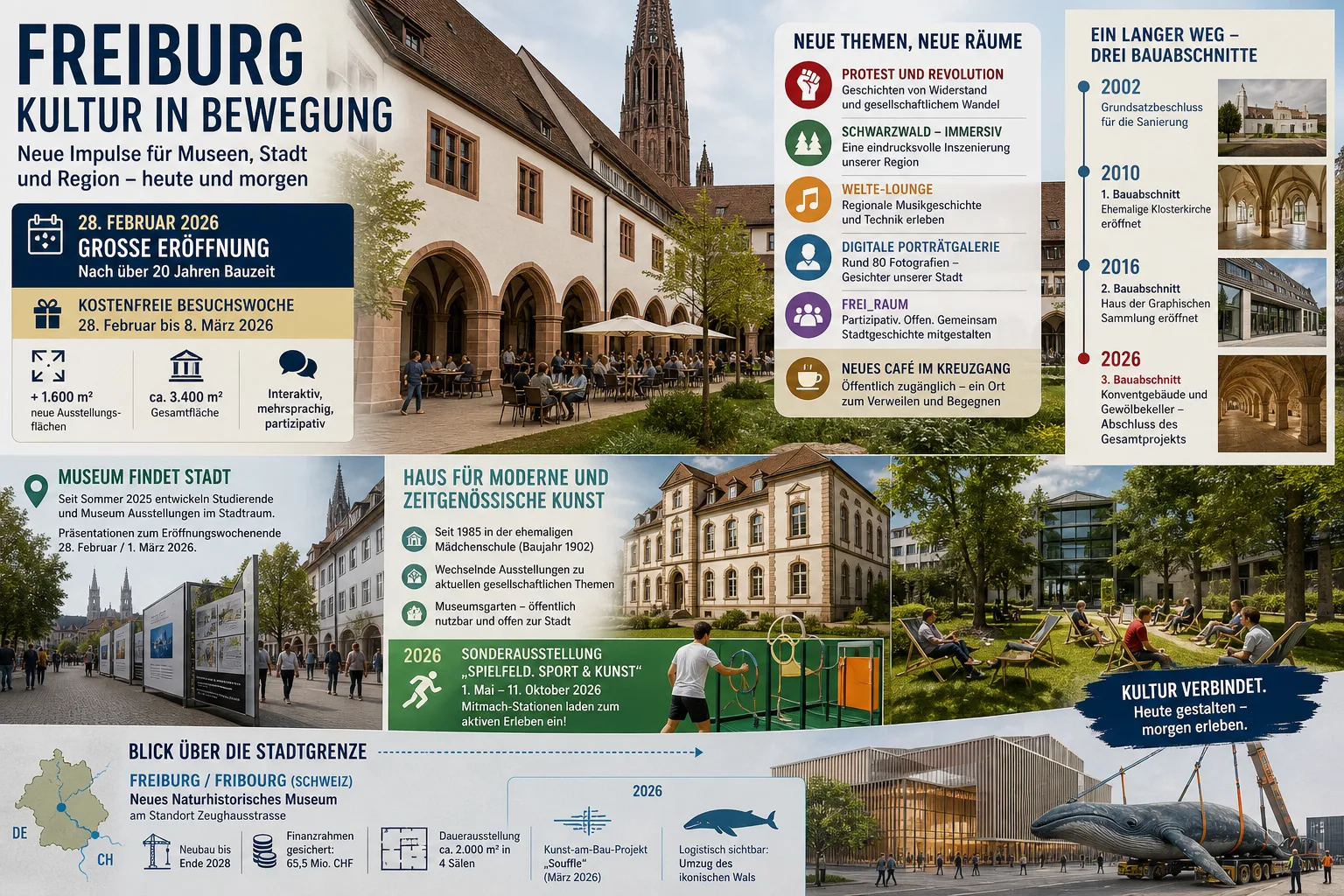
Freiburg is facing a phase in which cultural institutions and urban space are to become more closely intertwined: museums want to become more open, closer to everyday life, and more dialogical, while new construction and mediation projects in the region (and across the border) show how culture can be conveyed in the future. This article summarizes the foreseeable developments and explains what residents, students, cultural workers, and guests can expect in the coming years.
Note on focus: This article describes exclusively upcoming or planned developments and how to reliably follow them (e.g., via official program information).
Why So Much Is Happening Right Now
Many cities are realigning their cultural policies and institutions: more participation, better mediation, lower access barriers, and a stronger presence outside of classic exhibition spaces. For Freiburg, this means above all in the coming years: culture should not only take place "in the museum," but become more visible in everyday life — in courtyards, corridors, gardens, on squares, and in neighborhoods.
For visitors, this has a practical consequence: cultural offerings are becoming increasingly modular, time-limited, and site-specific. Anyone who wants to experience "Freiburg as a cultural city" in the future is best advised not to plan just one museum visit, but several stops in the city.
Augustinermuseum: Where the Entire Institution Is Likely to Develop in the Coming Years
A further profiling as a "total institution" can be expected around the Augustinermuseum in the coming years: more closely interlinked areas, an expansion of mediation formats, and a programmatic opening towards city history, everyday culture, and contemporary issues. What matters is less a single event than the ongoing further development of spaces and formats.
New Spaces as Experimental Areas
When historical architecture is combined with new uses (e.g., vault and convent areas), spaces are usually created that are particularly suitable for experimental formats: smaller interventions, dialogical stations, time-limited presentations, or collaborations with universities and initiatives. In Freiburg, it can therefore be expected that such areas will increasingly serve as a "test field" in the future — for new storytelling methods, low-threshold access, and changing topics.
Mediation: More Interaction, More Multilingualism, More City Reference
Many museums are focusing more on multilingual, interactive mediation in their future programs. For Freiburg, the city reference is particularly obvious: urban spaces, biographies, local lines of conflict, and the question of how a growing city communicates culturally. Formats can be expected that not only show objects but also ask questions: How is belonging negotiated in the city? What remains, what changes? Which perspectives are still missing?
Closeness to Everyday Life: Culture as a Place to Meet, Learn, and Linger
Publicly accessible lounge areas (e.g., café or courtyard situations) are likely to become even more important in the coming years — as a bridge between institution and city life. For the urban society, this can mean a noticeable change: the museum becomes not only a destination but also a waypoint in everyday life (meeting point, workplace, short break between appointments).
When the Museum Finds the City: Culture in Urban Space as the Next Step
Cooperations between museum and university, in which students develop projects for urban space together with curators, fit a central future trend: to locate mediation where the public already emerges — on paths, squares, at transitions between neighborhoods, or in places that have so far been less "marked" culturally.
For the coming years, three effects are typically to be expected with such approaches:
- New target groups: People come across cultural offerings by chance, without actively visiting a museum.
- New topics: Urban development, climate adaptation, housing, mobility, or protest culture can be negotiated particularly vividly in urban space.
- New forms: Shorter formats, temporary installations, audio walks, or participatory micro-exhibitions become more likely.
If you don't want to miss these projects, you should keep an eye on the program information of the participating institutions (websites, newsletters, social media channels), as location and duration are often communicated more spontaneously than with classic exhibitions.
Modern and Contemporary Art: Why Freiburg's Exhibition Profile Could Become Even More Flexible in the Future
Institutions for modern and contemporary art often work with changing programs, respond to debates, and focus more on cooperation. For Freiburg, this means: thematic exhibitions, interdisciplinary formats (e.g., at the intersection of art, sport, digitality, or ecology), and events in outdoor spaces are likely to continue to increase.
Freely accessible or publicly usable areas such as gardens and courtyards are particularly important for the city's impact. Such places function as "cultural infrastructure" even when you are not visiting an exhibition — and they are suitable for readings, discussions, performances, or seasonal programs that are announced at short notice.
For local scenes (independent initiatives, project spaces, universities), this is an opportunity: in the coming years, more co-productions could emerge in which institutions contribute their visibility and spaces and independent actors provide new perspectives and formats.
Looking Across the Border: Fribourg/Freiburg (CH) and the Planned New Building by 2028
An international comparison helps to classify Freiburg's development: in Fribourg/Freiburg (Switzerland), a new natural history museum is planned by the end of 2028. Such new buildings are often more than just "new square meters" — they bundle research, mediation, sustainability issues, and visitor guidance into a new overall narrative.
This is relevant for the cultural region for two reasons:
- New standards in mediation and building concept: New buildings often set standards for accessibility, energy and operational concepts, as well as for educational offerings.
- Symbolic narratives: When iconic exhibition objects (such as large exhibits) change location, the move itself becomes a story — and thus a communication moment that can generate attention for nature and climate topics.
If you want to follow the development, you should use the official announcements of the city or canton as well as the museum's project communication; with construction projects, schedules and program steps are usually dynamic.
What This Cultural Movement Could Mean for Freiburg's Future
If museums and cultural venues open up more in the coming years, the role of culture in the city will change: away from a "reason to visit" towards a permanent public resource. For Freiburg, this can bring three concrete advantages:
- More participation: Dialogical formats and urban space projects lower access barriers.
- More orientation: City history and contemporary issues can be told as a context in exhibitions (not just as a collection of individual objects).
- Higher quality of stay: Gardens, courtyards, and open areas strengthen the city as a space for learning and encounters.
At the same time, the success of such strategies depends on how transparently programs are communicated (dates, target groups, accessibility, costs) and how consistently cooperation with education, initiatives, and neighborhoods is maintained. In the coming years, it is precisely this reliability that will determine whether "culture in motion" actually becomes noticeable in everyday life.
Practical Planning: How to Stay Informed About Upcoming Cultural Offerings
- Check official programs: Museum and city websites (calendar/events) are the most reliable source.
- Use newsletters: Many institutions announce special openings, mediation offers, and short-term formats there first.
- Actively search for urban space projects: Temporary formats can have changing locations; information can often be found in digital maps, event feeds, or via project partners (university, initiatives).
- Clarify accessibility in advance: Especially with historic buildings and pop-up formats, it is worth checking information on access, elevators, guidance systems, and quiet zones.