Urban Change in Freiburg: new neighborhoods & sustainability
Urban Change in Freiburg: New Neighborhoods & Projects That Will Shape City Life in the Future
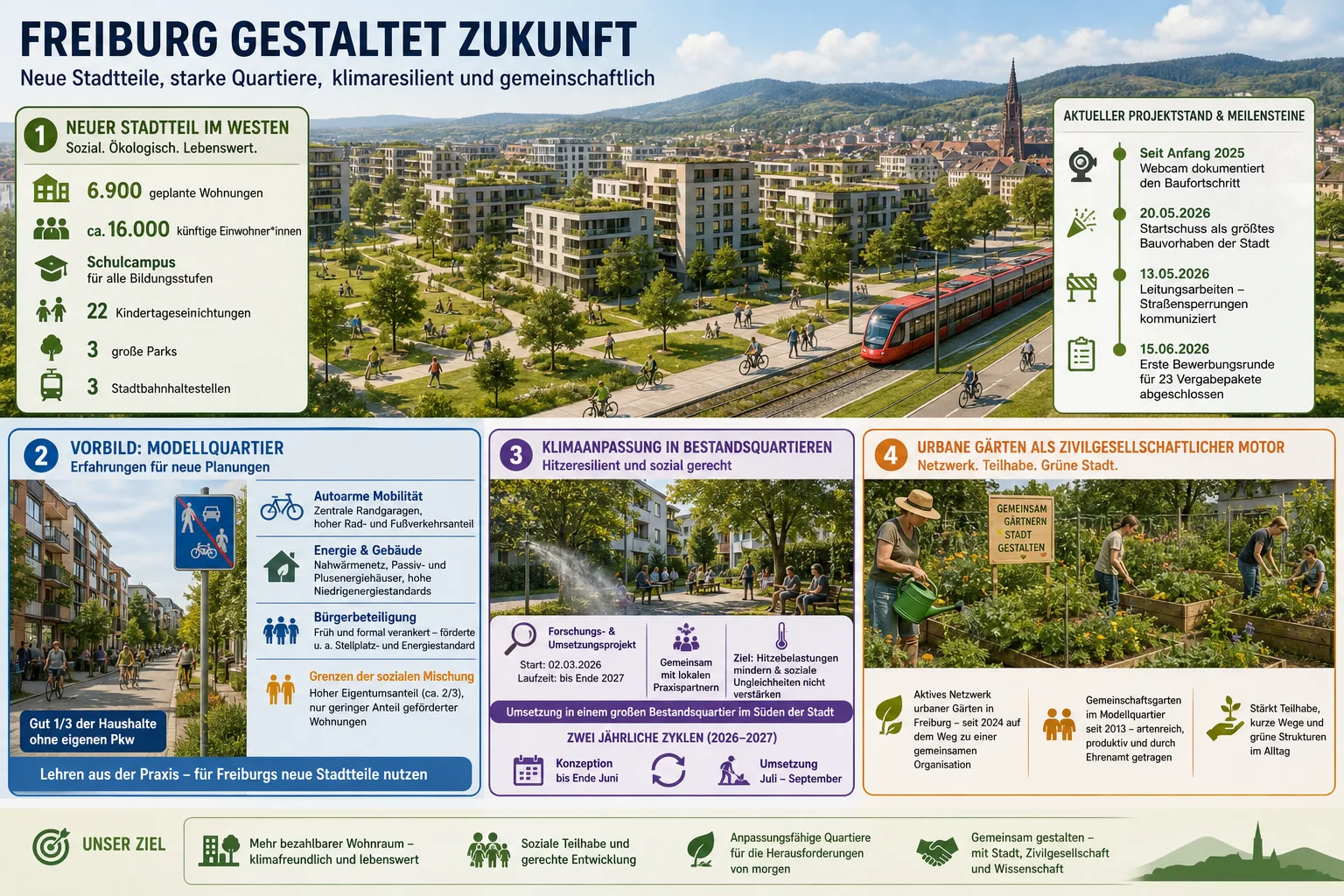
In the coming years, Freiburg will see several developments that are likely to noticeably change life in the city: new neighborhoods with many additional apartments, new standards for climate-adapted street spaces, and growing forms of neighborhood projects such as urban gardens. This overview bundles the most important future topics—with a focus on planned measures and foreseeable next steps.
Vauban as Reference: What Lessons for New Neighborhoods?
The Vauban neighborhood is often cited as a reference in debates about sustainable urban development. For future projects in Freiburg, it can primarily serve as a learning example: Which elements have proven themselves in everyday life—and which goals (such as social mix) are particularly difficult to achieve in practice?
Elements Likely to Become Important Again in New Neighborhoods
- Making Everyday Life Possible Without a Car: It is not the absence of cars that is decisive, but reliable alternatives: public transport, short distances, safe cycling networks, and well-planned sharing offers.
- Consistent Planning of Energy and Building Standards: High efficiency requirements, renewable heat supply, and a clear path to CO₂ reduction must be established early so that they are not "optimized away" later.
- Participation with Clear Rules: Citizen participation can create acceptance and bring in local expertise—but works best when goals, responsibilities, and decision points are transparent.
The Central Area of Tension: Attractiveness and Affordability
Sustainable neighborhoods are often particularly sought after. This can drive up prices and put pressure on the social mix. For future Freiburg projects, it will therefore be crucial to structurally secure affordability (e.g., through sufficient subsidized housing, long-term commitments, leasehold models, and an active land policy), rather than relying solely on "mixing through diversity of developers."
Climate Adaptation in Existing Areas: Heat-Resistant Streets and Squares
Not only new buildings shape the future, but above all the existing stock: street spaces, courtyards, stops, and squares that are already in use today. For Freiburg, climate adaptation is likely to be translated more strongly into concrete measures in the coming years—especially with regard to heat, heavy rainfall, and quality of stay.
Typical Measures Planned in Neighborhoods
- More Shade: additional street trees, shading structures at play and recreation areas, and heat-resistant plantings.
- More "Sponge City": unsealing, permeable surfaces, swale-trench systems, and rainwater retention to relieve pressure during heavy rainfall.
- Cooler Places to Stay: seating in the shade, drinking fountains (where possible), greening of stop environments, and squares that remain usable in summer.
- Socially Fair Implementation: prioritization where heat stress and vulnerability are high (e.g., densely built-up areas, older residents, little private green space).
For future neighborhood programs, it is also important to make impact measurable: e.g., through temperature measurements in street spaces, user feedback, and monitoring of tree locations. This way, Freiburg can specifically scale what actually cools and is accepted in everyday life.
Urban Gardens: Community and Urban Climate
Urban gardens and neighborhood spaces are considered building blocks of climate- and socially-oriented urban development in many cities. In Freiburg, it can also be expected that such initiatives will increasingly be linked with urban planning, education, and climate adaptation in the future—for example, through new land concepts, cooperation models with schools, or neighborhood-based funding programs.
Why Urban Gardens May Be Particularly Relevant in the Future
- Community: Gardening together creates low-threshold meeting places and can support integration and neighborhood assistance.
- Ecology: Unsealed beds, humus-rich soils, and diverse plants promote biodiversity and improve the microclimate.
- Education & Health: Gardens can strengthen nutrition education, nature experience, and physical activity in everyday life—especially for children and young people.
For urban gardens to have a long-term effect, they need reliable framework conditions: clear usage rules, secured durations, conflict moderation (e.g., regarding noise/opening hours), and a fair distribution of space between recreation, housing, and social infrastructure.
What This Means for Everyday Life in Freiburg
Urban development only becomes "real" when it changes everyday life. For Freiburg, some concrete future effects can be derived from the planned and foreseeable trends:
- Shorter distances through mixed neighborhoods where living, education, shopping, and leisure are closer together.
- More options without a car when public transport, safe cycling connections, and good parking management are planned together.
- Noticeably cooler street spaces during heat phases where greening, unsealing, and shade are specifically implemented.
- More places for encounters through neighborhood spaces such as urban gardens, which can strengthen social networks.
Whether these effects actually occur depends less on guiding principles than on implementation, financing, and the interaction between the city, housing industry, initiatives, and citizens. It is crucial that goals such as climate protection, affordability, and quality of life are pursued not one after the other, but simultaneously.