Sustainable Enjoyment in Freiburg: regional, organic, fair
Sustainable Enjoyment in Freiburg (2026–2027): organic, regional, fair – what's next
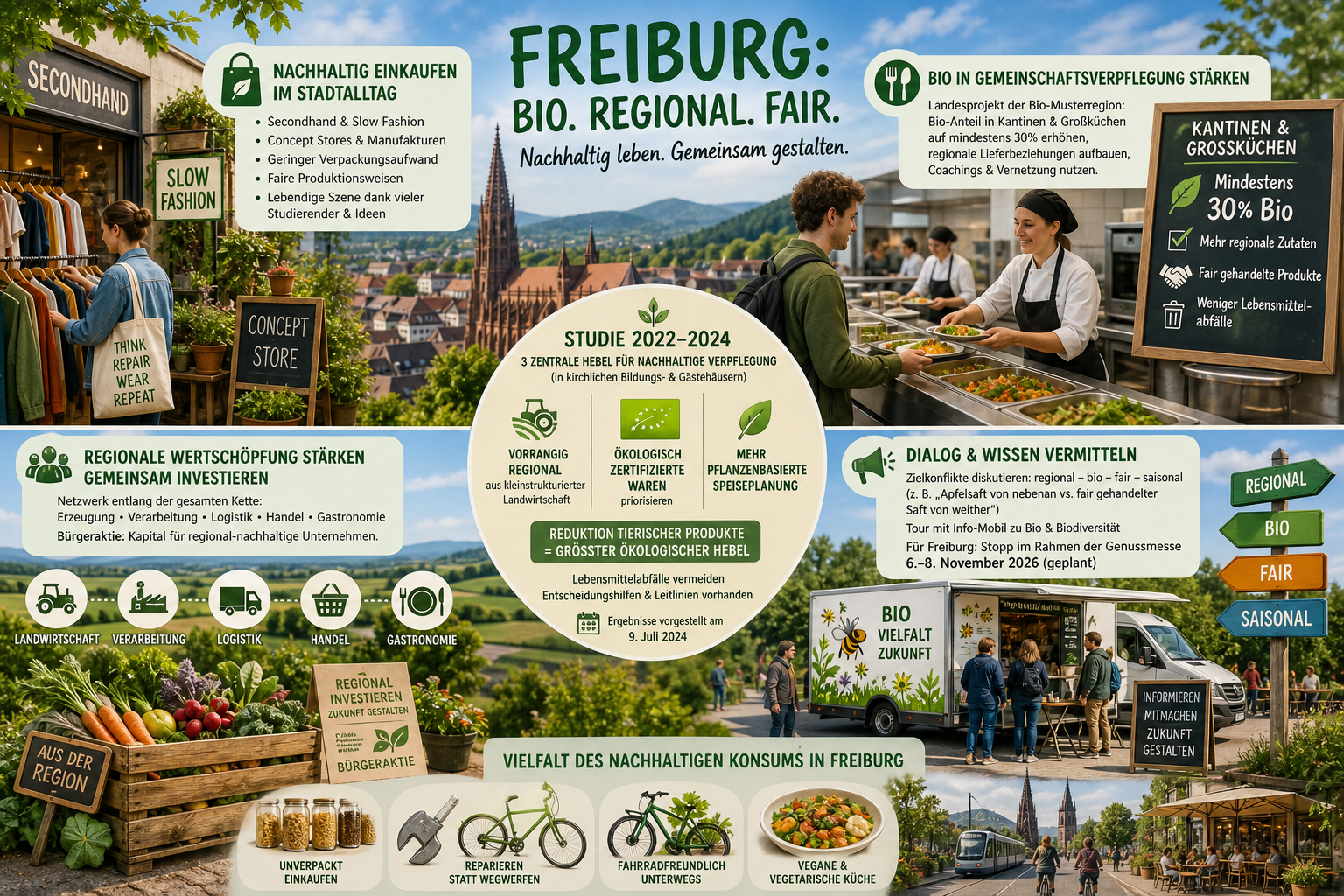
Freiburg wants to make sustainable consumption even more visible in the coming months and years: with more regionally oriented communal catering, greater transparency in supply chains, new dialogue formats on goal conflicts (regional vs. fair, organic vs. seasonal), and publicly accessible information offerings.
This article bundles announced, ongoing, or expected next steps for future visits, semester starts, and event seasons in Freiburg – with a focus on organic, regionality, and fairness.
1) What is set to further develop in 2026–2027 regarding "regional, seasonal, organic"
For the next seasons, it is increasingly expected in Freiburg that purchasing and food offerings will be even more consistently oriented towards seasonality and regional origin – especially where many people shop or eat daily (markets, gastronomy, university environment, canteen structures).
- More seasonal cuisine: Menus and themed weeks should be planned more around regional harvest windows.
- More organic transparency: Menus, displays, and notices are expected to feature clearer organic indications more often (e.g., EU organic logo or equivalent labels).
- More reusable and less packaging: Businesses are to increasingly rely on reusable and deposit systems, supported by the generally stricter focus on waste reduction.
Important: "Regional," "organic," and "fair" can complement each other, but do not automatically mean the same thing. That is precisely why more formats are expected for 2026–2027 that make everyday decisions understandable (see section 4).
2) Organic in cafeterias & canteens: Which goals are in focus for communal catering
For Freiburg, it is still expected that communal catering facilities (e.g., canteens, cafeterias, educational centers, guesthouses) will increasingly align their procurement and menu planning with sustainability goals. Typical target marks pursued in this context for the coming years are:
- Increase the organic share (often a benchmark of at least 30 % is mentioned as an orientation goal).
- Shop more regionally and seasonally to reduce transport distances and dependencies and to strengthen relationships with producers.
- Reduce food waste, for example through better quantity planning, use of leftovers, and more tailored serving formats.
- Supplement with fairly traded products (e.g., for coffee, cocoa, tea, or bananas), where regional alternatives are naturally limited.
What guests will likely notice on their plates
For 2026–2027, two visible changes are especially expected:
- More plant-based dishes (not just "substitutes," but independently developed, attractive recipes with legumes, grains, and vegetables).
- More seasonal menu changes that are more closely oriented to regionally available ingredients.
Anyone who wants to eat sustainably in Freiburg in the future can specifically ask in canteens and cafeterias: What is the organic share? Which products are regional? Which are fair certified? Such questions support transparency – and often accelerate internal changes.
3) Regional value creation & participation: Which models may gain importance in the future
For the coming years, continued interest is expected in Freiburg for structures that keep value creation in the region: cooperations between agriculture, processing, logistics, trade, and gastronomy – complemented by financing and participation models where citizens can support regional businesses.
Such participation approaches (e.g., in the form of cooperatives or comparable citizen participation) can make three things easier in the future:
- Planning security for businesses through long-term oriented capital.
- More transparency along the supply chain (origin, production methods, standards).
- More resilience, because regional networks can be less susceptible to global price and supply chain disruptions.
Those who want to actively participate in 2026–2027 can look out for regional participation opportunities (e.g., via events, local networks, economic development, or provider transparency in shops and gastronomy) and pay particular attention to comprehensible reports, clear risk notices, and understandable use of funds.
4) Dialogue & events: Which dates and formats are especially relevant for 2026/2027
In the coming period, further public dialogue formats are expected in Freiburg that practically play out typical goal conflicts in sustainable consumption:
- Regional vs. fair: When regional alternatives are lacking (e.g., coffee, cocoa), fairness becomes more important.
- Organic vs. short distances: Organic standards can have advantages over mere proximity (e.g., in pesticide use), while short distances can reduce transport emissions.
- Seasonality as a "third lever": Seasonal goods can complement both regional and organic particularly sensibly.
Additionally, for November 2026, a stop of an information mobile is announced in the context of a food fair in Freiburg, which aims to convey knowledge about organic, biodiversity, and sustainable nutrition in a low-threshold way. For those interested, it is worth checking the current event pages of the organizers shortly before traveling, as times and locations can typically be adjusted.
5) More than food: Which everyday decisions can support sustainable enjoyment in 2026–2027
Sustainable enjoyment in the future will not only be decided by ingredients, but also by mobility, usage duration, and consumption rhythm. Those visiting or living in Freiburg in the coming months can significantly increase the impact if they understand "enjoyment" more broadly:
- Short distances without a car: For trips to markets, cafés, or events, bicycles and public transport can significantly reduce the CO₂ footprint in the future.
- Repair instead of replace: Repair services (e.g., for clothing or electronics) help conserve resources and avoid waste.
- Slow fashion & secondhand: Durable materials, transparent supply chains, and reuse are expected to continue gaining importance in 2026–2027.
- Consider reusables: Your own cup, box, or cloth bag reduces packaging waste – especially for to-go offers.
6) Practical plan for the next Freiburg day (as a checklist)
- Morning: Shop seasonally and specifically ask about origin (regional, organic, fair).
- Lunch: Choose a plant-based dish in the cafeteria/canteen and ask about the organic/regional share.
- Afternoon: Use unpackaged or reusable options; ask small producers/manufacturers about standards and ingredient lists.
- Evening: Choose a venue that offers transparency about suppliers, organic certification, or fair trade products.
- Optional: Plan a discussion event or information stand to better understand goal conflicts.
This way, sustainability does not remain abstract, but becomes a series of verifiable decisions that can be easily repeated and further refined in the coming years.