The History of Freiburg im Breisgau – Briefly Told
Experience Freiburg's History: Your Outlook on Upcoming Discoveries in the City
You don't just want to see Freiburg, but actively experience its history in the coming days and weeks? This compact guide compiles future experiences where you can consciously perceive Freiburg's historical traces in the old town, around the Münster, and in neighborhoods – as a walking tour, museum visit, or themed guided tour.
How to Plan Your Next Historical Experiences in Freiburg
If you're out and about in Freiburg soon, these three building blocks work particularly reliably to make "history" tangible:
- Guided Tours (External Perspective): You get explanations of connections directly on site – ideal for a first overview.
- Museums (Internal Perspective): Objects, models, and documents help you classify what you've seen.
- Self-Planned Themed Route: A self-planned walk (e.g. "Water & City", "Architecture", "Urban Development") makes you independent of schedules.
For the coming weeks, it is worth checking the official pages of Freiburg's tourism, museums, and institutions in advance: There you will find current information on opening hours, guided tours, and tickets.
Old Town & Bächle: What to Look Out for on Your Next Walk
On your next old town walk, history becomes especially tangible if you don't just "walk through" but consciously pay attention to details. A practical approach:
1) Walk slowly – and look at ground level
The Bächle are a natural "guide" on your next walk. Follow them for a while, observe crossings, branches, and places where they structure the path space. This turns a photo motif into an urban element that you actively read.
2) Focus on sightlines instead of individual houses
For upcoming explorations, a simple trick is helpful: Pick a destination (e.g. a square, a gate, a distinctive tower) and notice how the urban space opens and narrows again. These changes show you how old town paths provide orientation – even without a map.
3) Use markets and everyday activity as a "living museum"
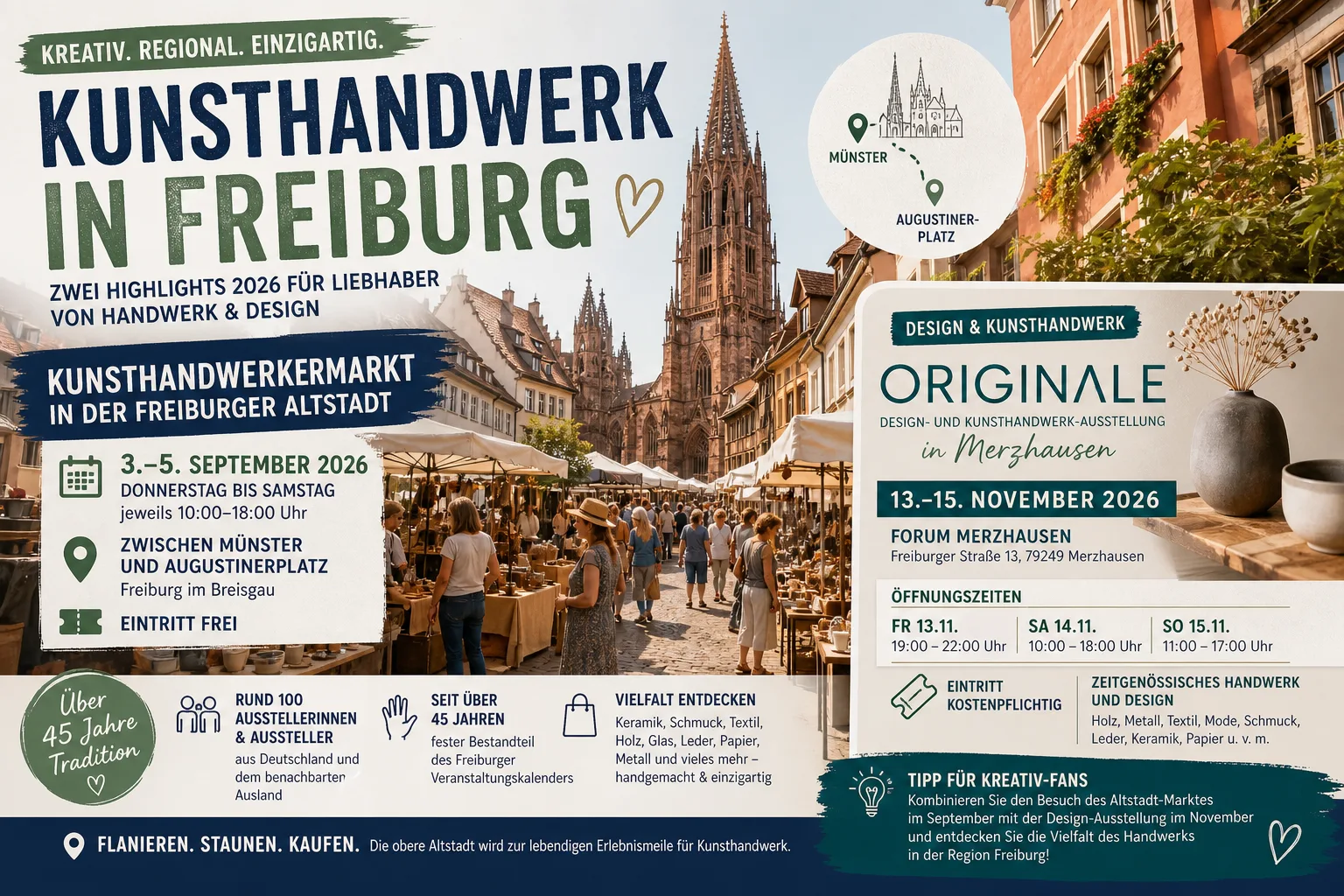
When you pass market stalls, small shops, or craft references in the future, you can imagine Freiburg as a place where urban functions (supply, exchange, encounter) still visibly take place in the center – and are not pushed to the edge.
Around the Münster: What You Can Specifically Discover on Future Visits
The Münster area is suitable for your next visit as a compact "concentrate" of urban identity: architecture, public space, pathways, and uses are close together.
Your Next "Münster Check" in 20–40 Minutes
- Choose a vantage point: Start at a corner of the square and first look at proportions, not details.
- Read material & craftsmanship: Consciously notice surfaces, repair spots, and stone images – they show you that buildings are maintained and continued.
- Recognize the logic of the square: Observe how people cross the square: This reveals which paths work "naturally."
- Interior as contrast: When you go inside, you feel the change from city noises to room acoustics and light. This experience makes history physically tangible, without needing prior knowledge.
For concrete visitor information (guided tours, opening hours, notes), the official Münster or operator communication is the most reliable source; plan a short time to check the websites on your next trip.
Museums & Collections: Good Options for Your Next Bad Weather Plan
If you want to delve into "history" in Freiburg in the coming days/weeks regardless of the weather, museums are the most pragmatic solution. There you can:
- Understand urban development using models (how spaces are connected),
- Understand everyday culture through objects (how people lived, worked, organized themselves),
- See image and text sources in context (instead of collecting individual facts).
University, Archives, Lectures: How to Dive Deeper in the Future
For your next step beyond the classic walking tour, public institutions often offer events, lecture series, exhibitions, or digital collections. This is especially useful if you:
- not only want to "see" but get to know sources,
- seek contextualization by experts on controversial topics,
- want to expand your knowledge systematically rather than randomly.
Before your next visit to Freiburg, check the official pages of the university, the city, and the museums: Future dates, programs, and registration modalities are maintained most reliably there.
Sustainable Urban Development as a "History Topic" for Upcoming Tours
If you visit Freiburg soon, you can also understand "history" as ongoing urban development: Which decisions shape the urban space today, and how will they be interpreted later?
For upcoming explorations, it is worth looking at:
- Everyday mobility: How bike and pedestrian paths organize the urban space and connect squares.
- Neighborhood structure: Where mixed uses (living, working, supply) shorten routes.
- Public spaces: Which squares function as meeting points – and why.
This way, you turn your next walk into a "reading" of the city: You observe which solutions are built and used today – and what traces they leave for the future.
Practical Tips for Your Next Visit (Without Guesswork)
- Check in advance: Always check opening hours, tickets, guided tour dates, and any access rules on the official websites.
- Plan time slots: For a good impression, 2–3 hours are often enough if you set a clear theme (old town + Münster area or museum + themed walk).
- Accessible travel: Cobblestones, narrow alleys, and watercourses can be challenging; if necessary, plan routes along larger axes and rest points.
- Respect in urban space: Religious sites, memorials, and residential neighborhoods are not backdrops – behave considerately during visits.
Sources & Further Links
- City of Freiburg im Breisgau (official) — Information on institutions, services, and current information (accessed 2026-07-22)
- Freiburg Tourism / Freiburg Information — Info on city tours, sights, and planning (accessed 2026-07-22)
- Freiburg Museums — Overview of venues, exhibitions, opening hours (accessed 2026-07-22)
- University of Freiburg — Events, public offers, and institutions (accessed 2026-07-22)